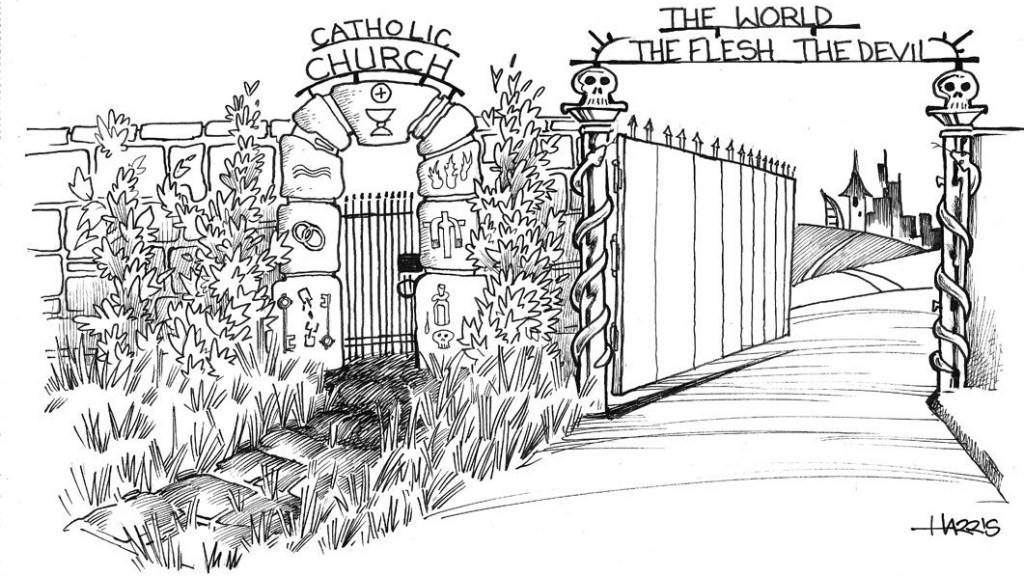
“Enter through the narrow gate; for the gate is wide and the road is easy that leads to destruction, and there are many who take it.” (Matthew 7:13)
Entering through the narrow gate that leads to the perfect supernatural happiness we call heaven means we must follow all of Christ’s teachings and all of God’s commandments, not just pick out a few to follow. The Catholic Church is not an HOA where there are homeowners’ votes taken to choose what neighborhood rules to create or amend. The Catholic Church is not a PTA where with a show of hands at an annual parent-teacher-association meeting the members decide what bylaws to update. We must follow Jesus on His terms and not on our own terms.
Over the past two years, the Pope internationally and the United States Council of Catholic Bishops (USCCB) nationally have been promoting the concept of synodality – the idea of coming together and agreeing on a path forward by consensus. In Church history, a synod has served as an advisory panel of bishops who give the pope a way of discussing the issues of the day, as he receives feedback and advice from them. This 2023 worldwide synod is unfortunately tainted, as many bishops (most notably from Germany) and the pope have been pushing a progressive agenda instead of merely opening up neutral listening sessions. From the get-go, these liberal voices were saying the key points for discussion need to include encouraging diversity, overcoming racism, fighting climate change, welcoming so-called “LGBTQ+ persons,” and empowering women. You would think these woke talking points were copied directly from the Democrat-Socialist party platform.
The best outcome of this synod would be if the nation’s and world’s bishops restored clarity to Church teachings not just because the fundamental tenets of our faith are under attack by the secular world, but also because too many of the Pope’s statements over the past ten years have created widespread confusion. Regrettably, this whole synodal process with Pope Francis favors endorsing heresy and immorality, and there is not doubt the final synod document (due in the fall of 2023) will reflect this. The concept of unhappy and follow-away Catholics sharing their feelings with their bishops about what changes they want out of the Church is a modern idea that is alien to Catholicism. The Church’s mission isn’t to make us feel happy and welcome. The Church’s mission is to proclaim the Gospel and save us. We can only be saved if we change our lives – not change the Church.
Before He ascended into heaven, our Lord started the Catholic Church when he handed the keys to the first pope and bishops (Peter and the Apostles) and told them to continue teaching His truth. This truth does not change by popular vote or by the whims and fads of the current culture. This is why the Magisterium of the Catholic Church cannot function like a democracy and simply take a poll to see which teachings are good and which ones need to be dropped. The Magisterium refers collectively to those who exercise teaching authority – the pope and the bishops teaching in union with him. Catholics believe that the Magisterium can be trusted because of Jesus’ promise to send the Holy Spirit upon them, guiding them in proclaiming Church teachings and doctrine and in judging the authenticity of traditions.
The Church did not make up Catholic teaching, but only passed on what she had received from God. The truth is unchangeable as it comes from God, not humans. Sadly, a large portion of today’s Catholics – and the majority of Catholics who participated in the recent synod listening sessions – want to change a lot about Church doctrine and Jesus’s teachings. These Catholics are often nicknamed “cafeteria Catholics.” The term comes from equating picking and choosing what food you will eat as you walk through a cafeteria line to picking and choosing what doctrine and rules you will follow.
Perhaps it would be better understood using the analogy of grocery store shopping. Imagine a grocery-shopping person walking up and down a supermarket, peering down each aisle before deciding if he or she will turn up the aisle and push the cart through to pick up needed items. If the aisle doesn’t look relevant, or if after reading the signage above the aisle the shopper realizes nothing down that aisle is appealing, he or she will bypass and go up to the next aisle. Then at the next aisle, the grocery-shopper will repeat the process by looking down to see if he or she wants or needs anything, and if not, will avoid walking down it. Comparing this shopping method to the metaphorical, faith-life grocery store, imagine a grocery-shopping Catholic strolling down the lineup of Church doctrine, looking down each “aisle” of Catholic precepts, Christian commandments, and Church beliefs, and making statements like these:
Looking down the Baptism aisle: ‘I’ll get my child baptized, but I won’t make him go to Mass.”
Looking down the Confession aisle: “I don’t need to confess my sins to a priest; I’ll just talk to God myself.”
Looking down the Right-to-Life aisle: “Although I believe in the 5th Commandment of “Thou shall not kill,” abortion is different; it’s a woman’s right to choose so I can’t go along with Catholicism on this topic.”
Looking down the Sexuality aisle: “The Church is wrong on not supporting (so-called) gay marriage; I have no problem with attending a gay wedding and totally support this lifestyle since ‘love is love.’”
Basically, grocery-shopping Catholics, by picking and choosing what doctrines and rules they want to follow, are subconsciously saying, “I love certain sins, and the Jesus I want to worship is one who would love these sins.” A cafeteria Catholic or grocery-shopping Catholic is assuming that many or some of God’s directives are illogical, outdated, or incorrect, and thus, are of no real consequence if not followed since their Jesus would understand.

To be honest, I would prefer to not have to use modifiers like traditional, devout, or grocery-shopping when applied to what type of Catholic people are considered. A Catholic should have only one definition – one who trusts the Magisterium of the Church, follows all of God’s Commandments and all of the Catholic Church’s precepts, and believes the Catechism of the Catholic Church is the truth. Unfortunately, there is such division in the Church today that modifiers are necessary to separate the goats from the sheep.
If you can ever get a grocery-shopping Catholic to debate you in what a true Catholic is, ask them what Jesus meant when He said, “One does not live by bread alone, but by every word that comes forth from the mouth of God” (Matthew 4:4). Ask if a follower of Christ is allowed the option to disregard statements that He made, even when He specifically stated we must live by every word?
Then ask this grocery-shopping Catholic which of these proclamations came from Jesus:
A) “And you will know the truth, and the truth will set you free” (John 8:32).
B) “And you will know opinions, and opinions will set you free” (False 6:66).
Next, in this hoped-for debate, ask which is the actual word of God as written in Proverbs (3:5):
A) “Trust in the Lord with all your heart, and do not rely on your own insight.”
B) “Trust in yourself will all your heart, and do not rely on God’s insight.”
Catholics-in-name-only often will pervert the teachings they oppose either purposely or due to ignorance. It’s common for these grocery-shopping Catholics to ignore God’s commands and oppose a particular teaching or two (or three or ten) and immediately justify by saying Jesus would agree with them. After all, for many of these types of people, their Jesus is a free-spirited hippie of the 1960s whose main objective is to simply love everyone without judging, less people’s feelings would get hurt. Hippie-Jesus is the lukewarm or liberal Catholic’s depiction of Jesus – a God who would never hurt anyone but instead meekly asks us to all hold hands, dance around the campfire, and love one another. With a hipster flower-child as your God, one’s beliefs and lifestyle – no matter what they are – can be validated.
An authentic Christian can immediately cite the problem with believing in a hippie Jesus by asking how can you reconcile that fictional version of God with the reality of a God who caused millions to die in a flood, who burned down the towns of Sodom and Gomorrah, and who as the Son wildly smashed and destroyed the tables in the temple and angrily called people “hypocrites,” “blind fools,” “children of hell,” “brood of vipers,” and “serpents”? You can’t.
Moreover, Jesus said to His Apostles:
“Whoever listens to you listens to me, and whoever rejects you rejects me, and whoever rejects me rejects the one who sent me.” (Luke 10:16)
If we do not want to be seen in Jesus’s eyes as rejecting him, we must follow Him on His terms and not ours. Pope Leo XIII wrote in his encyclical “On the Unity of the Church”:
“If it be certain that something be revealed by God, and this is not believed, then nothing whatever is believed by divine faith…. He who dissents even in one point from divinely revealed truths absolutely rejects all faith, since he thereby refuses to honor God as supreme truth.”
When deliberating with a grocery-shopping Catholic, ask them if they think children should be able to choose which parent directives and family rules they will follow and which ones they will ignore because child knows best. Would they be okay with their child eating only junk food and not the fruits and vegetables the wiser mom or dad served for dinner? Would they be okay with their teenager staying out all night and not staying in touch with mom and dad because the teen believed the family’s curfew rule was wrong or capricious? Of course not. A child follows the instructions and commands of mom and dad because older, wiser parents know best. A Christian follows the instructions and commands of our Father in heaven because our omniscient Father knows best.
To push their agenda, especially on Christians, the culture of the 21st Century hastily quotes the famous Bible line from Jesus, “Do not judge (Matthew 7:1).” With those simple three words resounding in their ears, along with society’s influence and peer-pressure, too many of today’s Christian adults feel justified in letting everyone do anything they want, from a man so-called marrying another man to a girl so-called transitioning to become a boy. Anyone who opposes so-called gay marriage or transgenderism is being judgmental, which Jesus cautioned against – so says today’s culture.
“Do not judge” is NOT the mantra by which Christian should live. We must judge if we want to save our kids’ souls. I will explain more in a future post.

 A PRINCIPAL'S PRINCIPLES FOR PARENTING
Leave a comment