October 5, 2023
Today, attention is focused by many school teachers, most journalists, and the entire woke-culture solely on the negative-connected history of Christopher Columbus and not his positive achievements, and this has resulted in Columbus’s legacy being “canceled” by our politically correct society. I propose that instead of cancelling Columbus, we should restore his reputation and resurrect his historical accomplishments. It is for his magnificent courage, the boldness of his conception, and his deep faith that Columbus should be rightly honored in the 21st century as he was in all six centuries prior. A devoted Catholic explorer, Christopher Columbus was the discoverer of the future “America,” and by that discovery, he was ultimately responsible for America’s evangelization. For this, Catholics and all Americans should forever honor him each October 12 (or the second Monday in October – the 9th this year – which is the official, government-set holiday date).
When I was a child, “Columbus Day” was celebrated, not just with banks and post offices closed on October 12, but with a day off of school as well, as America celebrated the hero who “in 1492…sailed the ocean blue” (as every kid of my era and earlier memorized). If you went back one hundred years in America you would see that every state had a parade to celebrate what everyone considered a really big deal – the annual anniversary of Columbus’s discovery of the new world.
Fast forward to today and mostly you only hear that Columbus Day should be a day of repentance, a day for whites to acknowledge a history of oppression and genocide against so-called BIPOCS. The Columbus-haters also point out that he actually didn’t make a real discovery at all, because there were people already in the Americas when he found them. They tell us that the anniversary of Columbus’s sailing should be an occasion to condemn him, not to praise him. This vitriol started its climb in 1992, when Berkeley, California became the first city in America to mark so-called Indigenous Peoples’ Day as a replacement for Columbus Day. These days, hundreds more cities nationwide along with a dozen states (Alaska, Hawaii, Iowa, Louisiana, Maine, Michigan, New Mexico, North Carolina, Oregon, South Dakota, Vermont, and Wisconsin at last count)have officially canceled Columbus Day and in its place officially celebrate Indigenous Peoples’ Day the second week of each October.
The indigenous peoples are the pre-Columbian inhabitants of North America, South America, and Central America, commonly known as Native Americans, Alaska Natives, and/or Indians. Of course, it is appropriate and right to recognize them, be it in history classes or in proclamations. My concern with these state governments and city councils who swapped-out holidays is not that they want to honor indigenous peoples, but that they are purposely doing this as a way to slam the heroism of Columbus.
Yes, Columbus was flawed, but aren’t all heroes flawed? And when we pick a hero of five hundred years ago and compare his lifestyle and actions to today’s culture, of course we’re going to see he did some things that today would be frowned upon. It’s similar to how we know George Washington owned slaves but that doesn’t undermine the argument that he should be praised as the “Father of our Country” and our country’s greatest president. The imperfect Columbus was nevertheless a hero, achieving in a manner unequalled in the history of exploration, changing history forever. Instead of criticizing Columbus’s failings, we Catholics should dust off the playbook of festivities from prior eras and return to promoting the inspiration he gave and the evangelizing he did for the Church.
It’s important to remember that 1492 was the Middle Ages, with the Reformation not occurring for another 15 years. Thus, the sociological dimension to exploration and colonization wasn’t comprehensible to that mindset. Columbus saw the “Indians,” as he named them, as potential converts to Catholicism and potential allies to Catholic Spain, so as a faithful evangelist, he attempted to convert them. He may have had ambition for fame and wealth, but he also worked tirelessly on the conversion of the pagan peoples that he would encounter, as he saw this as his Christian duty.
All Americans, but especially Catholic Americans, need to proudly recognize Columbus’s accomplishments and put the negative actions of Columbus into perspective for the uniformed and misinformed by having them consider the century in which he lived. Yes, Europeans such as Columbus brought diseases to the New World, but they did so unintentionally. Nobody in the 15th Century understood the causes of diseases, nor did they know the native population would have no resistance. Yes, the actions of early explorers such as Columbus were cruel, such as his use of slaves, but so were many of the practices of the native populations. There is no evidence that Columbus thought that the indigenous people were congenitally or racially inferior to Europeans. In his ship’s log, Columbus wrote about the peaceful natives and called them “the handsomest men and the most beautiful women” he had ever encountered. He praised their generosity and their high natural intelligence.
It is just as important to realize that while these first natives that Columbus encountered were hospitable and friendly, Columbus and explorers who followed him witnessed shocking practices of some other tribes who were brutal, practicing human sacrifice and cannibalism. In fact, it was reported that Columbus lost some of his own crew to cannibalism from some indigenous tribes.
It’s difficult to choose a right and wrong, to identify a black and white, when cultures collided five hundred years ago. Today’s cancel-culture, however, is very certain that they know it was entirely the evil Columbus’s fault during the Middle Ages and that all the indigenous people at that time were pure innocents. The woke crowd is either ignorant about or purposely concealing the positive realities that get lost in today’s retelling of history, such as that due to Columbus’s discovery and connection with natives, an interracial culture developed in much of Latin America. Moreover, human sacrifice and cannibalism were eventually ended, and many indigenous pagans were converted to Christianity.
Just as important for our children to learn about the positive qualities of North American natives, it’s also crucial that we teach them that many explorers, especially Columbus, had admirable qualities of being daring, ambitious, and devout Christians. Your kids will be taught by the secular culture that they should doubt the goodness of Columbus’ character because of how he supposedly treated the natives and because of the perception that Columbus sailed solely for gold and glory. But listen to what Columbus himself said about his reason for sailing:
“It was the Lord who put it into my mind to sail to the Indies. The fact that the gospel must be preached to so many lands—that is what convinced me.”
One long forgotten story that is most likely only being taught these days by homeschooling parents is about what happened when Columbus and his crew on his three ships had been out of sight of land for a full month. This was a longer voyage out of sight of land than any other in the history of the world up to that time. Columbus’s men became both scared and angry, and the crew came to the verge of mutiny, when Columbus tells us in his log how he answered them:
“They [the crew] could stand it no longer. They grumbled and complained of the long voyage, and I reproached them for their lack of spirit, telling them that, for better or worse, they had to complete the enterprise on which the Catholic Sovereigns [Isabel and Fernando] had sent them. I cheered them on as best I could, telling them of all the honors and rewards they were about to receive. I also told the men that it was useless to complain, for I had started out to find the Indies and would continue until I had accomplished that mission, with the help of Our Lord.”
Columbus’s dedication to Christ was also evident in how he named his famous ships “The Santa Clara” – referring to Saint Clare (but later nicknamed “The Nina”) – and “La Santa María de la Inmaculada Concepción” – referring to Holy Mary of the Immaculate Conception and later shortened to The Santa Maria. Also indicating his Godly-focus, he gave his first few landing places Christian names:
- “San Salvador” – which means “Holy Savior”
- “La Navidad” – which means “The Nativity”
- “Santa Lucia” – which means “Saint Lucy”
- “Trinidad” which means “The Trinity”
Christopher Columbus’s defects have been blown out of proportion and his admirable qualities have been forgotten during the raising of the most recent generations of children. I urge Catholic parents to share with their kids the opposing, pro-Christopher view to counter what much of the media, progressive educators, and woke culture are propagandizing this time of year. Columbus Day is worth celebrating if only for the basic reasons that it celebrates character qualities that were foundational to America and it recognizes America’s first preacher/evangelist.
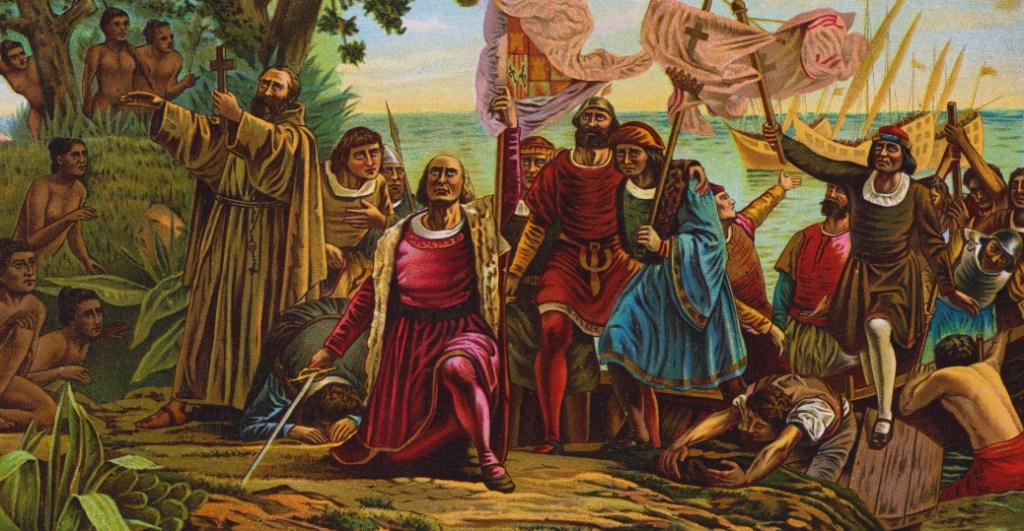
I make this claim of first missionary because it was on October 12, 1492, when Columbus made the first landfall in the Americas (North and South America) on an island we know now as the Bahamas but he named “San Salvador/Holy Savior,” that he knelt on the beach to give thanks to God, and prayed in Latin this prayer which is said to be the first Christian prayer recited in the Americas:
“O Lord, eternal and omnipotent God, Thou hast, by Thy holy word, created the heavens, the earth, and the sea; blessed and glorified be Thy name; praised be Thy majesty, who hast deigned that, by means of Thy unworthy servant, Thy sacred name should be acknowledged and made known in this new quarter of the world.”
Columbus was a hero of the Catholic Church and of the United States for eons because he was considered a bold navigator, a man of original ideas who was persistent and determined in carrying out his plans, and a success in overcoming the obstacles of his voyages. Those things haven’t changed; they were just forgotten or buried, and they need to be recaptured. Above all, Columbus has always been a model of courage who admirably drew his life’s vision from Jesus Christ. Let’s celebrate him loudly on October 12 (or on the first Monday of October – the 9th this year – which is the national day of observance).

 A PRINCIPAL'S PRINCIPLES FOR PARENTING
Leave a comment