In our 41 years of married life, my wife and I have lived in five different homes and were members at just as many parishes. Our checklist when looking for a new house included desiring a big kitchen, a large yard, a walk-in closet, multiple bathrooms, and located in a safe, quiet neighborhood. When it came to choosing a Catholic church to call home each time we moved to a new community the checklist was much shorter. We only were looking for two things – a reverent congregation and a pious pastor.
In all five different communities we lived, we never attended the Catholic church nearest our house. Instead, we chose to drive past two or three substandard Catholic churches just so we could finally arrive at our new parish – the one with a reverent congregation and a pious pastor whose only negative was that it was inconveniently located, often a 30+ miles and/or 50+ minutes drive from our house.
The inadequate parishes we passed over might have had a lot of fun community events listed in their bulletin, might have served the tastiest coffee & donuts after Masses, might have had a professional sounding choir, and might have been run by a pastor whose sense of humor made his homilies amusing to hear, but those attributes don’t necessarily equate to a solid parish. Rather, a reverent parish is one whose congregation respects the solemnness and piety of the liturgy and whose pastor is not afraid to publicly preach Catholic truth and act counter-culturally in the face of our depraved culture.
Although there are many components to a parish and many happenings besides the Sacred Liturgy, the primary way to determine how impressive and impactful the church is that you’re considering joining is to look at how they offer their Mass. The Catechism of the Catholic Church insists that “Sunday Eucharist is the foundation and confirmation of all Christian practice” and the “Sunday celebration of the Lord’s Day and His Eucharist is at the heart of the Church’s life.” Thus, the best way to judge a Catholic parish is based on how properly and piously the priest offers Mass and how devotedly and reverently the congregation participates.
The majority of today’s Catholic parishes celebrate Novus Ordo Masses (meaning “New Order”) which came about after Vatican II in the late 1960s and early 70s. Whereas one can find a solid Catholic parish offering Novus Ordo Masses, it’s becoming a rare occurrence, as the conventions and decorum of these “new” Masses often compel some impious and distracting behaviors from both the priest and the congregation. You will often see abuses such as the following:
- The priest disregarding the prescribed text of the Order of Mass and adding in his own editorialized versions;
- The tabernacle tucked away instead of being placed in a prominent location;
- The pastor refusing to administer Communion on the tongue or to someone kneeling;
- The congregation spending more time shaking hands and chit-chatting during the Sign of Peace than they spend time praying in silence after receiving Communion;
- The choice of music being more related to Broadway-style love songs that employ guitars and drums than to sacred, traditional hymns with an organ;
- The people impulsively applauding at the end of every Mass as a show of thanks for what they perceive was the choir’s “closing number.”
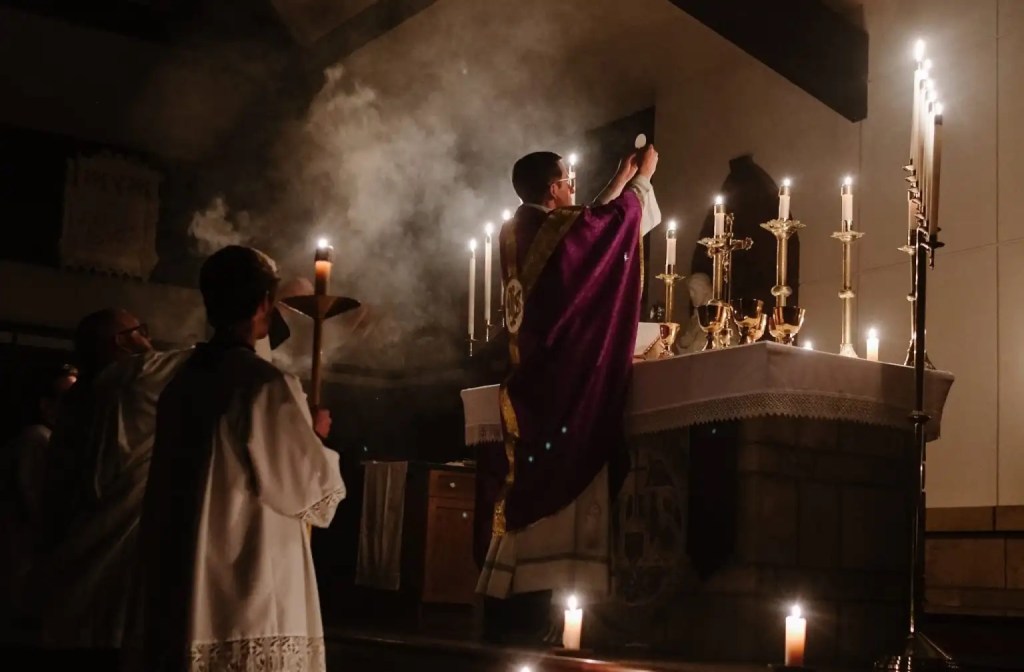
The most solid, reverent parishes my wife and I found during our searches in our new communities were either ones that had the Traditional Latin Mass or ones that had a Novus Ordo Mass which was offered ad orientem. This is a Latin term meaning “toward the East/sunrise” and refers to a Mass where the priest and people face in the same direction. Latin Masses are naturally presented ad orientem and Novus Ordo Masses can be, but it’s unusual to find, so we were excited when we came across a parish that provided this form – even it it meant we had to be up for traveling over an hour roundtrip each Sunday.
It was about 50 years ago when the Mass in most Catholic parishes suddenly changed after 1,900 years of tradition by having the priest no longer face the tabernacle and the altar, which was typically attached to the wall, but instead face the people by moving the altar away from the wall. The reason that, prior to Vatican II, all Masses were celebrated with the people and the priest facing the same direction toward both the altar and tabernacle was the Mass is Christ’s sacrifice made present again, and this re-presenting of the sacrifice of the crucifixion is what leads us out of our earthly bondage to the Heavenly Jerusalem, which is located toward the East, toward the rising of the sun.
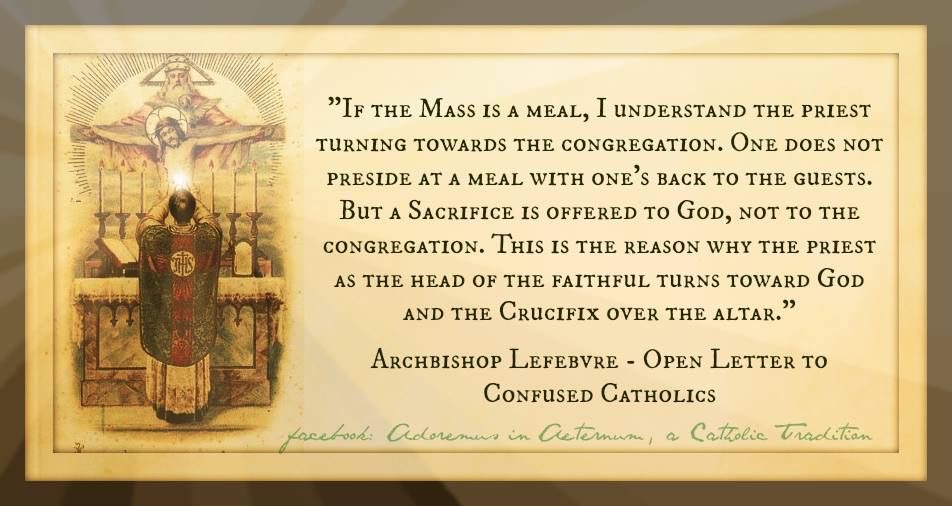
Since the 1970s, Catholics have been led to believe by a false presentation of Vatican II that the Mass is primarily a symbolic, communal, fellowship meal and a reenactment of the Last Supper. The truth is the Sacred Liturgy is chiefly a sacrificial worship where the priest is offering the Father the very best we have, the only sacrifice that could possibly please Him – His perfect Son, the spotless Lamb of God. When the priest speaks the words of Consecration at Mass, he is not addressing the congregation – he is directing them to God. The priest is speaking in the person of Christ and indicating that this act of our worship, as members of the Body of Christ, is united to the perfect sacrifice of Jesus on the cross. Thus, the priest must face both the tabernacle and the altar of the sacrifice, and since the Son has generously made us members of His body, this is our offering as well, and therefore we must stand behind the priest facing in the same direction he is.
Correspondently with the time that Masses changed so priests turned to face the people, newly constructed or remodeled church buildings transformed into large, in-the-round, meeting-type houses for this so-called family meal. Thus, the focus of Mass shifted from worship of God and presenting a sacrifice to Him, to family togetherness. Most priests started saying the Mass as primarily a re-enactment of the Last Supper, a kind of Jewish ritual fellowship meal, and therefore began to face the people just as dad might preside at the table for family dinner. That is why the altar in most churches was moved to be in the center of the sanctuary, and some “with-it” priests even started calling the congregation to literally come forward and stand around the “table.”
Ignorant or oppositional Catholics will say that when the priest prays the Mass ad orientem – whether at a Traditional Latin Mass or at a Novus Ordo Mass offered ad orientem – he is rudely “turning his back” to the people. They don’t realize that the priest, who is leading the congregation in worship of God the Father, is facing the Lord together with the people. The Mass is meant to be a prayer where we are not praying to each other but rather to God. Thus, we all need to face in the same direction – toward Our Lord and not toward each other.
Just as you would want your bus driver to “turn his back” to you and the other passengers so he can properly lead your busload of people as you drive together to your destination, so too should you want your priest to “turn his back” on you so he can properly lead the congregation in prayer addressing our Father when re-presenting the sacrifice on the altar.
Most Catholics presume that the liturgical changes after Vatican II mandated priests to make a change and face the people throughout the Mass, especially during the Liturgy of the Eucharist. They are mistaken. To this day, the conventions and decorum of a Mass (called the “rubrics”) specifically name the specific times during the Mass the priest is to “turn and face” the people, thus inferring that the priest is already offering the Mass ad orientem. Otherwise, why would the rubrics have to specifically point out when the priest needs to turn and face the congregation?
Here are some of the current rubrics, as stated in The General Instruction of the Roman Missal, that prove the priest was never meant to always be facing the people:
- “Returning to the middle of the altar after washing his hands and standing facing the people, the Priest extends his hands, and calls upon the people to pray, saying, ‘Pray, brethren . . .’”
- “Then the Priest, extending and then joining his hands, announces the greeting of peace, facing the people and saying, ‘The peace of the Lord be with you always.’”
- “Then the principal celebrant takes a host consecrated in the same Mass, holds it slightly raised above the paten or the chalice, and, facing the people, says the ‘Behold the Lamb of God.’”
- “Then after Communion standing at the chair or at the altar, and facing the people with hands joined, the Priest says, ‘Let us pray…’”
It is obvious from these above examples that the expectation is there are reoccurring times in today’s Novus Ordo Mass when the priest is to have his back turned away from the people so he is facing both the tabernacle and altar, and then when instructed for specific prayers and actions he is to turn around and face the people. Due to priests either misinterpreting the revised norms from the late 1960s or purposely acting out of bounds due to their personal fancies, we gradually came to where we are today with almost all priests, out of routine, now facing the people the entire hour of Mass.
To fully understand the specialness of a Mass offered ad orientem I strongly recommend Catholics find this manner of Mass in their diocese and attend, so they can feel for themselves the greater reverence coming from the priest, the more solid prayerfulness of the congregation, and the higher attentiveness that will be created in their own hearts. At most Novus Ordo Masses, the priest is the people’s focus as he literally becomes the center of attention, almost like playing the role of a talk-show host giving his opening monologue at center stage. Conversely, one’s focus at a Mass offered ad orientem will be where it is meant to be – toward the altar, the tabernacle, and the re-presenting of a sacrifice to our Almighty Father. It feels so much more like a sacrifice on the sacrificial altar and not a so-called fellowship meal if the location and actions of the priest are what they always were for the first 1,900 years of the Catholic Church.
If you have never attended a Traditional Latin Mass, this resource and this video give some suggestions of how to prepare and what to do when at this Mass that was considered standard for 20 centuries but for whatever reason in the 21st century is considered “divisive,” “backwards,” and “a nostalgic disease.” Because it will be very different from what you’re used to, it is recommended to attend a Latin Mass a few times before possibly writing it off as not for you. Some people fall in love with the Latin Mass immediately while others need time to better comprehend what is happening and how to take it all in. If you prefer Mass in English, this helpful map can help you find parishes in your state that offer reverent Novus Ordo Masses ad orientem.
As previously noted, it is possible to find reverent Novus Ordo parishes with traditional Liturgies and pious priests who do not offer Masses in Latin and/or ad orientem. Although a pastor at one of these “Vatican II” parishes chooses to face the people throughout Mass, due to other changes and expectations he has instituted and/or other customs his congregation have adopted, his parish can indeed still be considered solemn and highly inspirational. Some indicators that you have probably found an upstanding, reverent Novus Ordo parish include:
- The use of incense and ringing of bells during Mass (such as during the elevation of the Sacred Host and Precious Blood after their respective consecrations).
- The preference for sacred music during Mass (such as Gregorian Chant and organ music) and the congregation responding in Latin to certain prayers (e.g. Agnus Dei and Sanctus).
- The priest encouraging his congregation to receive Holy Communion on the tongue (and kneeling if possible) and the people walking to and fro in the Communion line piously holding their hands together in reverential prayer instead of waving to their friends in the pews.
- The priest providing two or more days a week to hear Confessions instead of the typical Saturday-afternoon-only schedule the majority of parishes offer.
- The parish referring to itself by the proper term – Catholic “parish” – instead of the progressive and Protestant/non-denominational sounding term – Catholic “community” – and also referring to the Mass as “the sacrifice of the Mass” and not the weaker and vague terms of “meal” or “celebration.”
If your search online for all the Catholic parishes within an hour’s drive from your home and look through their websites and virtual Sunday bulletins, you can learn how often they hold Confessions and what terminology they use, and thus narrow down which churches in your county or the next county over might meet the criteria for high-principled piety led by a righteous pastor. This resource can also help you.
Don’t just settle for the Catholic church closest to your house as your “home parish.” A little researching and a few Sundays of trial runs will help you uncover the Catholic parish that offers solid, solemn Masses with a devout priest.
Although it may mean you must drive a lot longer to get to that perfect Mass, the results will be feeling the profound aura that is present at a traditional liturgy, sharing in the awe radiating from the reverent priest and engaged congregation, and experiencing a closeness to Our Lord than you never encountered at a substandard, Catholic-light parish.
 A PRINCIPAL'S PRINCIPLES FOR PARENTING
Thanks for raising this important issue. At the end of the day, for any particular movement, prayer form, or liturgy, the job of promoting it must belong to those who love it most. Shepherds don’t have sheep; sheep have sheep.
LikeLike