(This is the third in a series of five articles assisting parents in teaching the parts of the Mass to their children to enlighten them on what is taking place and help them develop a deeper understanding of why attending Mass is critical to our spiritual health. Note that the following explanations of the parts of the Mass and our expected responses/actions are written for the most common Mass that Catholics attend in the U.S. – the Novus Ordo Mass – as opposed to a Traditional Latin Mass.)
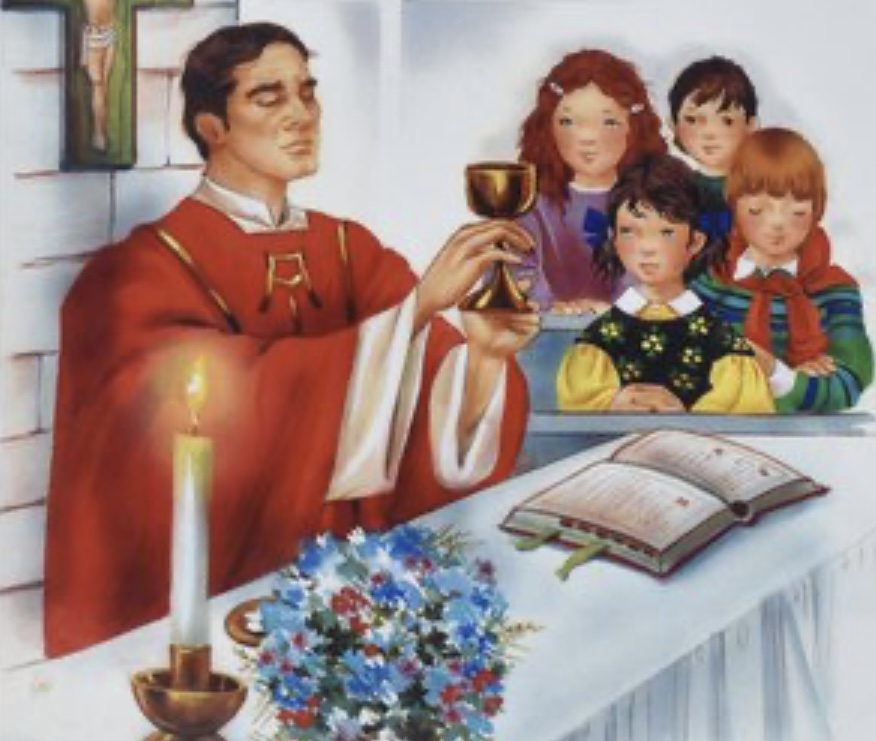
Catholic families participate in Mass every Sunday but many children do not have a clear grasp of what to expect during the Mass, why the priest is doing certain things, and why we are responding in words and actions. This third article in a five-part series continues offering suggestions for parents in how to “teach the Mass,” and in particular how to explain the Consecration, which is the heart of the Mass when the priest repeats the words of Jesus at the Last Supper, and the bread and wine become the Body and Blood of Christ.
The Liturgy of the Eucharist is made up of multiple components, that begin with the Presentation and Preparation of the Gifts, reach a pinnacle with Consecration, and end with Communion. The Eucharistic Prayer comprises the central portion of these components. It is both a statement of praise and thanksgiving for God’s works of salvation and the making present of both the Body and Blood of the Lord. At the conclusion of the Sanctus (explained in last week’s Part 2), we kneel because we are about to begin the most solemn moment of Mass.
There are four versions of the Eucharistic Prayer from which the priest can choose to read, and it would help visual-learner children to follow along in the Missal. In this prayer, the priest will say the words of Consecration, which are taken from the accounts of the Last Supper. Up to this moment, what is on the altar has been bread and wine. But from the moment when the priest pronounces the words of the Consecration – “Take this, all of you, and eat of it, for this is my Body…Take this, all of you, and drink from it, for this is the chaliceof my Blood…” – what is on the altar is now the Body and Blood of Jesus Christ.
At most churches, the altar server will ring bells when the priest performs the Consecration. The bells are rung first at the time of the “epiclesis” in the Eucharistic Prayer, which is near the beginning when the priest joins his hands and places them over the bread and wine for the Holy Spirit to come down upon the gifts so that they may become the Body and Blood of Our Lord. The next two rings are at each “elevation,” which is when the priest, after saying the words of Consecration, lifts high the Sacred Host and then the chalice of Precious Blood.
Kids should be prepared to listen for these times, as they’re meant to tell us, “Pay attention! Look! Look! This is important! Jesus is about to be made present on the altar!” Both silence and sounds are important in our worship – from the quiet of private prayer to the singing of the congregation. The sound of bells adds to the reverence and the solemnity of the Mass and highlights in a conscious way the sacred action taking place on the altar.
Besides listening for the ringing of the bells and keeping their eyes on what the priest – acting in the person of Christ – is doing at the altar, children should be taught that there are some actions we the people should be performing. During the two times when the priest elevates the bread and wine, we all should have our eyes fixed on Christ and silently profess an act of love and adoration. A good suggestion is to silently mimic the words of St. Thomas the Apostle, who when he encountered the risen Christ exclaimed, “My Lord and my God!” (Read John 20:19-29 with your kids.) By saying this statement to ourselves, we are expressing our own belief that God is truly there, overcoming any doubts, similar to what “Doubting Thomas” experienced.
After looking up in adoration to now see Jesus as the priest elevates the host and then the chalice, and after silently offering to Him our love, we should then bow our heads at the same time that the priest will genuflect. This is our solemn act of reverence to Our Lord who is now present under these two forms. Many Catholics will say a quick prayer at these times of bowing their head, such as, “O Sacrament most holy! O Sacrament divine!All praise and all thanksgiving be every moment Thine.” Parents could also suggest to their youngsters that at this time they could bow and simply say to themselves, “I love You, Jesus.”
“Transubstantiation” – what Catholics call this miracle of the bread and wine we offer being changed into Jesus’s Body and Blood – is a hard concept to teach to adults, let alone little ones. Parents can try the following explanation. With the eyes of our person we only see bread and wine, but with the eyes of faith we see and recognize Our Lord Himself. Jesus is really present, offering Himself for us on the altar just as He offered Himself for us on the cross. The appearance of the bread and wine remain – it still looks, tastes, feels, and smells like bread and wine. But at the moment of the Consecration, God changes the core reality of them into something divine – into Himself. All of this is done by the power of Jesus, who is God who became Man. He can do anything, including changing a little bread and wine into His own Body and Blood. If we are fit to receive Him, this once-bread and now-Body will be our spiritual food.

After kneeling for the Consecration, we stand to pray the Our Father together. Contrary to popular practice in many churches, holding hands or raising one’s hands during this prayer at Mass is discouraged as it can be a distraction or an imposition on others. (Here is a good explanation from a priest regarding why hand-holding or hand-raising is not desirable during Mass.)
Similarly, when we then reach the next point in the Mass called the Sign of Peace, it has become commonplace in some parishes to turn this into a lengthy meet-and-greet like we were walking down a receiving-line of people at a reception. This too is discouraged as it is meant to be a calm, quick time to make peace with your “brother and sister” by simply extending your hand for a gentle handshake with no more than a couple of people immediately around you as you whisper, “Peace be with you.”
The Sign of Peace is following a Biblical principle by asking us to extend a sign of peace to those around us before we approach the altar. In the Gospel we hear these words from Jesus: “If you bring your gift to the altar, and there recall that your brother or sister has anything against you, leave your gift there at the altar, go first and be reconciled with your brother or sister, and then come and offer your gift.”
Children often have to be taught that the Sign of Peace is to be a brief, symbolic gesture of following Jesus’ words, and it is not meant to be a “Hey! How ya doin!?” moment, exchanging two-fingered-peace-signs and high-5s with as many people around you as possible. You will find some parishes where there will be no allurement of reaching out to others because the priest/deacon will not state the words, “Let us offer each other a sign of peace,” as this part of the Mass is optional to be included.
Just before Communion is shared with the whole community the priest raises the large host he is about to consume for all to see, and he then loudly proclaims, “Behold the Lamb of God…!” To help children understand why the title Lamb of God is used for Christ, parents would do well to read to them Exodus 12, which describes Passover and how people were protected with the blood of a slaughtered lamb. This image of the lamb was also seen in the story of Abraham sacrificing his son and later used by prophets Isaiah and Jeremiahto describe the coming Messiah as being “like a lamb led to the slaughter.” Then in the Gospels, Jesus would be specifically identified as “the lamb of God” in the sense of both the sacrificial offering for sin and the suffering servant. As John the Baptizer was proclaiming the coming of the Messiah at the River Jordan, he saw Jesus and shouted, “Look! There is the Lamb of God who takes away the sin of the world!”
It might take a while for kiddos to understand and appreciate the depth of how both the Passover and Passion narratives relate to what is happening during the sacrifice of the Mass. At the crucifixion, Jesus is the innocent and sinless victim, who is taking all of our sins unto Himself. He offers Himself on the altar of the cross. Through His blood He washes away sin. However, unlike the Passover lamb that was slaughtered, roasted, and eaten, Our Lord the Lamb of God rose from the dead, conquering both sin and death.
Immediately after the priest says his “Behold the Lamb of God…” lines, we respond with our own line that acknowledges our need for God and our belief in God’s love: “Lord, I am not worthy that you should enter under my roof, but only say the word and my soul shall be healed.” This response is taken directly from Scripture, when a centurion (military officer) approached Jesus and pleaded with Him to heal his paralyzed servant. Jesus said He would go to the centurion’s house to cure the servant, but the centurion urged Him, “Lord, I am not worthy to have you come under my roof; but only say the word, and my servant will be healed.”
Jesus was amazed at the faith of the centurion. We likewise amaze Our Lord with our faith in the Holy Eucharist. We show our belief in Christ being the Lamb who suffered, died, and rose for our salvation, and though unworthy, we welcome Him into our own souls with reverence and humility.
In the upcoming fourth article of this five-part series, we will dive into detail of that special time of the Mass when Jesus dissolves into us and we more fully transform into Him.
 A PRINCIPAL'S PRINCIPLES FOR PARENTING
Dan,
I’ve never had “transubstantiation” better explained to me than your description. It really cleared the fog surrounding my understanding of this miracle. Thank you for providing this marvelous insight!
Sincerely,
Danny Mueller
LikeLiked by 1 person