I grew up loving competition. Being the youngest of five, I would try my best to beat my older brothers in one-on-one basketball games or shooting “h-o-r-s-e” on our home’s basketball court. I didn’t get a trophy when I won, or even applause. (In fact, when I would defeat one of my bigger, stronger brothers in a game I would typically get beaten up afterward.) It was the intrinsic satisfaction of working hard and winning that made me feel rewarded.
I get concerned today when there are educators and athletic coaches who feel they have to hand out trophies or some types of awards to all the kids in the group, lest the children feel like “losers.” Trophies, ribbons, and certificates can indeed be powerful motivators, but constant, tangible prizes and/or superfluous acknowledgement does not motivate kids to succeed. Instead, it can cause them to underachieve. Ashley Merryman, author of “The Science of Winning and Losing,” wrote:
“If I were a baseball coach, I would announce at the first meeting that there would be only three awards: Best Overall, Most Improved and Best Sportsmanship. Then I’d hand the kids a list of things they’d have to do to earn one of those trophies. They would know from the get-go that excellence, improvement, character and persistence were valued.”
Of course, we as parents and youth coaches should be concerned with raising kids’ self-esteem, and giving tangible awards simply for effort or participation might be a suitable way to accomplish this. It just has to be done in moderation. Otherwise, children will end up learning the wrong lessons – that one should be tangibly rewarded simply for doing what one is supposed to do. Instead, the best lessons to teach kids are that true rewards are typically reserved for true accomplishments, and intrinsic motivation is usually better than extrinsic.
Moving from sports examples to the academic world, when I was hired as a Catholic school principal, the previous principal had in place an academic awards program where every student in the middle school won some sort of ribbon at the end of each trimester, regardless of if a student failed three classes or got straight “A”s. I immediately transformed this awards program into a system where only the middle school students who earned a 90% or higher grade in every subject at the end of a trimester would be placed on our Honor Roll. For any given trimester, we might have up to 30% of our seventh and eighth graders being recognized with a tangible Honor Roll ribbon and public mention in the parent newsletter, as well as listed on our school’s Facebook page. The other 70% of students received no recognition.
This limited and specific criteria for earning the Honor Roll reward motivated many of the students who weren’t able to achieve 90% grades to work harder so they could get recognized next time, and genuinely gratified the students who legitimately earned placement. With the prior system of everyone in the middle school handed a ribbon each trimester simply for “participating” in school, the 90%-grade students did not feel a real sense of accomplishment, the 80%-grade students had no added motivation to try harder next trimester, and the 70%-grade students felt they could keep earning their low level marks and all was good.
I would always suggest to my school parents that they should get together with their kids to discuss and come up with their family’s “belief system” on what mom and dad naturally insist on from their kids without the youngsters expecting any tangible award in return, and what actions or accomplishments are worthy of earning material prizes if their goal was attained. Specifically for academics, parents should plan with each child what the end-of-year or end-of-trimester report card could realistic look like with the proper work-ethic, and what steps son or daughter will need to make to accomplish this goal. Some families choose to reward high grades, teachers’ exceptional comments on report cards, and/or improved marks from one trimester to the next with cash, with a trip to the store to buy a longed-for item, or with a family movie/dinner night…kid’s choice, of course.
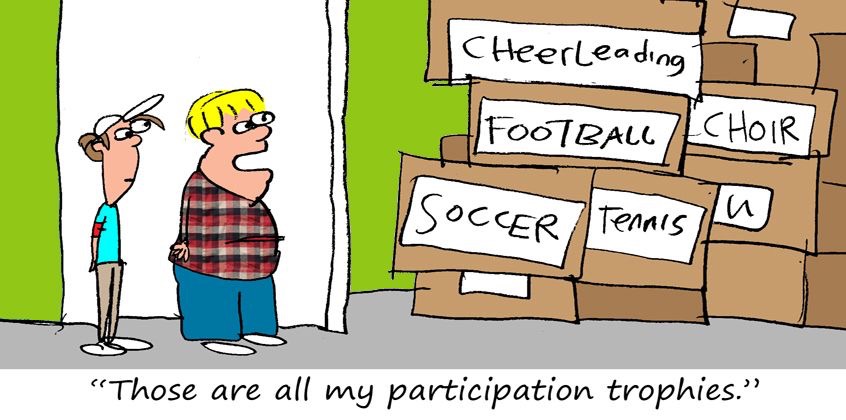
Realizing that certain children may need praise to raise low self-esteems, and receiving tangible awards for effort/participation actually in these cases could prove beneficial, parents still need to make sure they don’t reward their sons and daughters too often with undeserved trophies, ribbons, and certificates. By the time they’re 10-years-old, some kids nowadays already have 10 trophies collecting dust on their bedroom dressers – from the one that simply announces, “Kindergarten Soccer” to the one with the plaque reading, “2nd Grade T-Ball Participant.”
Personally, I had just one trophy in my bedroom by the time I was 10-years-old; it was for my Little League baseball team winning the league championship and making it to the regional playoffs. It could be argued that this one trophy was proof of my limited athleticism, but I like to think it was merely an indicator of the generation I grew up in – when children only got rewarded for accomplishing something big. Because trophies and ribbons back in the day weren’t handed out like bite-size candy on Halloween, that one baseball trophy meant a lot to me and is still vivid in my mind more than 50 years later.

I agree with the philosophy of Christian theologian and writer, Dr. Michael Brown, who says:
“There are elementary schools and middle schools across America that do not keep score in the children’s sports events, since everyone has to win (or, conversely, because no one can lose). How does this prepare them for the realities of life, where, every day, some people win and some people lose, where every day, there is disappointment and pain, where every day, some things go our way and some don’t, where every day, life is not always fair?”
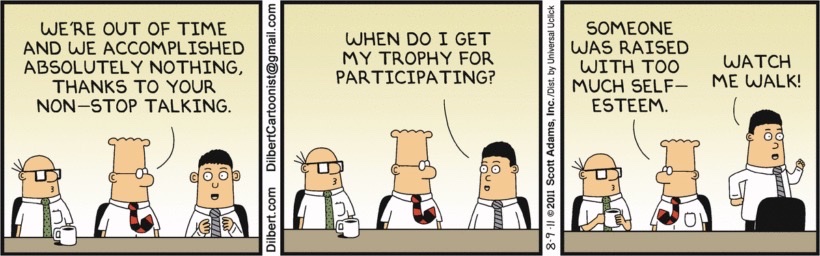
If we desire that our kids work hard as well as see the redemptive value of suffering, we cannot hand them a reward for simply showing up nor throw them a lifesaver at the first sign of distress. This artificial inflation of self-esteem will eventually end up hurting our children as they grow up and join the real world. We do not want them to enter the work force and assume if they simply show up at their job they will get ahead with bonuses and promotions. We do not want them, when their boss reprimands them for a poor job performance, to go into a deep depression due to everything in life up to this point having been handed to them and thus they had never experienced a smaller version of this type of disappointment.
In our modern culture, standards for competence have been lowered or removed completely, which is shown by how counterfeit praise in the form of tangible awards is distributed so freely and why some leagues’ athletic competition doesn’t even allow a score to be kept. Most youngsters will learn the wrong things if they are rewarded simply for doing what they were supposed to do or if they never get to experience both “the thrill of victory and the agony of defeat” in competition.
As a loving mom or dad, we should offer empathy to our young one when he/she loses a game or gets low marks in school, but we should not take away the sting. Handling adversity properly can only happen if one is allowed to fail at times, and true rewards should be given for true accomplishments.
 A PRINCIPAL'S PRINCIPLES FOR PARENTING
Leave a comment