There are decades-old irregularities in how Holy Communion has been treated that were not addressed by last summer’s “Eucharistic Revival” and don’t appear to be on any agendas for the current “Synod on Synodality.” These aberrations surrounding the Body of Christ have created the current situation where up to 69% of Catholics do not understand or believe in transubstantiation and the Real Presence of Jesus in the Eucharist. The once universal belief among the Catholic faithful that they are receiving the actual Body of Christ at Communion has weakened tremendously because of three basic changes that have watered down the reverence necessary in how Holy Communion should be distributed and received at Mass.
The first two irregularities concern the way people receive the Holy Eucharist. The dilution of the seriousness and sacredness began when Catholics stopped receiving the host while kneeling and on the tongue. The host is called the “Bread of Heaven” and the “Food of Angels,” and thus, it does not show reverence to consume it in the same way as we consume snacks. Yet, for about the last five decades, most Catholics have been doing it this irreverent way. It was about 50 years ago when this lack of reverence toward the Body of Christ began due to the repercussions from and erroneous interpretations of the Second Vatican Council (aka “Vatican II”).
During this same timeframe, a third irregularity has been in play, and this one concerns the people who distribute the Holy Eucharist. The most fitting ministers to dispense the Eucharist are bishops and priests, with deacons also allowed to be “ordinary ministers,” and yet since the 1970’s most Catholic Churches employ more lay ministers than ordained ministers to assist in this sacred act.
While using lay ministers for Holy Communion was permitted in limited cases since the implementation of Vatican II, these cases were only supposed to be for extraordinary circumstances. Never in the history of the first 1,900 years of the Church have lay persons distributed Communion at Holy Mass in such a common, nonchalant manner like is being done today in the majority of parishes. Most Catholics assume that lay persons who administer Communion are called “EM’s” because it stands for “Eucharistic Ministers.” The fact is the “E” stands for “Extraordinary,” because the “ordinary ministers” of Holy Communion – bishops/priests/deacons – are to be set apart by a special sacrament and anointment for this divine task.
Thus, it should be only in extraordinary circumstances that lay people administer Communion. These typically come down to two instances – either the priest/deacon is physically unable to stand for long periods of time to distribute at Mass or the number of faithful at Mass is so tremendous that the very celebration of Mass would be unduly prolonged with only a priest/deacon distributing. Only in these two out-of-the-ordinary times should a trained lay person assist as an EM.
Note that it is in the case of an exorbitantly long Communion line that lay ministers are to be used, such as when there is Mass of 1,000 at the cathedral and only one priest available. The Church has never officially declared that a sufficient reason for a parish to employ lay ministers is to eliminate a brief extension of the length of Mass due to a long Communion line. And yet, so many parishes these days do just that so as to save the congregation from having to wait a few extra minutes for Communion to end.
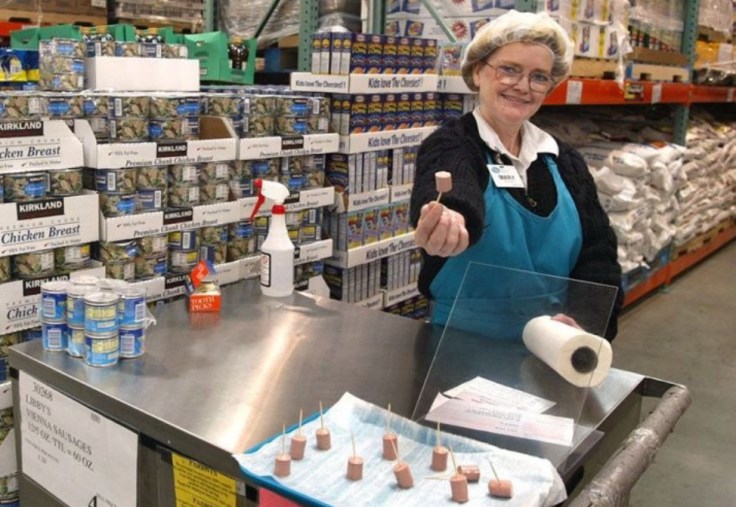
Using lay persons to hand out the Blessed Sacrament in a more speedy manner more often than not mimics the haphazardly tossing of candy to a large group of trick-or-treaters waiting at your front door on Halloween. Or it is like when the Costco sample lady quickly hands you – and the dozen other shoppers crowding around you – a sample to taste, and after grabbing it you turn your back to wheel your cart down the aisle as you pop the snack in your mouth. Yes, it is more efficient to dole out items as fast as possible, but it is not as personal and devalues the experience.
Receiving the Body of Christ in the hand, while standing, and from a lay person who a few minutes prior raced up to the altar to assist and has not been blessed like a priest to act in persona Christi – i.e. “in the image of Christ” – undermines all the symbolic and aesthetic aspects of the act of Eucharistic Communion. It is because of these modern aberrations that so many Catholics no longer believe the “Eucharist is the source and summit or the Christian life.”
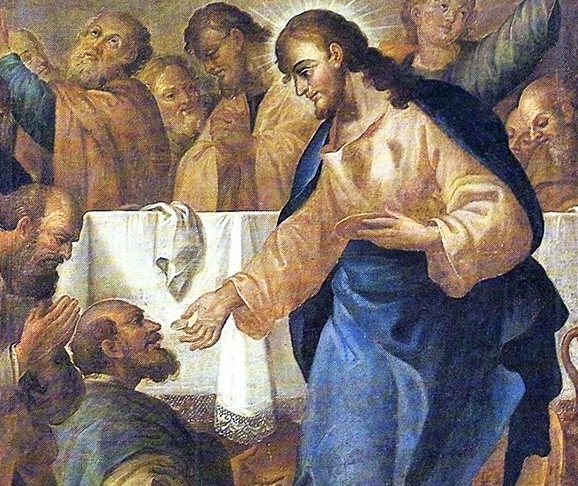
Saint Thomas proclaimed, “My Lord and my God!” when he first saw our resurrected Lord, which is also what Catholics should be saying to themselves at every Mass during the moment the priest consecrates the bread and wine and elevates for all to see the Sacred Body and Precious Blood of Christ. A Catholic will more likely believe in the awesomeness of receiving Christ in the Holy Eucharist if they revert to the millennium-old practice of kneeling before one’s Lord who is truly present in the Sacrament and receiving Him on the tongue from the hand of an ordained minister.
Performing these acts at Communion embodies are dependency on God, our unworthiness, and our need to fall in adoration before our Lord. When I do not feed myself I express that the one doing the feeding is Christ – or the priest acting in personal Christi. When the unanointed hands of a lay minister who was never ordained to act in the person of Christ stands before the communicant, who is also standing, and exchanges the host from his or her mortal hand to the recipient’s hand we are not experiencing the sacred, profound magnificence of Holy Communion.
Pray that the Church hierarchy and all parish priests begin to stress to the faithful that we can show how much we love Jesus and believe in His Presence by returning to the tradition of three fundamental actions – kneeling for Communion, receiving the host on the tongue, and discouraging the use of extraordinary ministers.
 A PRINCIPAL'S PRINCIPLES FOR PARENTING
Leave a comment