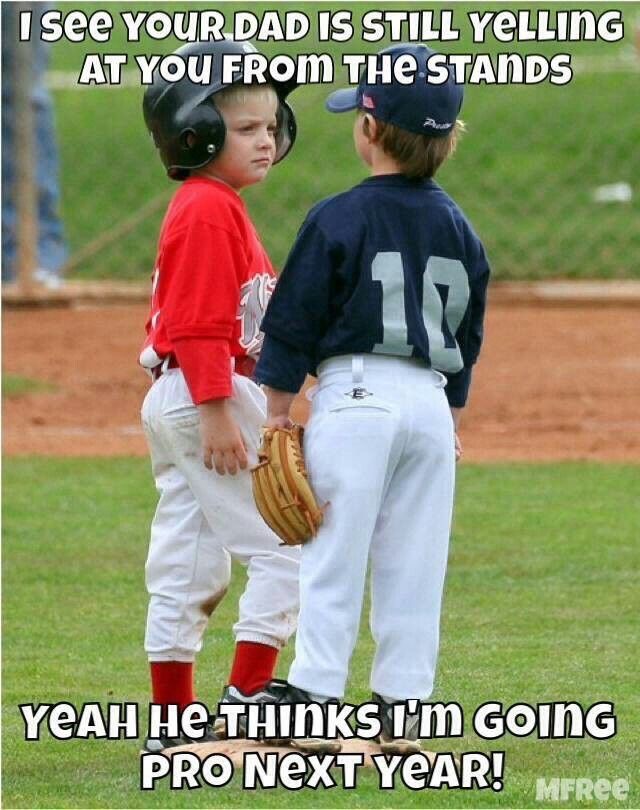
Recent generations has seen a dramatic shift in how kids play sports. Decades ago, what children would do is gather up neighborhood friends and start a pick-up basketball game at the school playground or play touch football at the park, with no adults in sight. If kids in the past did end up joining a competitive sports league, it typically was a simple one run by the church’s CYO program or the local Boys’ Club, consisting of less than a dozen “real” games. These days, with kids involvement in sports now more intense, more year-round, more expensive, and more parent-involved, mom and dad would do well to take their foot off the gas and not let themselves or their youngsters get so carried away.
One big error nowadays is that too many proudly overconfident parents wear rose-colored-glasses when they watch their child play competitive sports. These moms and dads confront their kid’s coach with advice, or even demands, while envisioning an imminent college athletic scholarship. Most youth program and high school coaches will admit that their biggest headaches are parents pressuring them to play their kid more or play them in a “better” position because he or she is “special.” But with less than 2% of high school athletes earning college athletic scholarships, the actuality is one’s child is not going to be the next Lionel Messi or Caitlin Clark.
I am not an opponent of kids playing competitive sports. Besides building healthy bodies, playing on sports teams builds a child’s social skills, helps him or her deal with the wins and losses in life, and develops lifelong prowess in learning to set goals and accomplish them. For myself, I loved the competition of playing Little League baseball and high school basketball when I was young, and I even attempted to play college basketball. (The key word here is “attempted.”) As an adult with my own kids, I coached some of their teams in their younger years, and then once they reached high school, I sat in the stands to enjoy seeing them compete and grow into hard-working and goal-driven teens.
I found myself needing to temper my expectations of my youngsters becoming superstars as they reached their teens, understanding the reality that it would be rare for my children-athletes to be “special” and most likely they will simply be “commonplace.” When parents realize this, they will develop the proper perspective on where competitive athletics should be placed in the list of what’s most important for kids and their families.
This proper perspective should start with parents not enrolling their elementary and middle school age children on teams or having them compete in an individual sport (e.g., gymnastics or swimming) that demands meeting every single day and/or requires the athlete to not play any other sport. It is too early in life for this much intensity and it cuts out the benefits of learning and enjoying multiple sports. Just as a mom and dad would want their academic-child to explore a variety of school subjects and not solely complete math problems all day without ever reading or writing, so too should they want their athletic-child to try a variety of sports.
When parents make or allow their kiddos to eliminate all sports but one, they are hindering all-around athletic development. Multi-sport participants learn a variety of sports skills that translate to improved athleticism, as many famous, successful multi-sport athletes would concur. Plus, playing more than one sport decreases the chance a kid will burnout in a few years.
Most Catholic diocese’s CYO sports programs are perfect examples of the best plan for a 5-to-13-year-old child’s development and mental health, avoiding the pitfalls of intense, year-round sports. These programs usually consist of three sports seasons that each take up about three months of practices and games, for example: soccer in the fall, basketball in the winter, and volleyball in the spring. What about summer? That’s for riding bikes, swimming at the pool or lake, and pick-up games in the neighborhood.
The opposite types of athletic programs from the CYO-types are the travel/club/select sports leagues that demand too much of kids (and of their parents) by being so intense, exhausting, and expensive. While there are some benefits of kids playing travel/club/select sports, such as bonding with teammates and fun trips traveling to distant tournaments, participating in these high-intensity programs are frequently associated with burnout, an increased risk of injuries, and conflict with a child’s overall development and faith-life growth. While there are cases of elementary and middle school youth who made it on their high school teams or played college athletics due primarily to playing travel/club/select sports, there are countless other cases of kids who ended up getting cut from their high school tryouts or spending most of their time sitting on the bench in high school even though their parents assumed they had literally paid for this not to happen.
Too many child-athletes and their parents get the impression that the only way to make a high school team when one is 15 is to join the “best’ travel/club/select team when one is 10. But truly, the fundamental need is merely that the kid needs to get in enough practice and playing time. So instead of mom and dad making sure their son and daughter join the “best” club teams, they simply need to find teams where they will get mostly-equal playing time with the other players, and preferably where both teammates and opponents are all at a similar skill level.
For this reason, parents are smart to sign up their elementary and middle school age children on recreational teams (CYO, parks department, Boys & Girls Club, YMCA, etc.) which can give their kids similar benefits as travel/club/select teams but at a fraction of the cost. The savings is not just in money though. Recreational leagues do not disrupt family time nearly as much, do not keep the child from school work responsibilities, and typically don’t interfere with Sunday obligations to get to church. Besides, mom or dad can supplement the less amount of practice time and competitive games these recreational leagues provide by working with their kid at home and/or finding low-cost clinics and sports camps that emphasize skill development balanced with fun.
A final piece of advice for parents of young children and preteens playing on sports teams is if your child had a good attitude at practices and tries his or her best, but rarely gets off the bench at games, this is not the right team/coach for your family. Parents should be searching for teams and coaches who promise every player guaranteed minimum playing time and where no players are stuck in only one position. We should want our children to develop confidence in a variety of roles, but unfortunately there are unproductive coaches in youth sports who will only play a so-so athlete in the least “damaging” position on the team. Hence, this is why we will often hear the stereotypic tales of the maltreated Little League baseball players who always end up stuck in right field.
The culture needs to let kids be kids by encouraging them to play an array of sports while also taking time off from intense athletics to enjoy other, less-structured aspects of life, such as riding bikes or swimming at the beach. Childhood goes by fast. A youngster’s future-adult-self will look back and appreciate that he or she did not spend so much time focusing so intently year-round on one sport in hopes to earn that elusive scholarship or miraculously make that pro team. It’s up to mom and dad to be counter-culturally and not try to keep-up-with-the-Joneses in today’s arena of ultra-intense, ultra-time consuming, and ultra-expensive sports.
 A PRINCIPAL'S PRINCIPLES FOR PARENTING
Leave a comment