
Kids certainly deserve to enjoy a summer vacation. However, there is a big problem that develops if children stop any form of “schooling” for two or more months straight. This void period of learning will create “summer slide.”
Summer slide is when students return to school in the fall with lower ability in academic skills than at the level they finished that prior spring. Children not “exercising” their brains for an extended length of time produces summer slide (also known as “summer slump” or “summer learning loss”). They forget the educational facts, knowledge, and skills they learned just months prior in school. Then when they return to school in the fall, they have to relearn much of the curriculum.
The Evidence
One study of over half a million students in grades 2-9 found that students lost an average of 25 to 30 percent of their school-year learning over the summer. Another study focused on summer slump in math skills and knowledge in elementary and middle school students. It found evidence of average summer learning loss amounting to at least 20% of school year growth, and in some grade levels as much as 42%. Then there is the study on summer slump regarding reading. It showed that elementary and middle school students who did not read books over the summer showed a two month loss of reading achievement in the fall. These figures compounded each summer, so the reading achievement gap widened to a two year loss by the eighth grade.
Anecdotally in my 40-year career as both a middle school teacher and K-8 school principal, I can attest to how much students’ summer learning loss affects the beginning of a school year. I witnessed a great number of teachers who had to spend most if not all of the first month of the new school year reviewing the previous year’s grade level curriculum. Only when they could get their students back up to speed, regaining the knowledge and study skills they last had in the spring, were teachers confident enough to put out new lessons appropriate for their students’ new grade level.
Parents Create a Plan
June, July, and August should be time for youngsters to enjoy traditional summer fun and family trips. But to combat summer slump, parents must work into these vacation months consistent time spent reading books, completing math problems, and practicing writing and keyboarding skills. Otherwise, their kids will lose too much learning.
This time spent countering summer learning loss doesn’t have to look like “real” school, taking hours a day sitting at a desk. School-age kids should not be made to feel like they really don’t get a vacation but instead are enrolled in a type of summer bootcamp. But there does need to be learning expectations and structure.
Kids slide backward when they return to school at the end of summer because they have gone up to a dozen straight weeks with no structure. They are then expected to flip a switch the day they return to school and go right back into systematized-learner mode.
Parents can create structure by establishing a schedule of learning-related lessons and activities that they and their kids follow over the summer for four to five days each week. Below is a suggested, structured schedule for families during the summer vacation months.
Reading
Children who will be entering grades K-5 should read for at least 20 minutes every weekday in the summer, practicing the reading strategies they learned over the preceding nine months. Middle and high school aged kids should read independently for at least 30 minutes daily. These 20-30 minutes do not have to be continuous. If it works better for your family’s schedule to build in some minutes in the morning and some later in the evening, that’s fine. Of course, for younger children, these minutes will include a combination of times parents both read to and read with them.
Children are more likely to read if they have a say in what they read, so you will want to let them choose their own books at the public library or to occasionally buy at a bookstore. However, comic books or “graphic novels” should only be read in moderation.
Math
Parents should attempt to play at least one math game/activity with their kids two to three days each week. This will reinforce what they had learned in the recently-completed school year in regard to addition, subtraction, multiplication, and/or division facts. Some game ideas include using flashcards, using a deck of cards, and playing free games found online.
On the other two to three days, kids can be assigned either a tangible math workbook page (like these examples) or a free, online math lesson (such as those found on the Khan Academy website.)
Along with the above, it will pay off to give a child every weekday a two-minute timed-test on paper using the addition, subtraction, multiplication, and/or division facts appropriate for each child’s grade level. The goal is to solve one more problem in two-minutes’ time as the day prior. A quick and effective way to start the day is to give this timed-test at the kitchen/dining table around breakfast. Resources for timed-tests include these: addition, subtraction, multiplication, division.
Keyboarding
Typing skills are essential in today’s technology dependent learning environment. Just as learning to play a sport or an instrument with correct form is vital, it’s also essential that youths use the correct finger positions on the QWERTY keyboard to build accurate muscle memory. As children develop in age and finger dexterity, they should be increasing the level of speed and accuracy while typing. The minimum words per minute students should be typing accurately are:
- 15-20 words per minute by the end of 3rd and 4th grade;
- 25-30 words per minute by the end of 5th and 6th grade;
- 35-40 words per minute by the end of 7th and 8th grade.
Parents can easily have their children practice proper keyboarding fingering about two days each week with the help of a free, online program such as this one.
Writing (Penmanship/Cursive)
Keyboarding may be an essential skill for 21st Century kids, but handwriting with a paper and pen/pencil is a timeless skill. Depending on children’s ages, they should either be working on their manuscript printing or their cursive handwriting throughout the summer.
One suggestion is to let the child choose two days during each week when he/she will spend 10 minutes sitting upright in proper position and complete workbook pages from a purchased or online, printed-at-home booklet. Catholic parents might want to kill two birds with one stone by using penmanship books that have their kids practice by writing Bible verses and Catholic doctrine, such as this source.
Another option for two-days-a-week writing practice over the summer is to have children go “old-school.” With a parent’s help in locating addresses and buying stamps, each child can write friendly letters on stationery after choosing a different grandparent, aunt, uncle, or other relative each time as the recipient.
Physical and Spiritual Development
Besides the above suggestions for combatting summer slump in the key academic areas, there are also two other tangential areas that kids should consistently dive into over the summer.
Of course, each summer day needs to see children going outdoors. Instead of slouching on the couch playing video games or engaging in excessive screen time, kids need to get their hearts pumping and soak in vitamin D while improving their small and large motor skills. A day shouldn’t go by that youngsters aren’t doing one or more of these outdoor activities: bike riding; jumping rope; shooting the basketball; playing catch with the football or baseball; swimming; kicking the soccer ball; playing an old-fashioned game such as tag or red light/green light.
Secondly, with the assumption that parents and their children are saying their daily prayers throughout the summer, one day a week should also involve a faith formation lesson. Mom and/or dad preparing their children for understanding what readings will be heard at Mass that Sunday is an easy-to-incorporate faith lesson. Elementary and middle school aged kids will have fun using this free resource addressing the Mass readings – The Kids’ Bulletins.
Build In Some Learning Time When on Trips
Even though the objective is to fight off summer slide with structure, flexibility is also needed. Parents will need to set aside the schedule when there are family trips and special events planned. However, on those occasions where the trips and events are going to interrupt the schedule for more than a few days straight, parents will need to build in some style of educational-learning. Some ideas include having their children:
- journal about their trip;
- read about and discuss the history behind the historical places being visited;
- “unintentionally” work on math skills by calculating mileage to and from locales;
- cook/bake by following a recipe, thus utilizing math, science, and reading skills.
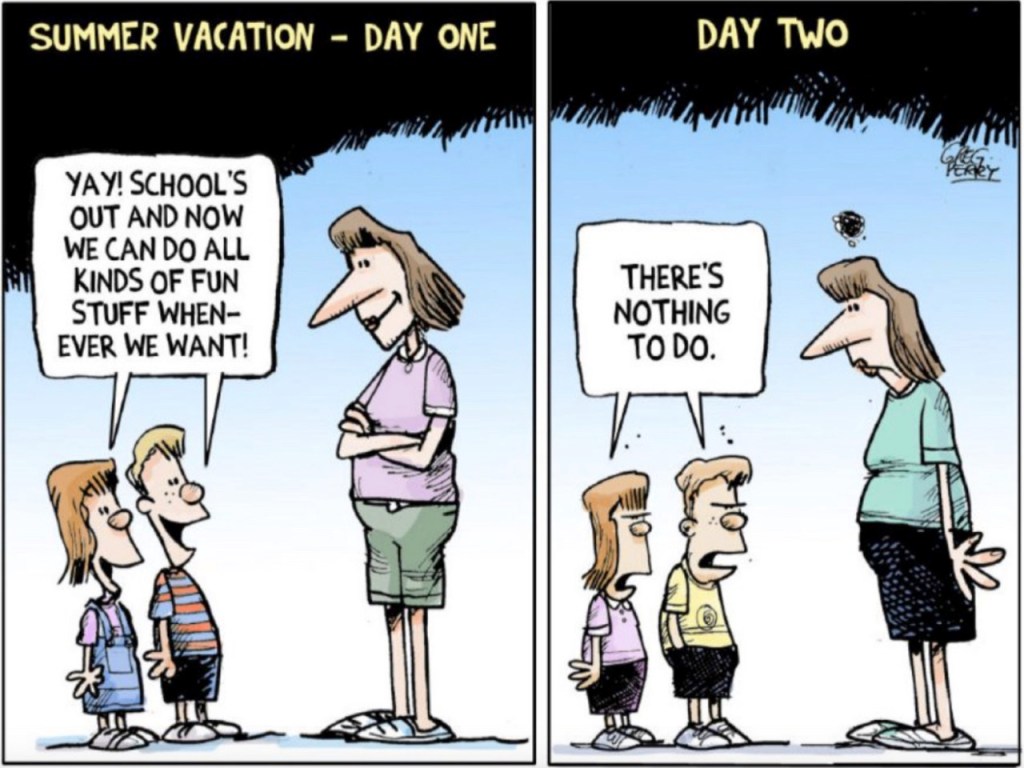
Regardless if a family chooses to follow the above plans for daily and weekly structure of summer learning, or to develop their own ideas, they will accomplish three things by the fall. They will better set up their children to have a successful start to the upcoming new school year. They will enjoy doing fun activities together as a family. And perhaps the most valuable outcome for many moms and dads will be they will end up eliminating their kids from whining the ever-so-popular declaration, “I’m bored!”
 A PRINCIPAL'S PRINCIPLES FOR PARENTING
Leave a comment