
In the wake of the horrific murders of Catholic school children in Minneapolis, parents all throughout the country are understandably concerned that a similar event could happen at their children’s schools.
School parents should look into verifying their school is taking smart measures to better assure their children’s safety from attackers.
Preventative Measures Could Help
A school taking preventative measures could save lives should a deranged or evil person choose to enter a campus or church to do harm. Measures include both hardening the building and training the staff.
One example of hardening the building is to make it more difficult for non-employees to enter the building or classrooms. It is best if a school creates only one access for visitors that automatically funnels them directly to the main office staff who can verify their admission. Correspondingly, all other access doors should be locked. Only teachers and staff should have the keys to be able to unlock doors and let in students (from recess, for example).
One example of training the staff that most schools enact is to teach their teachers how to lockdown their classroom doors and keep the students quiet and out of sight should a “stranger-danger” type of incident occur on campus.
Hiring Armed Security Is an Offensive Measure to Take
But a committed criminal can find a way to breach locked entry points. And a teacher and her couple dozen students are often nothing but sitting ducks if they are trying to hide from a madman with nothing to protect themselves. This is one reason why approximately half of the public schools nationwide acquire local police or other trained security staff to serve as “school resource officers.”
School resource officers – or “SROs – are sworn law-enforcement officers with arrest powers. They work, either full or part time, in a school setting. Nearly all SROs are armed, and most carry other restraints like handcuffs as well. Public tax monies typically pay for SROs’ salaries.
In Catholic and other Christian private schools, SROs rarely exist. One reason is these schools usually don’t have the potential concern for student-on-student or student-on-teacher violent acts that an SRO frequently handles in most public schools. Of course, another reason is parochial and private schools don’t receive public monies and don’t often have the ability to afford hiring armed security themselves.
Catholic and Christian schools throughout the country need to realize that the preventive measures like locked doors can be breached. Thus, they must be prepared with offensive measures. Those offensive measures might best be in the form of having armed security on campus.
Schools Should Be Able to Arm & Train Select Teachers & Staff
There is an option for non-publicly-funded schools to consider besides the expense of hiring plainclothes or uniformed, armed security to be ever-present around school. The more forward-looking schools these days (if allowed by state law) are training current employees – administrators, support staff, and/or teachers – who already legally conceal-carry firearms when off campus, to now conceal-carry on campus.
In these schools, the school budget only needs to cover the training costs of a few hundred dollars per a few or dozen employees who undergo training. Schools in addition may choose to give an added stipend to those employees who volunteer to be trained, conceal-carry employees. This is nowhere near the expense of hiring full-time armed security.
If the school can cover the small price to train some of their legal, conceal-carry employees, and even add small stipends, there can no longer be an excuse for a Catholic/Christian school that they can’t afford armed security. Instead, the only excuse at that point would be that going beyond preventative measures by taking an offensive measure that involves firearms is too disconcerting to many parents and staff.
Training school administrators and/or other school employees has already been the practice of some parochial and private schools in various states for years. Most airline passengers after the 9/11 event feel more secure knowing the pilots are carrying firearms to protect their passengers and crew. Likewise, the school community should find comfort in knowing their school staff are given a similar ability to protect their students should a would-be-killer enter their campus or classroom.
Arming School Staff Should Not Be Considered Scary
Many non-gun owners are afraid of firearms. They need to understand the facts. There are currently 20 states who allow school staff to carry guns on school property to varying degrees – some in private schools and some in public schools. In none of these schools has there ever been a mass shooting. Additionally, parents’ fears of teachers carrying guns and accidentally hurting children or using them as a type of discipline-device have not materialized. Nor has a student ever gotten hold of a teacher’s gun.
Some skeptics might voice a concern that they or their children will discover which teachers or staff members are carrying guns, and this will put like a “scarlet letter” on them. But carrying in a school isn’t much different than carrying in other places. When one goes out in public to the store, movie theater, or restaurant, chances are some strangers (and friends) around you are conceal-carrying without you knowing. That is why it is called “concealed.”
Also important to point out to skeptical or apprehensive opponents of this proposal is that only those who volunteer to conceal-carry on campus undergo this training. These will most likely be those school employees who are already conceal-carry gun owners in their private lives and thus, are comfortable and competent doing so. Allowing staff to conceal-carry on school campus is not meant to be mandated for all. It is very likely that a majority of any school’s employees would want nothing to do with carrying a gun while working at school. This is especially true of preschool and primary grade teachers who might be leery of being armed while closely surrounded by a class load of constant, hug-giving students.
But every school has one or more employees who already conceal-carry in their private lives and would volunteer to add “security” to their job descriptions when at work, if allowed. They would need to commit to be trained at the same level as a public school’s resource officer.
Make Sure Everyone Knows Your School Staff May Be Armed
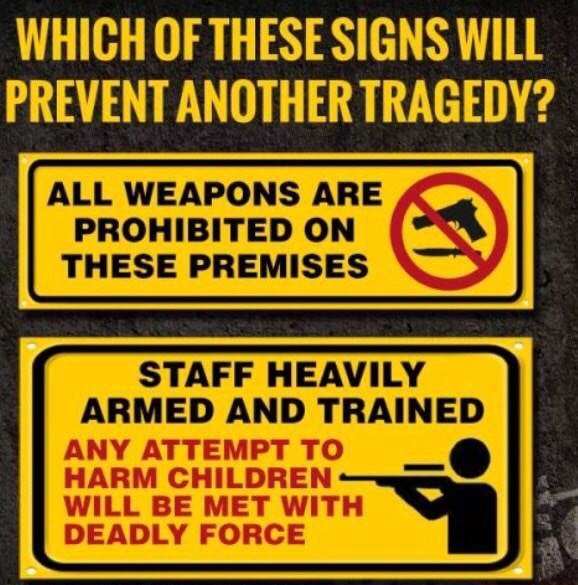
But there is something more a school who allows some of their staff to conceal-carry must do. They must publicize this offensive measure with visibly posted signs at school entrances that read something like these:
- “Staff Members Are Armed and Trained to Use Deadly Force to Protect Our Students”;
- “Be Aware That Some School Employees Are Armed and May Use Whatever Force Is Necessary to Protect Students and Staff”.
All the shooting attacks at schools have occurred in schools that ban teachers from having guns. Signs that read, “This Is a Gun Free Zone” might as well say, “Bad Guys Who Wish To Do Harm Won’t Be Stopped.” A gun free zone is a soft target – a location that is easily accessible, relatively unprotected, and thus vulnerable to crimes such as mass shootings. Research shows that 96% of mass public shootings have occurred in soft target, gun free zones. An evil person who wants to do the most harm will not pick a fortified school with armed personnel to attack when an easier, unarmed school is just blocks away.
The typical training schools have been taking for many years regarding what to do if a murderer comes on campus is somewhat laughable. A common type of training is to have teachers and school staff practicing tobarricade doors, evacuate through windows, and run in a weave pattern to make themselves and their students more challenging targets. Training also often includes countering attackers by throwing classroom objects like staplers at them. Some schools even ask every student each fall to bring a canned-food to keep at school in the event an active shooter enters their classroom, since there wouldn’t be enough staplers to go around.
The truth is whenever a bad guy with a gun has entered a school, they have only been stopped by a good guy with a gun – never with a can of corn. However, the good guys with guns typically don’t stop the shooter until after he has already done a lot of deadly harm. It takes many minutes for a single SRO or a local police department to get to the scene of a school shooting.
But if a dozen school employees are conceal-carrying and naturally scattered around campus, those many minutes are reduced to seconds and the deadly harm casualties are also reduced. One study found that “having either an armed guard or armed staff on school grounds can reduce the number of casualties in a mass shooting situation by up to 70 percent.”
Parents Should Expect School Administration to Consider Strong Offensive Measures
If your child is in a school with weak preventative measures and laughable offensive measures against school attackers, you should speak with your school’s principal about enhancing security. Especially if the only training of employees involves how to hide and run, parents should push for stronger measures such as the hiring of armed staff or the training of select, conceal-carry employees (assuming there are no state laws prohibiting this).
With proper training, armed school faculty have the potential to respond quickly should an emergency arise. As shown in previous school shooting tragedies, it can take several if not dozens of minutes not only for police to arrive on scene but also to devise a plan and learn the layout of the school. Those minutes can cost more lives in an active shooter event. But if the principal, 6th grade teacher, recess supervisor, and custodian are armed and trained, they possibly can more quickly stop the perpetrator and save students’ lives.
 A PRINCIPAL'S PRINCIPLES FOR PARENTING
Leave a comment