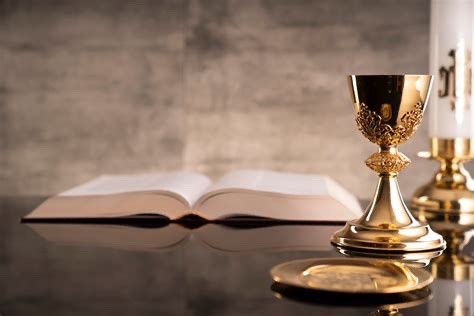
A common name many Protestants and Evangelical Christians call themselves is “Bible Christians.” These same Christians criticize Catholics for not knowing their Bibles, reading their Bibles, and referencing their Bibles enough. However, the truth is Catholics are indeed Bible Christians.
Catholics believe that the Bible is the inspired Word of God. The Church maintains that Scripture, together with Sacred Tradition, are the supreme rule of Faith. God inspires both, and both impart the Word of God.
Pope Paul VI in the document “Dei Verbum” (“The Word of God”) promulgated that the Bible “stands as the support and energy of the Church, the strength of faith for her sons, the food of the soul, the pure and everlasting source of spiritual life” (Dei Verbum 21).
Moreover, the Catholic Church is responsible for the Bible’s original coordination and publication. Catholics compiled, canonized, and preserved the Bible centuries before so-called Protestants and Evangelicals even existed. One could say that when non-Catholic Christians reach for the Bible, they are holding a Catholic book in their hands.
The Catholic Mass Has Its Roots In the Bible
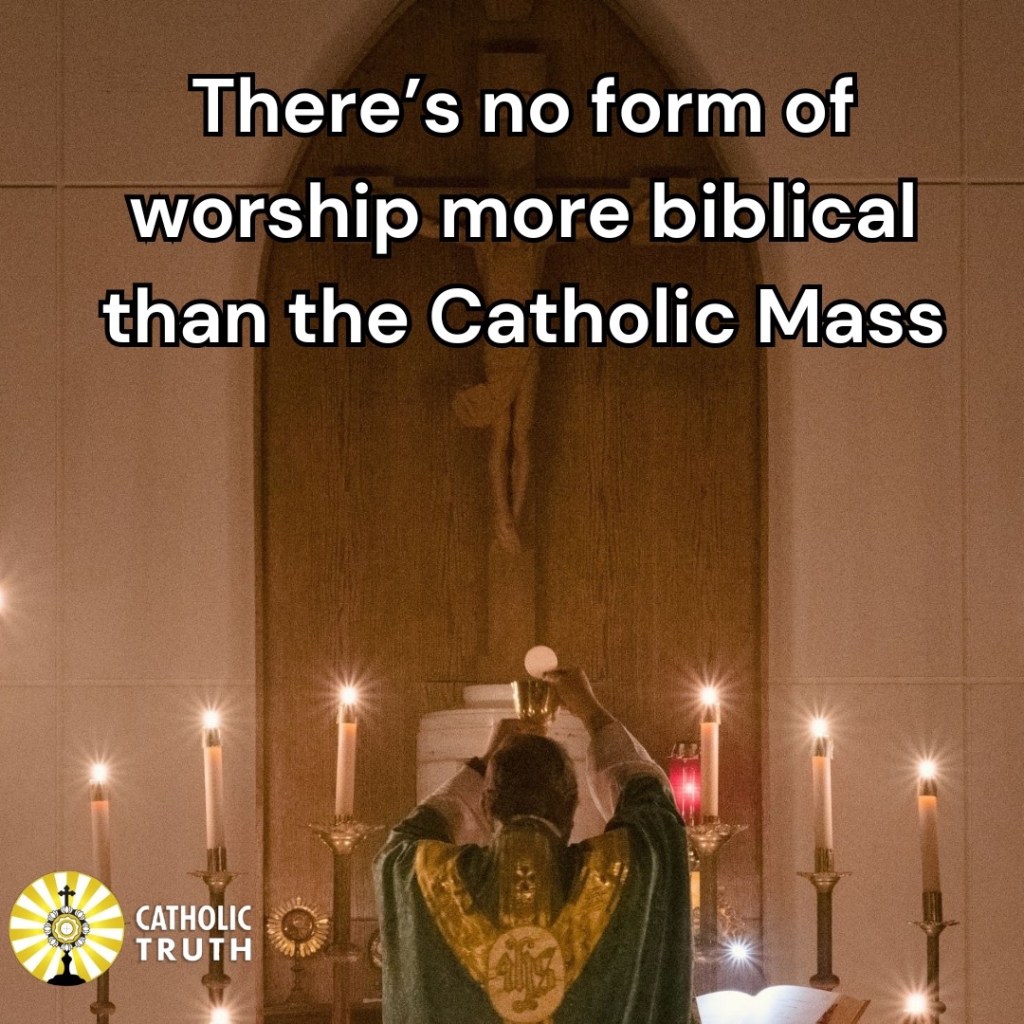
Therefore, Catholics are certainly Bible Christians. Our Faith exhibits our profound connection with Scripture at every Mass. Possibly the best proof of Catholicism’s deep love and highest regard for the Bible is how the Mass’s words and gestures are incorporated with the pages of Sacred Scripture. Catholic worship via the Mass is indeed a biblical style of worship.
Because the Catholic Mass is full of Scripture, Catholics should not let their Protestant/Evangelical brethren get away with saying Catholics don’t read or know the Bible. We live its words at least every Sunday. Some Catholics even engage Scripture daily since, unlike most non-Catholic Christian denominations, Catholic Churches are open for worship 364 days a year. There is a Sacrifice of the Mass offered somewhere in the world every minute of every day (except for Good Friday
The order of the Mass is comprised of the Introductory Rites, the Liturgy of the Word, the Liturgy of the Eucharist, and the Concluding Rites. As the Mass unfolds, a type of biblical blueprint is revealed.
Introductory Rites
The very first words uttered by the priest to begin the Mass – “In the name of the Father, and of the Son, and of the Holy Spirit” – come from the Bible. Christ commands his Apostles in Matthew 28:19, “Go therefore and make disciples of all nations, baptizing them in the name of the Father and of the Son and of the Holy Spirit.”
The priest continues his greeting with, “The grace of the Lord Jesus Christ and the love of God and the fellowship of the Holy Spirit be with you all.” One will read these words verbatim in 2 Corinthians 13:14.
Even if the priest uses the shorter option of the opening greeting, “The Lord be with you,” the congregation’s respond with either greeting is the same, “And with your spirit.” There is a biblical origin of this language. “The Lord be with your spirit” comes directly from 2 Timothy 4:22. Additionally, St. Paul often ends his various letters with, “The grace of our Lord Jesus Christ be with your spirit.” (See Galatians 6:18 for one example.)
The Introductory Rites also include the Confiteor, a prayer of confession of sins to God which follows biblical tradition. In the Old Testament, verbal confession played a part in public worship. For example, Leviticus 5:5 states that a man shall confess the sins he has committed. Later in Nehemiah 9:2, when the Israelites renewed their covenant with Yahweh through the priest Ezra, they “stood and confessed their sins.” Plus, Psalm 51 declares an admittance of sinning and a prayer for cleansing.
Furthermore, Luke 18:13 describes a tax collector who beats his breast while saying, “God, be merciful to me a sinner.” Catholics in the Mass strike their breasts three times while voicing their sinfulness in the Confiteor.
James 5:16 tells the faithful to “confess your sins to one another, and pray for one another.” Some of the Confiteor’s lines are “I confess to…you, my brothers and sisters,
that I have greatly sinned…therefore I ask…you, my brothers and sisters, to pray for me to the Lord our God.”
After the prayer concludes, the priest says, “May almighty God have mercy on us, forgive us our sins, and bring us to everlasting life.” 1 John 1:9 has similar wording.
A biblical blueprint constructs another prayer in the Introductory Rites, the Gloria. The very first line is a direct quote from Luke 2:14 when the angel addresses the shepherds about the Savior’s birth: “Glory to God in the highest, and on earth peace to people of good will.” 43:15). Other language in the Gloria prayer comes from, among others:
- John 3:16 – “only begotten Son”;
- John 1:29 – “Lamb of God”;
- Revelation 3:7 – “the Holy One”.
The Liturgy of the Word
After the Introductory Rites, the Mass moves into the Liturgy of the Word. Obviously, there is a direct connection with Scripture since the First Reading comes from the Old Testament, the Responsorial Psalm is directly reciting the Book of Psalms, the Second Reading is taken from the New Testament Epistles, and the Gospel Reading is a passage from Matthew, Mark, Luke, or John.
The Bible is also connected in more subtle ways. For example, the liturgical practice is to respond to many of these readings with, “Thanks be to God.” Many of Paul’s letters use this same phrase. (See Romans 6, Romans 7, 1 Corinthians 15, 2 Corinthians 2, 2 Corinthians 8, and 2 Corinthians 9 as some examples.)
The Psalms over two dozen times use the word, “Alleluia” (spelled “Hallelujah”),which congregants sing prior to the Gospel reading. In addition, Revelation 19:1-19 repeats this exclamation multiple times. It is describing a heavenly vision of the angels praising God for his work of salvation through Jesus.
One of the final components of the Liturgy of the Word is the congregation’s reciting of the Nicene Creed. Over a dozen different Scripture passages link with these statements of Catholics’ beliefs. Some examples include:
- John 1:2-3 – “through Him all things were made”;
- 1 Corinthians 15:3-7 – “He suffered, died, and was buried; on the third day He rose again in fulfillment of the Scriptures”;
- Ephesians 4:5 and Acts 2:38 – “we acknowledge one baptism for the forgiveness of sins”.
The Liturgy of the Eucharist
The Mass next moves into the Liturgy of the Eucharist, and prayers and practices alluding to the Bible continue in this part as well. The priestly act of washing hands during this part of the Mass models the biblical tradition in Exodus 30:17-21 where the Lord provides Moses with specific instructions for the priests to wash their hands next to the altar of sacrifice.
The Sanctus (aka “Holy, Holy, Holy”) is a prayer that praises the Lord and all Mass-goers recite it immediately prior to the Eucharistic Prayer. Its words are taken from Isaiah 6:3 – “Holy, holy, holy is the Lord of hosts; the whole earth is full of his glory” – and from Revelation 4:8 – “Holy, holy, holy is the Lord God Almighty!” In addition, it calls to mind Jesus’ entry into Jerusalem in both Mark 11:9-10 and Matthew 21:9 as the crowds shouted, “Blessed is He who comes in the name of the Lord! Hosanna in the highest!”
Of course, an essential section of the Mass is the Eucharistic Prayer itself. The Last Supper account of Jesus taking bread and wine, blessing them, and giving them to His disciples is associated with this part of the Mass. During this consecration of the bread and wine to become the Body and Blood of Christ, many of the priest’s words come directly from the Gospel accounts of Jesus speaking the words, “This is my body which is given for you; do this in remembrance of me” and “This is my blood of the covenant, which is poured out for many…”(Found in Matthew 26:26-28, Mark 14:22-24, Luke 22:19-20.)
The Eucharistic Prayer I (“the Canon”) even mentions the parallel time of when the priest-king Melchizedek offers the bread and wine in Genesis 14:18-20 and referenced in Hebrews 5:10.
The Liturgy of the Eucharist continues with the recitation of the Lord’s Prayer, found in Matthew 6:9-13. The Sign of Peace soon follows. It is a biblical principle to extend a peace offering before we approach the altar. In Matthew 5:21-24, we hear these words from Jesus: “If you bring your gift to the altar, and there recall that your brother or sister has anything against you, leave your gift there at the altar, go first and be reconciled with your brother or sister, and then come and offer your gift.” Not to mention that “Peace be with you” was a greeting from Jesus in John 20:19.
Also taking place just before Communion are the act and words of the priest raising the large host he is about to consume for all to see. He loudly proclaims, “Behold the Lamb of God who takes away the sins of the world!” The title, Lamb of God, relates back to Exodus 12. At the original Passover, the blood of a slaughtered lamb protected the Faithful. Genesis 22 likewise portrays this image of the lamb with Abraham sacrificing his son. Isaiah 53 and Jeremiah 11 later describe something similar as prophets explain the coming Messiah as being “like a lamb led to the slaughter.”
The Gospels continue with this, specifically identifying Jesus as “the lamb of God” in the sense of both the sacrificial offering for sin and the suffering servant. In John 1:29, John the Baptizer was proclaiming the coming of the Messiah at the River Jordan and saw Jesus approaching. He shouted, “Behold, the Lamb of God, who takes away the sin of the world!”
Immediately after the priest says his “Behold the Lamb of God…” lines, Mass-goers respond with their line that acknowledges one’s need for and belief in our Lord by saying, “Lord, I am not worthy that you should enter under my roof, but only say the word and my soul shall be healed.” This response is almost verbatim from Matthew 8:5-13 when a centurion approached Jesus and pleaded with Him to heal his paralyzed servant.
Concluding Rites
As Mass comes to an end, the priest gives a final blessing on the congregation which sounds very much likehow the Lord told Moses to bless the people of Israel. In Numbers 6:22-26, God’s words of blessing were, “The Lord bless you and keep you. The Lord make his face to shine upon you, and be gracious to you. The Lord lift up his countenance upon you, and give you peace.”
The final words at Mass are a directive to the faithful to “Go in peace” and then often followed by, “…to love and serve the Lord” or “…glorifying the Lord by your life.” This is connected scripturally to Matthew 28:19-20 when Jesus gives His disciples a similar instruction. Jesus also told a sinful woman in Luke 7:50 to “go in peace” after he forgave her of her sins.
The Word of God Is Heard Throughout the Mass
The Catholic Mass is a form of worship that is truly pleasing to our Lord. It was created using a type of blueprint tightly linked with His Sacred Word. One could say that the Bible and the Mass are inseparable. Together they direct Catholics toward their ultimate goal of reaching Heaven.
Although many non-Catholic, Christian brothers and sisters scoff at Catholics supposedly not knowing or using their Bibles, Catholics know the truth. It is evident that the majority of the Mass has its roots in the Bible. When we participate in the Sacrifice of the Mass we appreciate the deep connection between the Scriptures and Tradition. If we listen closely during Mass, we hear the very Word of God.
 A PRINCIPAL'S PRINCIPLES FOR PARENTING
In spite of the presence of much Scripture in our liturgy, the Protestant criticism is not a lie. Most Catholics remain unfamiliar with most of the Bible. Pretending otherwise does us no good, and only perpetuates the near-universal ignorance of Scripture among Catholics at all levels. On an almost daily basis I find myself shaking my head in sadness as I watch our bishops trying to justify their policies on the basis of Scriptural passages that they haven’t studied and don’t understand. This has to end.
LikeLiked by 1 person
I have to agree, but with qualifications.
LikeLike