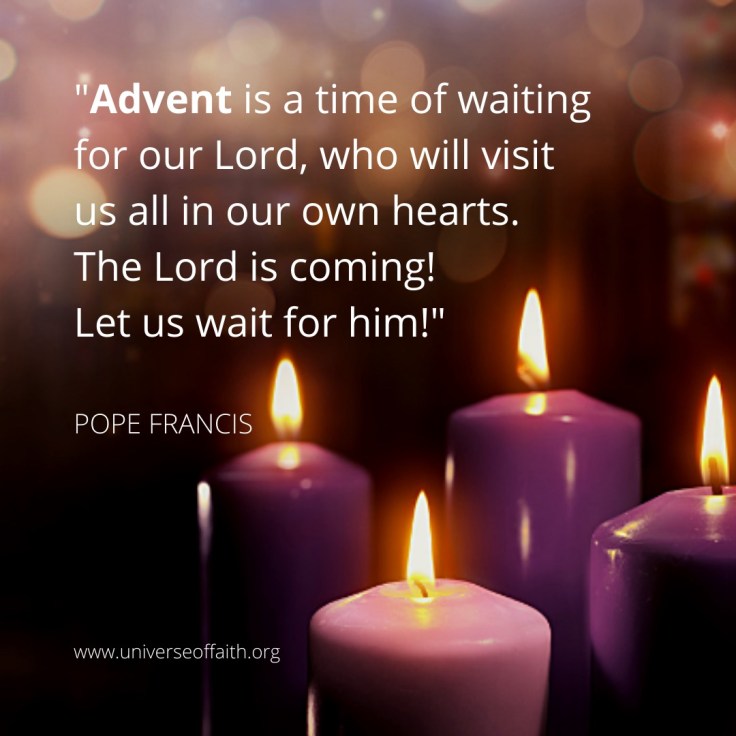
November will soon be ending and December beginning. To most people that erroneously means it is Christmas season. Catholic families trying to live counter-culturally know that this approaching time of year is actually Advent season.
It is difficult for parents and children alike to resist the tendency to think of nothing but Christmas starting no later than every December 1, as all the stores, ads, and TV shows constantly hammer us with all things Christmasy. It also makes it challenging to keep the focus off Christmas and on Advent in the days and weeks after Thanksgiving when all the neighborhood houses are aglow in twinkling lights and have inflatable Santas staked on their lawns. And there is also that radio station which plays nothing but Christmas music beginning on the final days of November.
Popular culture’s powerful influence of commercialism has gotten most to believe that Christmas begins somewhere between the day after Halloween and the day after Thanksgiving. In the same vein, Christmas supposedly ends on December 26, to coincide with the annual event of returning all those unwanted presents to the stores.
Isn’t it interesting that most families would never go trick-or-treating in September or eat their Thanksgiving turkey the first Thursday in November? But they would gladly start celebrating Christmas many weeks prior to its actual date.
Liturgical Calendars vs. Secular Calendars
Catholic families understandably follow the world’s secular calendar for most things. But they should follow the Church’s liturgical year when it comes to religious-based events. The liturgical calendar has the Christmas season beginning late Christmas Eve and extending into the Baptism of the Lord. (Depending on the year, country, and form of Mass, this feast day could be anywhere from January 7 to 13).
It is fine for Catholic parents of young children to talk with their kids throughout December about Christmas, Santa, and wish-lists. But it is necessary that in these conservations there are explanations about Christian “companion words.” The most prominent examples would be to make sure to teach and talk about Advent (a “companion word” to Christmas), about Jesus (a “companion” to Santa), and about giving presents (a “companion” to getting presents or creating wish-lists.)
Parents may not be able to eliminate the non-Christian terms of the secular Christmas season. And they probably do not want to. After all, words and events like Santa and creating wish-lists provide enjoyment and memories for kids. But mom and dad can make sure the Christian terms of the season get their rightful place and plenty of “face time.”
Specifically regarding two of the companion words heard this time of year – Jesus and Santa – parents should employ the story of a saint. Christianity is incorporated in the story of Santa when families annually celebrate the Feast of St. Nicholas each December 6th. Children need to learn about Santa Claus actually originating from St. Nicholas, a kind and giving bishop. Parents can demonstrate this kindness by implementing the tradition of leaving shoes outside bedroom or house doors and then having “St. Nick” surprisingly leave treats in the shoes. In doing so, parents are not destroying the fun of Santa but are keeping in the Christian aspect.
Catholic Families Should Act Counter-Culturally
Regrettably, the secular Christmas season has supplanted Advent in modern times. Counter-cultural families have to put in some effort, but they definitely can keep the Advent season in its rightful place at the forefront during the four-week period between Thanksgiving and Christmas Eve. What moms and dads must do is return to the tradition of Advent being the time they and their kids are to prepare and anticipate. This will make Christmas Eve and Christmas Day more pined for and thus, more joyous.
One simple anticipation-activity Catholic families annually do to help keep the Christmas season from starting too soon is to daily light the candles on their Advent wreaths starting on the first Sunday of Advent. Best done as an activity at the dinner table, a different member of the family can take a turn each night lighting the candle or candles throughout the four weeks. There is great anticipation in seeing one week’s candle grow shorter and then the next week’s candle join the lighting.
As this ritual continues every day throughout the four Advent weeks, families can choose to recite something as simple as, “Come, Lord Jesus, Come!” as each candle is lit, sing a verse of “O Come, O Come, Emmanuel,” or find unique Advent prayers to pray aloud.
Of course, every Catholic family should have an Advent calendar. Similar to lighting an Advent candle each day, there should be a daily opening of a calendar door. The best calendars contain behind each door a scripture reference or prayer. Opening one door and reading its accompanying words each day is a simple, tangible way to show children that we spend Advent preparing for Jesus’ coming.
Having a nativity set/scene/creche is also a must during Advent. But the nativity scene must be set up the “proper” way. This means, if the scene is in the living room for example, that the wise men are hanging over at the other side of the room on the window sill, the shepherds are two tables away, and the baby Jesus is still in a box in a drawer. In this way, the children can be tasked with helping the characters travel closer to the crèche throughout the month. Talk about happily anticipating Christmas’s arrival! Do not let the kids add the baby Jesus until December 24 or 25. And the wise men finally make their appearance in January on Epiphany.
One more anticipatory activity for families with young children is to set up a pretend (small-scale) manger in a main room in the house. Next to it, have a container holding pieces of straw or something to replicate this such as strings of yarn or cotton balls. Then, every time someone in the family does a random act of kindness throughout the four weeks of Advent, he or she gets to fill the manger with a piece of straw (or string of yarn or cotton ball). The parents and kids get to daily witness the love that is building up the manger. Just before Christmas Eve it will be ready to comfortably receive the baby Jesus, bursting full of the what the family’s love for each other provided.
“A” Comes Before “C”
Advent, taking place from late November to Christmas Eve, is the real season we are in during much of December. The Christmas season has to wait a few weeks. Catholic parents must readjust their family’s priorities and teach their children how to best live their faith.
Catholic families would do well to live the liturgical year more than follow the world’s timetable. The Church gives us Advent as an opportunity to kick-off the liturgical year by spiritual preparing for and eagerly anticipating the birth of Our Savior Jesus Christ.

 A PRINCIPAL'S PRINCIPLES FOR PARENTING
Leave a comment