
The four weeks of Advent are set apart by the Church as a season of special prayer mixed with joyful expectation. Advent is also a time for penance and it marks the beginning of the Church’s liturgical year. This would actually be a perfect time to begin a special, pious practice – weekly fasting.
Historically, Catholics have always been called to fast as an act of penance as well as an act of self-denial. By fasting, we attempt to imitate the example of the Son of God Himself, who went into the desert to fast and pray for 40 days and nights. Friday has been the day most associated with fasting since it was a Friday in 33 A.D. when Jesus gave the ultimate sacrifice.
Current Church Regulations on Fasting
The Church typically only highlights the topic of fasting during the season of Lent, not Advent. The current Catholic regulation regarding fasting is for those ages 18 to 59 to fast on just two days – Ash Wednesday, the start of Lent, and Good Friday, the end of Lent. Fasting is presently defined in Catholic norms as eating “one full meal, as well as two smaller meals that together are not equal to a full meal.” In addition, Catholics ages 14 and older are compelled to abstain from eating meat on Ash Wednesday and every Friday during Lent.
At the beginning of the Lenten Season each winter, the Church makes this annual notice about the fasting and abstaining regulations. Regrettably, it also serves as a reminder to older Catholics just how “soft” the Church has become.
It is a measly expectation to expect fasting on only two days as well as to define fasting as eating only one full meal and two smaller meals. To put it another way, Catholics are being asked to “sacrifice” by reducing the number of bacon slices they eat for breakfast from three to one, by cutting the peanut butter and jelly sandwich in half at lunchtime, and then by enjoying a full dinner.
The Catholic Church has always taught that fasting is a powerful and necessary form of prayer and penance. But then in the last half-century, they relaxed the rules on fasting so much that they have become weak to the point of insignificant.
Asceticism is the practice of the denial of physical desires in order to attain a spiritual goal. This practice should be more significant in the 21st century than ever before due to how modern man is living in such a materialistic and “easy” world. Past generations had to forage and hunt for food and pull up water from a well. Today we simply go to a fast food drive-thru, order food to be delivered to our front door, and pop dinner in the microwave to be eaten five minutes later.
Start Off the New Church Year By Fasting as a Type of Sacrifice
Because too many present-day Catholics do not seem to be partaking in the genuine meaning of fasting and asceticism, it would be wonderful to bring back the original relationship of fasting with sacrifice. And since Advent is the start of the Church year, what better season is there to start than right now in December?
When engaging in a form of self-denial like fasting, a Catholic is getting closer to God and growing more spiritually. It is similar to other pious actions such as praying the Rosary, attending daily Mass, and participating in Eucharistic Adoration.
Fasting takes one’s mind off of one’s own needs, thus providing the opportunity to focus on feeding one’s soul. Most of a person’s bad habits are formed from uncontrolled desires. So if a person can be successful in giving up food for a day – or even a partial day – his or her self-control is strengthened. This in turn could help in the future with other desires that need to be controlled – from limiting gossiping, to stopping cursing, to refraining from viewing pornography.
God loves to see us, His sons and daughters, fast. His only begotten Son not only fasted Himself, but insists that we fast as well. Notice when speaking to His disciples, Jesus didn’t say, “If you fast…” He said (twice), “When you fast…” – inferring an obvious expectation that we are to fast.
“When you fast, do not look gloomy like the hypocrites…But when you fast, anoint your head and wash your face, so that you may not appear to others to be fasting, except to your Father who is hidden. And your Father who sees what is hidden will repay you.” (Matthew 6:16-18)
Fasting As a Weapon
We are in severe spiritual warfare nowadays with Satan and his demons attempting to lead people away from God and into sin. When large bands of society cheer the assassination of a Christian political leader, believe women have the right to murder their unborn babies, and think nothing wrong about so-called transgender men in drag reading sexual-content stories to preschoolers, we are at war with evil.
This battle is not like the physical ones with bodily fighting between troops, but more of a mental, emotional, and spiritual struggle. So the weapons to bring to combat are not tanks and rifles, but prayer, Scripture, Sacraments, and fasting.
- Daily prayer helps us strengthen our relationship with God and shield us against spiritual attacks;
- Regular participation in the Sacraments of Confession and Eucharist infuse our souls with sanctifying grace;
- Regular reading and meditating on Scripture deepens our understanding of God’s Word and provides spiritual insights.
Which brings us to the fourth weapon – fasting.
Fasting is an effective spiritual warfare weapon as it eliminates distractions, subdues fleshly desires, resists temptations, and maintains a close relationship with our Lord.
St. Francis de Sales said this about the spiritual and virtuous effects of fasting:
“Besides the ordinary effect of fasting in raising the mind, subduing the flesh, confirming goodness, and obtaining a heavenly reward, it is also a great matter to be able to control greediness, and to keep the sensual appetites in the whole body subject to the law of the Spirit. And although we may be able to do but little, the enemy (Satan) nevertheless stands more in awe of those whose he knows can fast.”
Today’s Catholics Are Confused and/or Slacking
For the most part, modern day Catholics today do not partake in the holy practice of fasting and abstaining at a level comparable with past generations who followed more stringent rules. In addition, not many Catholics understand the current penance regulation for all Fridays of the year – not just in Lent. We are still expected to refrain from eating meat all 52 Fridays of the year – not just the eight Fridays during Lent.
Confusion regarding this is due to Pope Paul VI softening the no-meat-on-all-Fridays requirement in the 1960s by adding this statement to Canon law: “The conference of bishops can…substitute other forms of penance…for abstinence and fast.”
Soon after, the American bishops embraced this new allowance and declared Catholics in the U.S. who do not want to eat on Fridays outside of the Lenten season can do so without fear of sinning. They added the condition that one needs to substitute some other act of penance or self-denial. But unfortunately, too many Catholics stopped listening after hearing only the first words that one can now eat meat on Fridays.
By removing the strict requirement, hindsight reveals that the pope and bishops ended up giving the faithful too much freedom. The majority of Catholics have forgotten that we are still supposed to offer up a form of penance every Friday with the traditional way to do this being to abstain from eating meat. But if one chooses a different type of penance, that is fine…just make sure you do indeed practice a meaningful form of asceticism or mortification.
Knowing the world isn’t getting any better, and agreeing that we need penance now more than ever, prayer and works of mortification can help turns things around. The call to fasting is a constant from saints and popes throughout history and in the Scriptures. Our Lord Jesus especially called us to conform our lives to His cross.
Fasting Can Be Your Substitute of a Friday Penance
So a suggestion for Catholics who have ignorantly been eating meat all other Fridays of the year outside of Lent is they should seriously consider stepping up the intensity of their sacrificing. Instead of returning to the simple practice of giving up meat every Friday year round, they could choose to fast every single Friday and not merely on the two days of Lent. Fasting can be their act of weekly self-denial that the Church expects.
Unless one has a medical condition that prohibits it or a highly laboring job that requires excessive calories, it would be beneficial for Catholic adults to consider elevating the level of suffering so that it is felt more intensely than the current, wimpish rules.
Fasting can be undertaken differently for different people. If a person can power through a full 24-hour period of nothing but water, God bless him or her! But it can also be benevolent to fast from solid food and only drink low or no-caloric fluids for a partial day.
An example of a 16-hour fast would be to stop eating after dessert Thursday night at 8pm and resume eating Friday at lunch at 12pm. Another example would be a 21-hour fast that begins at 8pm Thursday and ends with dinner at 5pm Friday.
These types of fasting schedules were referred to as a “black fast” in early Church history. Nowadays this type of fasting has become a popular health practice called “intermittent fasting,” which has been shown to provide physical benefits such as weight loss, stabilization of insulin levels, and reduction of inflammation.
Of course, historically and biblically speaking, fasting never came about so to help one drop some pounds and improve the body. Denying oneself food on a repeatedly continuing basis has been undertaken for thousands of years because it is a powerful penitential practice that bestows great benefits upon the soul.
Be Inspired to Fast
Here is one more suggestion that might help you remain faithful to fasting. Set your smart phone reminder-app to pop up motivational reminders throughout your fasting day. They can remind you every few hours about why you are doing this, inspiring you to keep suffering through the hunger pains. Here are some suggested messages to add as each reminder alarm sounds off:
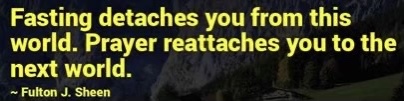
- “Fasting cleanses the soul, raises the mind, subjects one’s flesh to the spirit, renders the heart contrite and humble, scatters the clouds of concupiscence, quenches the fire of lust, and kindles the true light of chastity.” (St. Augustine)
- “Fasting gives birth to prophets and strengthens the powerful; fasting makes lawgivers wise. Fasting is a good safeguard for the soul, a steadfast companion for the body, a weapon for the valiant, and a gymnasium for athletes. Fasting repels temptations, anoints unto piety; it is the comrade of watchfulness and the artificer of chastity.” (St. Basil the Great)
- “Fasting represents an important ascetically practice, a spiritual arm to do battle against every possible disordered attachment to ourselves. Freely chosen detachment from the pleasure of good and other material goods helps the disciple of Christ to control the appetites of nature, weakened by original sin, whose negative effects impact the entire human person.” (Pope Benedict XVI)
Don’t underestimate the value of making a weekly sacrifice by fasting from food for a day or partial day every Friday all year long. Duty and obedience are often what sanctify us and strengthen our souls. Simply keeping to the Catholic Church’s minimal fasting and abstaining regulations might not bring about an impactful spiritual benefit as compared to increasing the intensity and commitment by genuine, weekly fasting.
Think about making Advent the time you begin this yearlong, perpetual practice on all 52 Fridays of denying yourself all food for an extended amount of time. With Jesus, the Saints, and even past generations of Catholics as our models, we should strive to make meaningful sacrifices to God, turning these sufferings into offerings to our Lord.
 A PRINCIPAL'S PRINCIPLES FOR PARENTING
Leave a comment