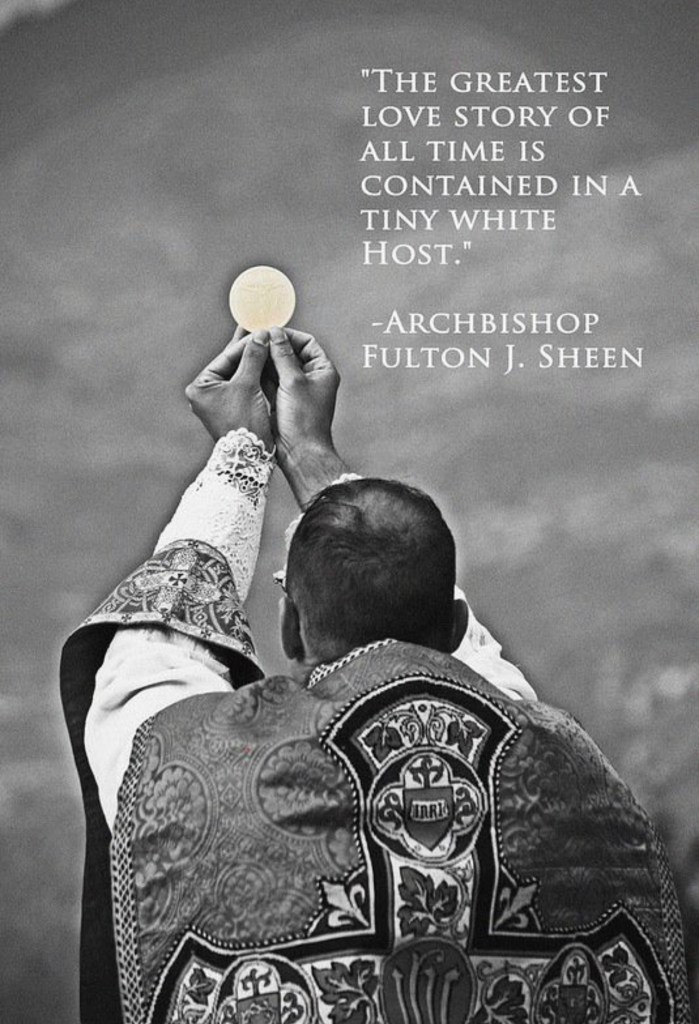
The Catholic Church designates a special honor to each month of the year. For example, Saint Joseph is honored each March and the Sacred Heart of Jesus is especially recognized each June. For this current month of April, the Church’s specific devotion is to the Holy Eucharist.
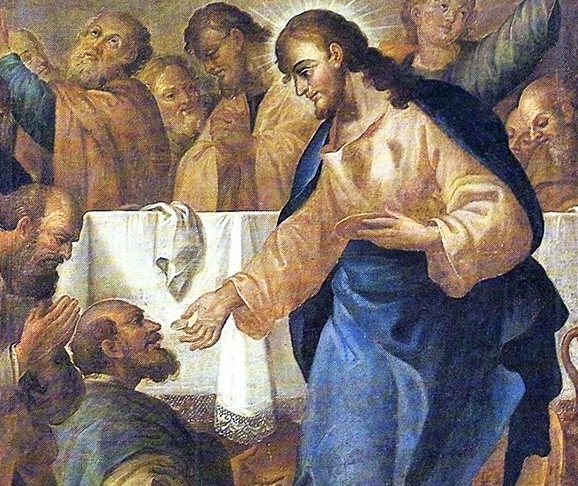
April was chosen because historians believe it is most likely the month of Christ’s Passion, which included the first Holy Thursday when Christ instituted the Holy Eucharist at the Last Supper.
The hope is April will be a special month for Catholics to begin to strengthen their understanding of and devotion to the truth that the consecrated Bread and Wine at Mass is Jesus Himself.
Transubstantiation
The Real Presence doctrine of “transubstantiation” means the substance or qualities of bread and wine are replaced by the gloried body and blood of Jesus Christ. This occurs each time the priest at Mass, obeying Christ, speaks the words of consecration:
“Take this, all of you, and eat of it, for this is my Body, which will be given up for you…Take this, all of you, and drink from it, for this is the chalice of my Blood…”
At this time, the “breadness” and “wineness” at Communion are changed into the living Jesus. Transubstantiation describes how the color, texture, and taste of the bread and wine remain, but they lose their substance. Transubstantiation not only means the Real Presence of Christ. It also means the real absence of bread and wine.
Historical Evidence
Belief in the Real Presence began in the year 33AD. Jesus told His followers about His body being in the bread, “My flesh is food indeed, and my blood is drink indeed.” Immediately, Peter replied, “You have the words of eternal life; and we have believed!” (John 6:25-69).
Evidence of this belief continued with the early Church Fathers. In the 4th Century, St. Cyril told Christians to be “fully assured that the seeming bread is not bread, though sensible to taste, but the Body of Christ; and that the seeming wine is not wine, though the taste will have it so, but the Blood of Christ.” (Catechetical Lecture XXII on the Mysteries on the Body and Blood of Christ).
The Council of Trent almost 500 years ago affirmed the Catholic doctrine of the Real Presence of Christ in the Eucharist:
“”Because Christ our Redeemer said that it was truly his body that he was offering under the species of bread, it has always been the conviction of the Church of God, and this holy Council now declares again, that by the consecration of the bread and wine there takes place a change of the whole substance of the bread into the substance of the body of Christ our Lord and of the whole substance of the wine into the substance of his blood” (Catechism of the Catholic Church, 1376).
Pope John Paul II, in his 2003 encyclical letter, Ecclesia De Eucharistia, proclaimed:
“For the most holy Eucharist contains the Church’s entire spiritual wealth: Christ himself, our passover and living bread. Through His own flesh, now made living and life-giving by the Holy Spirit, He offers life to men.”
Non-Catholics Do Not Believe
While almost all other Christian religions believe that the bread and wine of the Eucharist are just symbols, Catholicism believes in transubstantiation. The Church proclaims that the bread and wine becomes Jesus’s body and blood in order to nourish us.
The Church may proclaim, but sadly too many people who identify as Catholic do not. A 2019 Pew study stated that only 31% of U.S. Catholics believe that during Mass the bread and wine actually become the body and blood of Jesus. Another study in 2023 by the Center for Applied Research in the Apostolate used different methodology and came up with a slightly higher – but still embarrassing – number of 38% of Catholics not believing in and/or understanding what the Church teaches about the Real Presence.
When a Catholic receives Holy Communion, the priest presents the sacred Host and says, “The Body of Christ,” and the person responds, “Amen.” That word amen translates to mean, “I give you my solemn agreement.” By saying, “Amen,” the recipient is affirming before God a belief that what is being received is, in fact, the Body of Christ hidden under the appearances of bread.
If a Catholic is not sure of a belief in the True Presence, he or she must refrain from Communion at Mass. In its place, the “doubting Thomas” must pray to eventually become a believer in transubstantiation. It actually is a sin to receive “The Body of Christ” at Mass but not truly believe it is “The Body of Christ.”
It was St. Paul who chastised, “Whoever, therefore, eats the bread or drinks the cup of the Lord in an unworthy manner will be guilty of profaning the body and blood of the Lord” (1 Corinthians 11:27).
Paul’s warning would seem cruel if indeed what a person is consuming in the Eucharist is simply a piece of bread. His cautious counsel only makes sense if Jesus is really present.
It Is Not Symbolic or Metaphorical
Most non-Catholics – and regrettably, too many self-identifying Catholics – do not believe Jesus really meant to eat His flesh and drink His blood when he kept emphasizing, “For my flesh is food indeed, and my blood is drink indeed” (John 6:53-56).
But the fact is, both the disciples and Christ’s Jewish audience understood what He was saying was literal, not metaphorical. Many responded, “How can this man give us his flesh to eat?” and “This is a hard saying; who can listen to it?” (John 6:52;60).
If these people were mistaken in taking Jesus literally, Jesus would have explained the figurative expression He really was trying to illustrate so to correct their misunderstanding. But He did not do that. In fact, Jesus doubled down. He stated nine different times in John 6 that He is the bread and people are to eat His body.
In other Gospel accounts (such as John 4:31-34, Matthew 16:5-12, Luke 8:9-15), after using analogies and parables, Jesus would then go back to explain to His disciples the point he was trying to get across.
But in John 6, He doesn’t give any sort of explanation to ease the difficulty His disciples are having with the teaching of the Real Presence. He allowed many to walk away in disgust and disbelief because what He was proclaiming was literal and could not be explained away as a figure of speech.
He also repeats the corroboration, “Amen, amen (Truly, truly) I say to you!” three times in this chapter. Our Lord only used that phrase in the Gospels when He was resolutely making a point.
As further example, the time Jesus told His disciples, “I am the vine” (John 15:1-11), no one believed it was literal like they did when he said, “Eat my flesh.” In the former, no disciple or Jewish audience member shockingly replied, “How can this man claim to be a plant?!” They were not shocked but recognized Christ was speaking metaphorically.
Their lack of a stunned or offended response to the times Jesus spoke figuratively stood in stark contrast to their response to what He said about his body and blood in John 6.
Start This April
Knowing how significant and miraculous the Eucharist is, Catholics might want to consider partaking in several of the following suggested acts, not just in April, but all year-long:
- Attend Mass not just Sunday, but if possible weekday Masses as well, so you may receive Communion more than once a week.
- On days you cannot receive Communion, express a heartfelt desire to receive Jesus in the Eucharist. The most common way is to recite a “Spiritual Communion.” Increase the minimally required 1-hour time to fast from food and drink prior to receiving Jesus in the Blessed Sacrament to at least 3-hours.
- Increase the minimally required 1-hour time to fast from food and drink prior to receiving Jesus in the Blessed Sacrament to at least 3-hours.
- Since being in the state of grace is a necessary condition if one is to receive Communion, increase your participation in the Sacrament of Penance by going to Confession at least once a month.
- Read about the “Body and Blood of Christ” in the Bible. Read Chapter 6 from Saint John’s Gospel as well as the Last Supper accounts in the other three Holy Gospels.
- Attend your parish’s Eucharistic Adoration occasions. During these times, sit or kneel in front of the exposed Blessed Sacrament, be aware of the presence of the Lord, contemplate how much He loves you, and profess your desire to love Him and be with Him forever.
- Read “The Sacrament of the Eucharist” section in the Catechism of the Catholic Church.
- Increase the time you spend in prayer prior to receiving Holy Communion and in thanksgiving immediately after receiving. Some suggested prayers can be found here.
Receive the Host Most Reverently
Finally, if a Catholic does not already receive Communion on the tongue and kneeling, he or she might want to consider moving to this most reverent gesture. The preferred manner throughout most of Church history is to receive kneeling and on the tongue. It has only been since the 1970s that Catholics moved to receiving standing and in the hand.
When the Church moved to allowing reception of Jesus in the hand, it was always meant to be done as carefully as possible. One should be literally moving the mouth down to the palm of the hand on which the priest places the host and eating directly from this hand. The Body of Christ was never meant to be picked up with fingers as this will more likely cause small particles to fall to the ground. These particles are Jesus’s body!
Furthermore, throughout Church history it was always stressed that one should receive Holy Communion upon the tongue because it shows that the Eucharist is no common food but our very Lord and God. The most recent Catholic catechism, Credo: Compendium of the Catholic Faith, states:
“We believe, adore, and submit to the ineffable divine Majesty hidden in the little host, allowing ourselves to be fed by the good God like little children, since this supernatural food is His alone to give, and we cannot earn it or be ‘equal’ to it.”
The call is not only to return to the once universal practice of receiving the Blessed Sacrament on the tongue. Just as obvious a sign of adoration and reverence is to kneel when receiving. We recall how the Magi, after arriving at the infant Jesus’s manger, did not stand around while in the company of the newborn King, but “they fell down and worshiped him.” So too, should we the faithful when in the company of our King and about to receive Him in Communion.
It does not make sense that your average Catholic does all this kneeling before Mass when in silent prayer, during the priest’s act of consecration, and both just before and just after receiving Communion, yet this same Catholic does not kneel at the exact moment of actual, physical union with Christ.
Kneeling is the most solemn way for a Catholic to receive Jesus in the Eucharist because it expresses humility of oneself and deference to one’s Savior – just as being fed directly on the tongue expresses humility and submissiveness. Most importantly, kneeling embodies one’s profound encounter with the living Christ as the recipient believes, “Jesus is truly present, I am going to literally consume Him, and His life will now mix with mine!”
Christ Nourishes Our Souls
Nothing creates more intimacy with Jesus than literally receiving Him in the Eucharist, where He is truly present and living. When you receive Holy Communion, you make an act of faith. Your consuming of His body is proof of your belief that Jesus is truly present in the Blessed Sacrament.
One of the most wonderful things about being Catholic is the ability to receive the gift of the Eucharist. It is amazing to think that God is hidden under the appearance of the Host and is present in all the tabernacles of the world.
Our Lord becomes present to us at every Mass, asks us to consume him, and promises us eternal life when we do. As Archbishop (soon to be Saint) Fulton Sheen once said, “The greatest love story of all time is contained in a tiny white host!”
 A PRINCIPAL'S PRINCIPLES FOR PARENTING
Leave a comment