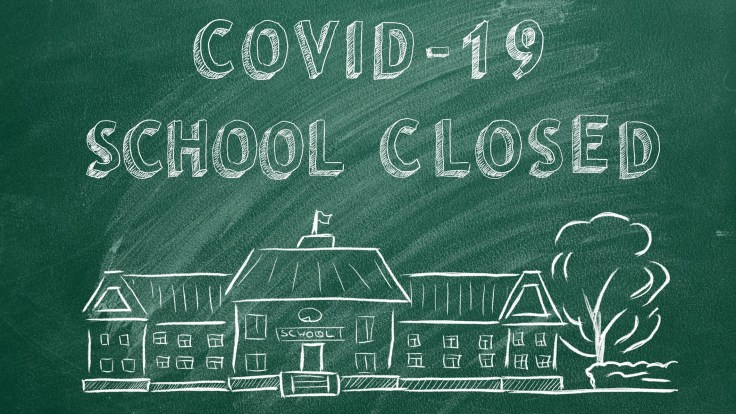
The coronavirus pandemic that began in 2020 with the national closing of schools was the catalyst that ended my career in Catholic education. At that time, I was approaching my 34th year as the principal of St. Louise Catholic School in Bellevue, Washington, and my 40th year total as an educator for the Seattle Archdiocese. For many years prior, I had been fighting against the secular culture’s harm to children and education. But the over-reaction and incorrect response to covid-19 by a great number of Catholics in authority now brought another opponent to my fight for what’s best for students. I now had to battle Church clerical and lay leadership.
The “15 days to slow the spread” message in March of 2020, which included shutting down all schools, was accepted by the majority of Americans as a safe and sane response to a novel virus. I certainly understood my school community’s uncertainty and uneasiness at the time because this was an unknown virus and some St. Louise School students’ grandparents or great-grandparents became seriously ill with covid. I particularly don’t blame anyone during that spring of 2020 for being scared because the government and media drowned us with their 24/7 fearmongering and alarmism. By intermixing their propaganda and sensationalism with the truthful realities of a virus that was predominantly hitting the elderly, they transformed a pandemic into a “panic-demic.”
I was one of the rare school principals in the Puget Sound-area who was resistant to go along with closing schools because I recognized the scaremongering. I immediately noticed how decisions from government officials and agencies weren’t always being based on science or health reasons but on political and economic rationales. For example, here are some of the decisions that were made in 2020 that in the best light could be said they were made due to uncertainty, but in the worse light were due to lies and hypocrisy:
Elementary and high schools had to shut down, but preschools and daycares could keep operating;
Churches were told to close, but pot shops were allowed to stay open;
Parks and trails were shut down, even though being outside and getting vitamin D through the sun are two fundamental ways to stay healthy during a coronavirus;
At first, masks were said to not offer protection (which is the correct response), but then later masks were mandated, even though the science never changed that the material used in a standard face mask cannot block the microscopic microbes of a virus;
Governors, mayors, and other politicians were wearing masks when they knew the cameras were recording them, but when they thought no one was looking, they took off their masks;
A restaurant was a dangerous place if one was walking through it on two feet, but as soon as one sat down, it was now considered a safe place where one could unmask.
Adding to the list of things that didn’t add up was how all of sudden healthy people were being quarantined because the notion of “asymptomatic spread” was asserted. Throughout history, the science had taught us that outbreaks of viruses don’t spread from healthy people infecting others. We were told at the beginning of covid-19 – by Dr. Anthony Fauci himself – that “The one thing historically people need to realize is that, even if there is some asymptomatic transmission, in all the history of respiratory-born viruses of any type, asymptomatic transmission has never been the driver of outbreaks. The driver of outbreaks is always a symptomatic person. Even if there’s a rare asymptomatic person that might transmit, an epidemic is not driven by asymptomatic carriers.”
There was even a study of 10 million residents of Wuhan, China, which found only 300 asymptomatic cases of covid-19. That’s a 0.003% chance of someone testing positive but showing no symptoms, which supports Dr. Fauci’s statement of how “rare” asymptomatic spread is. To add to this, not one of these 300 cases ended up infecting others, as not one of the over 1,000 contact-traced people who were in contact with these 300 tested positive. Of course, this study was not broadcast by mainstream media so hardly anyone heard about it.
So, to get people to comply with wearing masks, with staying the magical 6-feet away from others, and with self-quarantining because you happened to have stood next to someone who later tested positive for covid, the science was abandoned. The new “science” was you have to assume, no matter how healthy you feel, that you could be infecting people around you and likewise everyone you walk by could be unclean and carrying potential death. It’s nonsensical actions like that which took place in the first year of covid-19 that not only made me question what other lies were out there about transmission and prevention, but why we were forced to quarantine healthy students due to so-called “close contact.” These students had to stay home and couldn’t return until they showed a negative covid test a week or two later. Not surprisingly, all of our students who had to quarantine throughout the 2020-21 school year due to our state’s “close contact” mandate always had negative test results.
Because of hypocritical and untruthful behaviors and decisions such as these coming from those in charge, I came to the realization that I needed to be skeptical of anything proclaimed by the various chiefs and rulers. I would not fall for the lie that selling marijuana was a so-called “essential” business but educating children was not. I would not pretend that even though throughout history masks didn’t protect people from viruses and viruses didn’t spread from asymptomatic people, all of sudden in the latter part of 2020 and all of 2021 we were to assume the “science” changed.
Regardless of my skepticism over the assorted ways authorities dishonestly pretended their covid-19 decisions were sound and honest, the primary reason I disagreed with the closing of schools was the fact that this particular virus was not a danger to children. Our schools were in the business of educating 4-to-18 year-olds, but the overwhelming majority of those dying from covid were ages 75 and older. Had we been running nursing homes or assisted living facilities, we would have needed to be overly cautious. But we were running schools, and kids were not dying from the virus, and the threat it posed to them was practically at zero.
But the beliefs of a lone principal weren’t enough to keep our school open because, being a school under Archdiocesan control and with a pastor who had the last-word, I had no power to disregard calls to lock the school doors indefinitely. So, with much foot-dragging, we shut down our school like all the other Washington state schools and most schools nationwide did that March. I trustingly hoped our school would close for just two weeks and then we’d be allowed to get things back to normal. Instead, it was mandated a few weeks later by the governor that all Washington state schools would be forced to keep students out of school for the rest of that 2019-20 school year. (But again…pot shops were allowed to stay open…)
During that spring trimester, with a closed school but with my teachers working earnestly from home to provide online-learning lessons to their students, I tried to come up with ways we could continue providing faith-filled events and prayer time to the school community. I created a virtual rosary event and a virtual stations of the cross which I requested the parents to participate in on the home computer with their kids. Additionally, I tried to get our pastor to do an evening drive-up adoration, with people parked in their cars in our school parking lot and a bright light shining on the Blessed Sacrament in the second-floor window of the school for all to see. It would be similar to old times when families would be sitting in their cars at a drive-in theater to view a movie together. Unfortunately, our pastor balked, as he was worried about the bad message it would send of encouraging people to come to the parish when the Seattle Archbishop had made it clear there were to be no public events. I scratched my head on how people in their own cars could spread a virus to other cars, but common sense was not allowed to see the light of day during these hyped-up covid-19 times.
I was not only upset with the response to how to handle covid coming from government authorities, but similarly disturbed by how Catholic leadership – in all but a few dioceses nationwide – went along with the order to lock up their churches and shoo away their parishioners without putting up a fight. However, I was grateful for the response from my St. Louise School teachers who, compared to the majority of other schools’ teachers, delivered more effective and more frequent online lessons, and got more learning out of their students during those four months of virtual-only schooling. I also felt pleased to be a part of the larger Catholic school system that spring because in comparison to the public schools – both nationwide and locally in our area – it was clear Catholic schools had successfully handled the closing of schools to a much higher degree with more effective online-learning lessons and procedures, and with a higher percentage of parents who made sure their children kept up with their online learning.
Nevertheless, no matter how hard our teachers, students, and parents worked, virtual schooling was never going to replace in-person learning. It was obvious we needed kids back in regular school. All schools’ students, including ours, were seeing their academic gains regressing during this period of schools being shut down. It was much worse than the typical “summer slump” when students annually come back in September after two and a half months of summer vacation and teachers notice their kids have lost a lot of what they learned the prior school year. This nationwide “lockdown slump” would prove to cause student learning to deteriorate at a much deeper dive than what happens after the typical time off for summer vacation. I also was seriously worried about our students’ mental health, as it can’t be healthy for youngsters to not only be confined to their homes and deprived from socializing, but to have their eyes constantly glued to their screens with the overuse of computers and devices caused by the lockdowns.
When August came, the Washington State governor left the re-opening of schools to districts to decide for themselves, and our Seattle Archdiocesan Catholic Schools’ Office appeared to be set to allow our Catholic schools to open for in-person learning. However, many of my fellow Catholic principals were resistant to bring kids back into their buildings. In virtual meetings online that August with all the Archdiocesan principals and the Catholic superintendent of schools, many fearful school leaders were begging her to make a blanket statement that all Catholic schools must start the year with only online learning.
I argued that it made no sense to not return kids to school, based on the continuing fact that there was a miniscule percentage of children being affected by the coronavirus and that all our Catholic schools worked hard that summer to create specific and intricate safety protocols. My own school even made a video for parents and students that walked them through all our new safety procedures, putting their minds at ease that there was no danger in returning to their classrooms.
However, succumbing to the government’s and media’s propaganda and coerced by pleading from scared, over-cautious principals, just a week before the school year was to begin the superintendent and Seattle Archbishop got cold feet and announced no schools could open for in-person learning as planned that fall. I was irate as it made no sense for our schools not to reopen. It was in our children’s best interest to learn in-person. The academic growth of students was suffering, the social development of the children was being severely retarded, and – the most logical reason to bring students out of quarantine – kids never were the cause of the coronavirus nor were they ever in danger from it!
Did the Archdiocese not see the statistics that out of the over 50 million American school-age children (ages 5-17) there were only 58 deaths among children and adolescents that year, with the overwhelming majority of those being kids with comorbidities such as chronic lung disease and obesity? If you do the math, that put the chance of a child dying from covid at around 0.0001%.
I mockingly argued that if our concern is for the health of our students and to lessen the chances of children dying, instead of focusing on covid-related lockdowns, we should not allow kids to eat solid food. The statistics are that a child in America dies every five days from choking – a considerably higher death rate than dying from a coronavirus. So why are we allowing students to bring sack lunches to school? Shouldn’t they only be allowed to drink smoothies?
To further push against the illogical argument to shutdown schools, I also sarcastically asked why we would even want to hold in-person schooling ever again even if covid was to be eradicated for good. After all, car accidents are the leading cause of death of young people in our country. So, by holding school in-person we are increasing the chances of children dying since they would need to be driven to and from school. If the argument for covid-overreaction lockdowns was, “If we can save just one child’s life by closing schools, we should,” then shouldn’t we keep the schools permanently closed, otherwise we help add to the statistics of kids dying in car accidents when traveling to and from school?
Now, of course I really don’t want to close all schools permanently so to lower the number of car accidents on the way to school. And naturally I don’t want to keep kids from being able to pack a bag of chips and a bag of baby carrots in their school lunches. But my snarky arguments made more logical sense than their unfounded argument that children were in danger from a virus which was targeting the elderly. But all my arguing and mocking fell on deaf ears, and we had to start the 2020-21 school year as we ended the previous one – with teachers presenting lessons online to their students in their homes.
Finally, by the end of September, Seattle-area Catholic schools were given the okay by the Archbishop and superintendent to let the students return to school for in-person learning for the first time in over six months. By this time, it was obvious there was a polarization created from people’s differing reactions to the coronavirus pandemic. The entire country was in each other’s faces with one side screaming that the other side was not doing enough to battle the virus, and that other side screaming that there were too many dictatorial and unnecessary mandates. The polarization also was evident for me personally, as a rift developed between our pastor (who was my immediate, supervising boss) and me.
Actually, the division between my boss/pastor was obvious a few months prior on the final day of closing out the 2019-20 school year after that spring trimester of mandated online-learning. That June day we held an outdoor drive-by waving-event in our school parking lot, with our teachers standing on the sidewalk bordering our parking lot, spread apart at the magically-concocted 6-feet distance, while families drove by to wave good-bye to us on what was the last calendared day of the school year. The students had not seen their teachers in-person since March. Some kids made posters that thanked their teachers for their online-teaching efforts, and some teachers made similar posters showing love to their students.
I was also out there waving, but I made the politically-incorrect mistake of being the only employee not wearing a facemask. The pastor reprimanded me for not covering my face, even though I was outside, even though I stayed over 6-feet away from everyone, and even though at that time in June a statewide mask-mandate had not yet been instituted.
A few months later after in-person learning returned, and with a state mandate now in place for the 2020-21 school year that masks were to be worn at schools except when eating or drinking and except when outdoors, I was again reprimanded by the pastor. My routine was to stand outside to greet the students each morning when their parents drove into our parking lot to drop them off, and my other routine was to always have a cup of morning coffee in my hands. (I think having a cup of morning coffee is a requirement for all schoolteachers and principals.) My boss/pastor called me into his office to inform me some parents complained to him that they saw my mask lowered when I was sipping on my cup of coffee during the morning time when parents were driving in to drop off their kids. I tried to explain to my boss that if students themselves could lower their masks when eating lunch, and they were inside, then I should be able to lower my mask when drinking my morning coffee, especially since I was outside and never within 6-feet of anyone. He didn’t agree and directed me to keep my mask on. From then on, he would unpredictably walk to the parking lot at the morning drop-off time to make sure I was modeling proper mask-behavior.
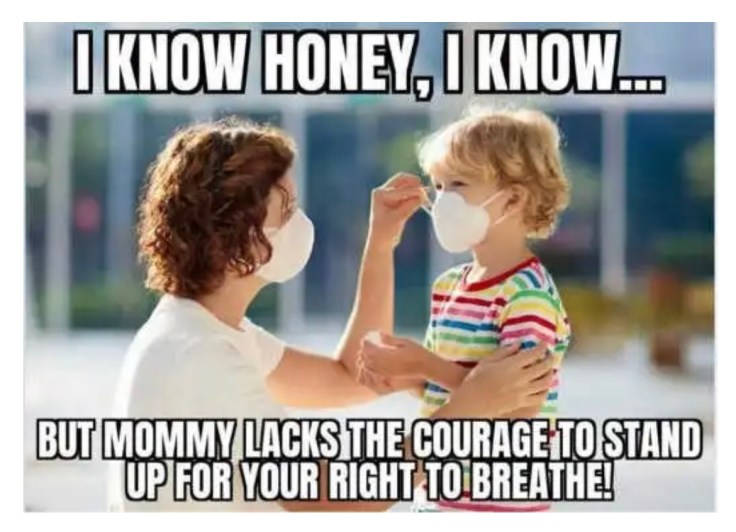
During this timeframe, not just my boss/pastor but many other people were also overreacting to the coronavirus pandemic, and mask-wearing was a big dividing point. Many erroneously believed the primary way to stay healthy was to cover one’s face and make sure everyone else was covering their faces as well. I sympathetically understood some people were more fearful of illness than others, and these same people might not be as educated on the science of viruses. They didn’t understand that even when double-masked, a virus is still going to virus regardless of if one is wearing a face-diaper or two, and that virus particles are way smaller than the microscopic holes in the fabrics of masks. To also give them the benefit of the doubt, I assumed the mask-mandate lovers only listened to government officials and mainstream news who never reported the scientific studies that demonstrated schools elsewhere in America and in other countries without mask-mandates ended up having as healthy if not healthier attendance numbers than those that kept kids muzzled all day.
As the schoolyear dragged on and covid-19 was still the top of the news, I was getting more and more frustrated with hearing stories of people nationwide overreacting in how to live their lives, such as by keeping loved ones apart at hospitals and funerals, by not allowing their babies and toddlers to see mask-covered facial expressions (which is a fundamental development-need for young ones), and worse than that, by putting little masks on babies and toddlers themselves. Closer to home, my state and Archdiocesan leaders were being illogical in continuing to require masking kids, in eliminating school sports (even outdoor sports), and in making students self-quarantine for two weeks if they happened to have had the slightest amount of being in the vicinity of someone who later tested positive for the virus.
After the end of that unpleasant school year, I realized I hadn’t vociferously protested enough and decided for the following 2021-22 school year I would need to push harder against the covid-overreactions because they were harming kids more than helping them. For the sake of our students’ mental health and education, I would begin that August with the start of our school’s summer camp to push against the illogically restrictive rules. Little did I know that I would not even make it past one trimester of that new school year before I was removed from my job – all because of the overreactions of Church leadership to the dangers of the virus and their acrimony toward people like me who dared to challenge common sense.
I will explain in my next post why my refusal to lie, pretend, and cave cost me my career.
Next Post coming April 17:
A Principal’s Principle for Parenting: Don’t Lie, Don’t Pretend, and Don’t Cave (Part 2 of 3)
It is illuminating to see the year in print. The whole story is right there and it wasn’t pretty. We carry on and even when it isn’t easy, we do the job we able to do. Thanks for the share.
Thank you for sharing these truths! We will always cherish our time our children had you at the helm. Also I had no idea the pastor would not allow a drive-in adoration. Sadly I am not surprised. Can’t wait to read the next installment!

 A PRINCIPAL'S PRINCIPLES FOR PARENTING
It is illuminating to see the year in print. The whole story is right there and it wasn’t pretty. We carry on and even when it isn’t easy, we do the job we able to do. Thanks for the share.
LikeLiked by 1 person
Thank you for sharing these truths! We will always cherish our time our children had you at the helm. Also I had no idea the pastor would not allow a drive-in adoration. Sadly I am not surprised. Can’t wait to read the next installment!
LikeLiked by 1 person
Tiffany, thanks for your support – then and now!
LikeLike