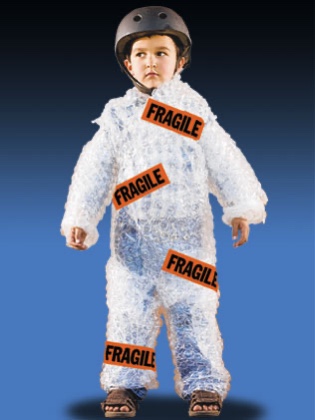
A disturbingly high number of Millennial and Generation X people have grown up to parent in one of three approaches, described as helicopter parenting, bulldozer parenting, and bubble-wrap parenting. During my time as a Catholic elementary and middle school principal, I saw these three troublesome types of parents constantly, with their numbers increasing in each succeeding year.
Common sense and history have taught us that people learn from their mistakes. That is how kids improve and grow. We know that youngsters need to be able to learn how to independently deal with suffering harm, be it in the form of getting upset, sad, or defeated. As long as we’re not talking serious harm, like getting a broken bone or getting kicked out of school, parents’ duties as their children reach the end of their primary grade levels and beyond should usually be resigned to observing and giving advice to steer their child right. Unfortunately, these popular ways to parent – helicoptering, bulldozing, or bubble-wrapping – involve moms and dads actually springing into action and doing too much for their 7-to-17 year-olds in their distorted belief that they are supposedly “helping.”
The first approach to parenting – helicoptering – can be described as parents who figuratively hover over their child to see if there is anything that needs to be done to prevent the youngster from getting hurt, feeling bad, missing out on something, or doing something incorrectly. Helicopter parents will hover over their children so they can fight their kids’ battles for them, lest their children will get their feelings hurt or fail at something. The helicopter parent is being overprotective and over-involved, not allowing his or her kid to make a mistake or suffer some harm.
The second approach of being a bulldozer parent can be described as a more aggressive style. Bulldozer parents won’t just hover so they’re ready to swoop in when necessary. They will be on the ground from the start, doing anything from badgering teachers, completing the child’s work for them at the first sign of struggle, or otherwise, like a bulldozer, flattening and pushing out of the way anything that would not be considered positive for their child. The bulldozer parent is like the helicopter parent on steroids.
The third type of parent – a bubble-wrap parent – acts similarly to how you would package your expensive, fragile vase in bubble wrap before shipping it in a box. The bubble-wrap parents figuratively wrap this air-bubble packing around their children so to keep them from any harm – not just physical harm but purportedly psychological harm. This bubble wrap can be in the form of physical, tangible protection like putting a cloth mask on their toddler in fear he or she might catch a covid virus, or in the form of emotional, intangible protection such as not talking about a difficult, scary subject like death in front of their child.
Call it whatever you want – helicoptering/bulldozing/bubble-wrapping or hovering/over-protecting/babying – these types of parenting styles will generally create children with anxiety, weak character, and a lack of resilience. The best type of parenting is to love your 7-to-17 year-old so much that you realize, as difficult as it is for you the adult, you must give him or her room to grow and be independent, which includes allowing him or her to fail, to make mistakes, to get feelings hurt, and sometimes even to get physically hurt.
My mom gave me a job when I was just a third grader that today would be considered politically incorrect, but for my Baby Boomer generation was not even blinked at. We lived almost within spitting-distance of the neighborhood mom & pop store, and it was such a close-knit type of atmosphere that the store owner kept customers’ credit accounts on receipt books so people could grab things and pay later. My mom would weekly send me to the store with a handwritten note to the store owner which read, “Please give my son two packs of Winston cigarettes.” I would walk to the store myself, hand the note over, and in return the store owner would hand my 8-year-old-self two packs of cigarettes.
First off, most parents today would not send an 8-year-old to the store by himself, even if it was less than 50 yards away from home. Secondly, stores today do not simply hand a child cigarettes. It’s actually kind of disappointing. Because from this big-responsibility chore my mom gave me, I learned bravery and independence by walking to the store myself and talking to the owner. As a side benefit, I also learned will power to not steal a puff of a cigarette when walking home with the packs.
As I got a little older, I performed other acts which helped me experience life with all its dangers and disappointments so that I would properly mature. My mom allowed my brother and me to get a paper route. Technically, he was the one assigned the route, but being his little brother, I was both coerced into and excited to help him. Thus, I should have been given the title of co-paperboy. Come to think of it, I should have been given half the money he made! Darn!
Anyway, every afternoon we rode our bicycles a mile to the newspaper shack where the bundles of papers were dropped off, wrapped our route’s supply with rubber bands, and took off with the stuffed newspaper bags draped over the backs of our bikes. We had a route of 75 houses to deliver to, so this entire process took about two hours each afternoon. There was no such thing as a cell phone to call our mom should we get a flat tire, or should we skin our knee by crashing our bike, or should we run into so-called stranger-danger. None of those bad things happened to us during any of our paper route days, but I do vividly remember when a dog once bit me on my leg as I walked up to a front door to drop off a paper. With no cell phone, I just had to wait until that day’s route was complete to ride my bike home and tell my mom about the dog bite.
Now, had our mom been a helicopter-type of parent, she would have followed right beyond our bikes in her car, being ready in case we had bike trouble or crashed our bike as we tried to carry the extra weight of newspapers, especially those huge, heavy Sunday papers. Had our mom been a bulldozer-type of parent, she would have driven her car in front of us to lead the way and make sure the traffic was safe and no dogs were ready to pounce. Had our mom been a bubble-wrap-type of parent, she never would have let us take on a paper route in the first place, for fear of potential stranger-danger or worry of us feeling like failures if we ended up not being able to handle this tough job.
Fortunately, we weren’t raised by an over-protective, over-involved parent, and because of this, my brother and I learned independence, perseverance, problem-solving, and how to spot a mean dog.
Parents serve their children best when they give them the opportunity to experience just enough responsibility – and the stress that comes with it – to bring about attention and accountability without overwhelming them. Giving your child a manageable experience like a paper route or permission to buy something independently at the store allows him or her to learn to take risks and assume responsibility.
Of course, this has to be age appropriate. You don’t give a 5-year-old his first pocketknife and tell him to go run off and play with it, so he can experience risky play with a sharp object. But to learn proper knife safety, you can ask that 5-year-old to help you make a snack by slicing a banana on a plate. Today, you don’t allow your 8-year-old to ride her bike herself to the big city’s downtown to buy herself a fast-food lunch. But you do teach and expect your 8-year-old to be able to tell her own order to the waitress when your family is sitting in a restaurant.
Unless you shut down the helicopter, park the bulldozer, and discard the bubble wrap, how will you ever be sure your kid is competent enough to keep himself or herself safe and to be responsible enough to make good decisions? When we baby our children, we deny them opportunities to mature, to learn how to overcome fear and cope with uncertainty, and to develop a feeling of responsibility. What we do instead by over-parenting and over-protecting is we create uneasy kids who can end up phobic and anxious over many things, such as talking to adults, tackling tasks requiring responsibility, and taking risks.
Now, without sounding hypocritical, there are certain times in today’s culture when parents must definitely be over-protective with their children. Keeping them away from the dangers of technology in the form of smart phones and internet use when they are too young is one big example of when parents must be hovering and guarding. Another example when it makes sense for a parent to be over-protective these days would be to not allow their child to attend a boy-girl party where parent chaperones would not be constantly present. But for most other situations, too many of today’s parents over-parent by hovering, guarding, and controlling too often.
One of my pet peeves as principal was seeing so many parents drive to school – an hour after they had already been there dropping off their kids – to return so they could drop off the lunches or homework their children forgot at home. I can understand a parent doing this the first time their child forgot, but if their child had made it a habit of forgetting and the parent was making it a habit to be right there to save the day, mom or dad was not doing their child any favors in the long run. By having to suffer the consequences of no recess due to forgetting homework or stomach growls due to forgetting the lunch box, the child will gain more from these lessons learned than if he or she is rescued by mom rushing home and returning to school.
Unfortunately, veteran schoolteachers and I have seen more of this in recent years compared to rarely if at all seeing it in the previous century. Many of today’s moms and dads need to be reminded that they have already been to school, turned in reports, completed projects, and received report cards. Now it’s their kid’s turn to do this. Teachers don’t want parents doing their kids’ work. Similarly, educators shouldn’t be harangued because a child got a low mark on a report card and coaches shouldn’t be yelled at because a child didn’t get to start on the sports team. The child’s efforts (or lack of effort) earned him or her the low mark or the position on the bench, and the sooner the kid learns this cause and effect, the better. When the child grows up to have an adult job, mom and dad won’t be able to be there to hover over the office desk ready to help with a tough assignment or to bulldoze out of the way any negative criticisms from the grown child’s boss.
The more you bail out your kid, the less he or she will learn and grow. The child who forgets things but is quickly saved by a parent does not learn about natural consequences and thus, does not fix this habit and does not properly mature. The cause is you forgot your lunch. The effect is you will now be hungrier than normal that day. Of course, if you’ve been a teacher in a classroom, you know that no child will starve when he or she forgets his lunch box. That is because classmates will happily hand over to the forgotten-lunch student from their own lunchboxes and lunchsacks a banana, a bag of chips, half a sandwich, carrot sticks, and even Oreos if one is lucky. So, mom and dad, leave the forgotten lunch on the kitchen counter when you notice it an hour after your child has left for school. Chances are your youngster will be fed better than the lunch you packed anyway.
I would see similar incidents with overindulgent parents happen a lot with forgotten homework. Again, if it’s your child’s first time of accidentally leaving the folder of finished homework at home, and it’s not too inconvenient, it makes sense for a parent to drive it to school later that morning. However, if the child has done this more than once, the parent must let the natural consequence take place. The consequences will range from your child being embarrassed to your child getting a lower grade. Those are the immediate, negative effects. The long-term, positive effect by not over-parenting and letting the chips fall where they may is your child will improve on being responsible by putting his or her homework folder in the backpack the night prior.
This is why one of my top pointers to parents would be to let your child go hungry for a day due to a forgotten lunchbox or earn a bad homework grade due to a forgotten assignment, because that’s when learning happens.
Hovering incessantly, removing all problems, and smoothing out any discomforts might bring immediate relief and pleasure to your children, but in the long run it will usually do more harm than good. So, parents who truly love their kids bite their tongues, put their hands in their pockets, and stand at a distance more often than not, so their youngsters will learn more quickly, develop more positively, and grow up to be even better parents in their future generation than mom and dad are.
As I’ve tried to stress, a parenting style that is helicoptering, bulldozing, or bubble-wrapping is unconstructive at best and damaging at worst. So what style is best? The answer will be in my next post.
“My child, do not regard lightly the discipline of the Lord, or lose heart when you are punished by him; for the Lord disciplines those whom he loves, and chastises every child whom he accepts. Endure trials for the sake of discipline. God is treating you as children; for what child is there whom a parent does not discipline? If you do not have that discipline in which all children share, then you are illegitimate and not his children. Moreover, we had human parents to discipline us, and we respected them. Should we not be even more willing to be subject to the Father of spirits and live? For they disciplined us for a short time as seemed best to them, but he disciplines us for our good, in order that we may share his holiness. Now, discipline always seems painful rather than pleasant at the time, but later it yields the peaceful fruit of righteousness to those who have been trained by it.” (Hebrews 12:6-11)
 A PRINCIPAL'S PRINCIPLES FOR PARENTING
Outstanding commentary! I love your common sense perspective. “Consequences” are absent from today’s parenting toolkit.
LikeLiked by 1 person
“Natural” consequences just make sense….
…keep forgetting your lunch? the consequence is a growling stomach 😉
LikeLike