
Many Catholics love the Advent season for its twofold purpose. One purpose of the season is to prepare for celebrating the anniversary of when Christ was made flesh on that first Christmas morning and dwelt among us. Secondly, Advent provides four weeks to focus our minds and prepare our hearts in anticipation of Christ’s second coming at the end of time. Although most children (and many adults) want to skip the season of Advent and go straight to the culminating event of Christmas, it is vital that we embrace the monthlong period of Advent as both a time of joy-filled, anticipatory celebration of the arrival of Jesus and a preparatory period of repentance, meditation, and penance.
Every year it seems that our culture has less and less patience to gradually progress through the four weeks of Advent and would rather just speed straight to Christmas. Nowadays, Christmas advertising starts the day after Halloween and fresh Christmas trees go on sale as soon as Thanksgiving Day. With this year’s Advent beginning as late as possible – starting on Sunday, December 3 – and thus giving the fourth and final week only one day – Sunday, December 24 – those who prefer to hurry up will be happy that Advent in 2023 is the shortest length of time possible.
It’s too bad, because the anticipation of Christmas that builds up during the Advent season is good for building up the virtue of patience and gives us an opportunity to imagine the long-awaited coming of the Messiah. Generations of saints had promises from God in Scripture about the arrival of Christ, and they yearned for the coming One. Advent reminds us that we must do the same waiting, and when we do this, God grows patience in our hearts just as He is patient:
“The Lord is not slow about his promise, as some think of slowness, but is patient with you, not wanting any to perish, but all to come to repentance” (2 Peter:3-9).
Because of the increasing commercialization of Christmas and the modern creation of a “holiday season” that begins around November 1, and runs through January 1, most Christians today spend the entire season of Advent celebrating Christmas rather than preparing for it.
The lack of patience and desire to skip straight to Christmas is why so many people these days decorate their Christmas trees as early as the end of November. However, traditionally, Catholics and most other Christians did not put up their Christmas trees until the afternoon on Christmas Eve. The same was true of all Christmas decorations. The purpose of the tree and the decorations are to celebrate the feast of Christmas, which begins with the celebration of Midnight Mass on Christmas Eve.
This tradition to not hurry-up Christmas made sense on a practical level as well for past generations. The freshly cut tree was illuminated with candles. The fire danger from candles or even hot electrical lights increases dramatically each day after the tree has been cut and brought inside.
Of course, these days, if you wait until Christmas Eve to purchase a live Christmas tree, you are likely to end up with a sad, spindly looking stick like the one that Charlie Brown brings to the Christmas pageant in “A Charlie Brown Christmas.” A reasonable compromise is to hold off on decorating your family’s Christmas tree until Gaudete Sunday, the third Sunday in Advent that is known as the period of rejoicing because the Lord is near.
Even if circumstances with your family’s busy schedule make it necessary to put up the Christmas tree by the first Sunday of Advent, you can still maintain a better sense of the Advent season by not lighting the tree’s lights until Gaudette Sunday and by only putting out your most precious decorations, including the star or angel for the top of the tree, once Christmas Eve arrives. Such practices will instill patience in and increase the sense of expectation from your children, and make Christmas Day all the more joyful for the entire family.
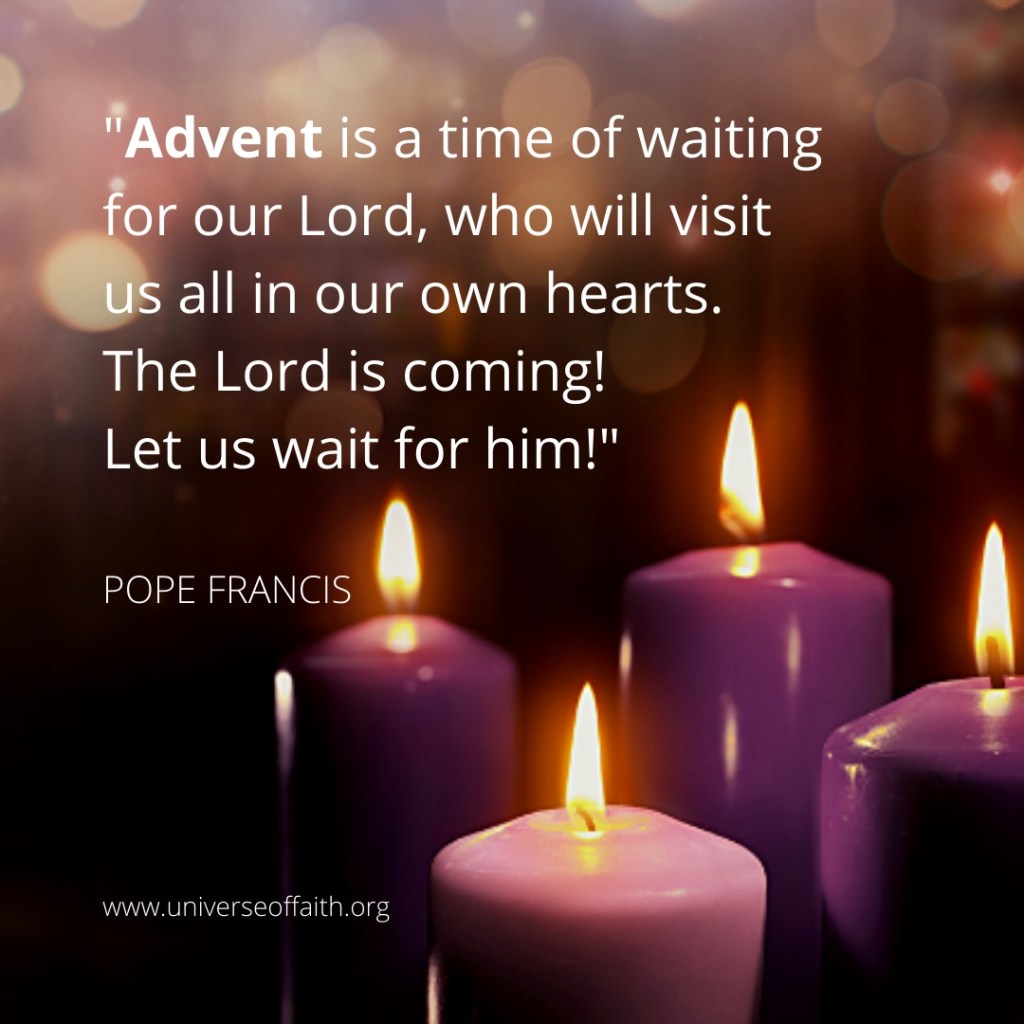
A family Advent wreath that is placed in a prominent place in the family home is a simple yet excellent way to make the first weeks of December centered on Advent and not so-much on Christmas. It is even more meaningful if mom and dad can get son and daughter to join in with creating or buying the wreath. (This resource explains how to make your own wreath.) Each night around dinner time, a brief Advent wreath candle-lighting and prayer can take place, with your kids (age dependent) taking turns lighting the candle(s) and saying the prayer. Prayer can be spontaneous or formal, focusing on the many reasons for praising Christ and how much we are lovingly awaiting His coming. Here is an example of Advent prayers with children:
**********Advent Week 1**********
Light the first purple candle, and allow everyone to take a second in silence to stare at the glow of the flame. Then pray aloud:
“Christ, our Light, shine in our lives with hope and promise. Give us right vision so that we remain attentive to this holy season. Remind us to look for you in small acts of kindness and love. We await your coming with wonder. Amen.”
**********Advent Week 2**********
Light the first two purple candles, and allow everyone to take a second in silence to stare at the glow of the flame. Then pray aloud:
“Christ, our Hope, illuminate our hearts with your grace. Enlarge our vision so that we recognize our kinship with all the people of the world. Help us to give to others in ways that meet their deepest needs. We await your coming with gratitude. Amen.”
**********Advent Week 3**********
Light the first two purple candles and the one pink candle, and allow everyone to take a second in silence to stare at the glow of the flames. Then pray aloud:
“Christ, our Joy, brighten our homes with your presence. Clarify our vision so that we might see you in the people we cherish. Make every holiday activity an opportunity to spread your light and love. We await your coming with joyful delight. Amen.”
**********Advent Week 4**********
Light all four candles, and allow everyone to take a second in silence to stare at the glow of the flames. Then pray aloud:
“Christ, our Peace, glow brightly in each moment. Enlighten our vision so that we see beyond the trappings of the holidays. Relieve us, if just for a moment, of our worries and stress. We await your coming with serenity. Amen.”
When I was a Catholic school teacher, I enacted another Advent activity in my classroom that mom and dad could do at home as well. To help children understand how Advent is both a time we celebrate the anniversary birth of Jesus and a time to prepare us to be more perfect for when we will meet Jesus in the second coming, I created a “giving manger.” Kids are very visual, so a giving manger is a great visual representation of how the kindness and good deeds we give to others assists in preparing our hearts to receive baby Jesus at Christmas.
How it works is at the start of Advent you set out an empty manger (you can create simple ones like these) and set aside a pile of straw (or strings of yarn will suffice). Then each time your kids do a good deed or an act of kindness, they get to put one piece of straw in the manger. These deeds could be simple yet selfless acts such as holding a door open for someone, sharing a snack at school lunchtime, assisting with a family chore, or sincerely giving a friend or sibling a compliment. The more good deeds, the more straw that goes in the manger, and thus, the softer the bed for baby Jesus. Daily, such as at the dinner table, your children can take turns naming their good deeds, not just so mom and dad can confirm the kids are properly comprehending what are benevolent acts, but so the kids get an opportunity to share how it feels good to do good.
Try as you might to make all of Advent and the first three weeks of December focusing on the true reason for the season, it is realistic to assume your kids will spend much of this period creating their toy wish-lists, excitedly pointing out Santa sightings, and loudly singing Frosty the Snowman and Jingle Bells. But if families just made an effort to remove a little bit of the commercialized Christmas activities during the first few weeks of December and replaced them with just one or two meaningful Advent activities, they would be taking a big step in helping their kids – and themselves as well – to focus on the meaning of Advent as the time we prepare to celebrate Jesus’ original and future coming into the world.
It is typical for adults to initiate a New Year’s resolution on January 1, and for many it will be resolving to improve their physical selves by dieting and/or exercising. Similarly, it is typical for us Catholics to resolve to improve our spiritual selves. The good news is we get about a thirty day head start. For this 2023 Advent season, we begin on December 3 to examine our spiritual lives and prepare the way of our Lord.
The Incarnation – the Word made Flesh – is the starting point of our Salvation. We prepare for the birth of Jesus because that is the moment that God enters humanity so that He might eventually be nailed to a cross for us. And at the same time this Advent season, we prepare for his second coming – when he will “come again to judge the living and the dead.” What an incredible, awe-inspiring season this is! May we not overlook it or hurry it up, but immerse ourselves in Advent!
 A PRINCIPAL'S PRINCIPLES FOR PARENTING
Dan,
Thank you for reminding us to slow down, to wait, and to remain ready at the manger. Jesus asks us to await his arrival with quiet anticipation. As you mentioned, we mark time by lighting a candle each week, filling the darkening days of December with more and more light, as we move slowly toward celebrating that Jesus has come again! We don’t light all the candles at once, but one a week, slowly, methodically, as we linger on the meaning and purpose of the coming of the precious Christ Child.
LikeLiked by 1 person