I grew up with my widow mom and four siblings doing “Catholic things” as regular rituals and annual family traditions – from attending Sunday Mass, to eating fish sticks and going to a Stations of the Cross service every Friday in Lent, and to lining up outside the confessional booth on a repeating schedule. Only when I got a little older did I realize that not all Catholic families did similar actions on a regular basis.
Of the five children my mom had, all five continued throughout their adult years to be practicing Catholics. Going 5-for-5 in this category would be a remarkable achievement for any parent. If a Catholic mom and dad these days had merely a 40% success rate with only two of their five baptized children continuing to be faithfully practicing the faith years later as adults, that couple would be considered very successful in our un-churched 21st century. Of course, if a couple today had five kids, today’s culture would consider them as crazy, old-fashioned weirdos who are damaging the earth with their huge hoard and stubborn unwillingness to use contraception or have abortions.
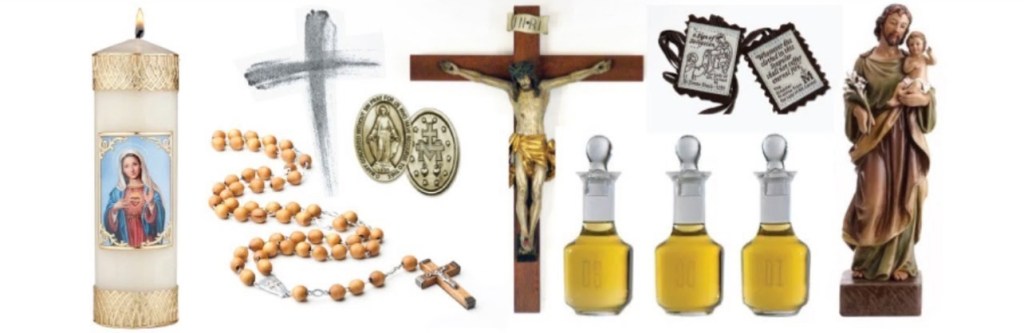
Besides my mom doing a commendable job in incessantly getting her kids to church, she also made it obvious when inside our house that we were a Catholic family. In my childhood home we had a huge portrait of Jesus in a prominent place, my mom always had her Rosary beads nearby, and every bedroom had a crucifix on the wall. These images and items are called sacramentals – unique to the Catholic faith and humble reminders to keep our minds on God and the Saints. Sacramentals help us always know that God is there.
Sacramentals can consist of actions, such as blessings from priests and we blessing ourselves with the Sign of the Cross, and of blessed objects of devotion, such as Palm Sunday palms and medals worn around the neck.
Two differences between Sacraments and sacramentals is that only Sacraments produce sanctifying grace and only Sacraments were instituted directly by Christ. Sacramentals were instituted by Christ through His Church and are never to be considered as equal to or able to take the place of Sacraments. Whereas Sacraments are necessary for salvation, sacramentals are not necessary. Nevertheless, sacramentals should always be treated with reverence and devotion since they may not save souls, but they are the means for securing heavenly help for those who use them properly.
For sacramental objects such as medals, it is good to get a priest’s blessing on them as the blessing gives God ownership over the object and dedicates it to Him, and He then works through it. When parents gift their children with sacramentals such as medals, they need to teach that it would be superstitious to believe that the grace and spiritual benefit one may receive comes from the sacramental itself. Instead, it is to be understood that all grace comes from God, and so the sacramental is merely a channel through which He has chosen to work. Some suggested medals that would make wonderful gifts for your children, grandchildren, or godchildren are the Miraculous Medal, a four-way medal, or a medal depicting the Saint associated with your child’s Baptismal or Confirmation name.
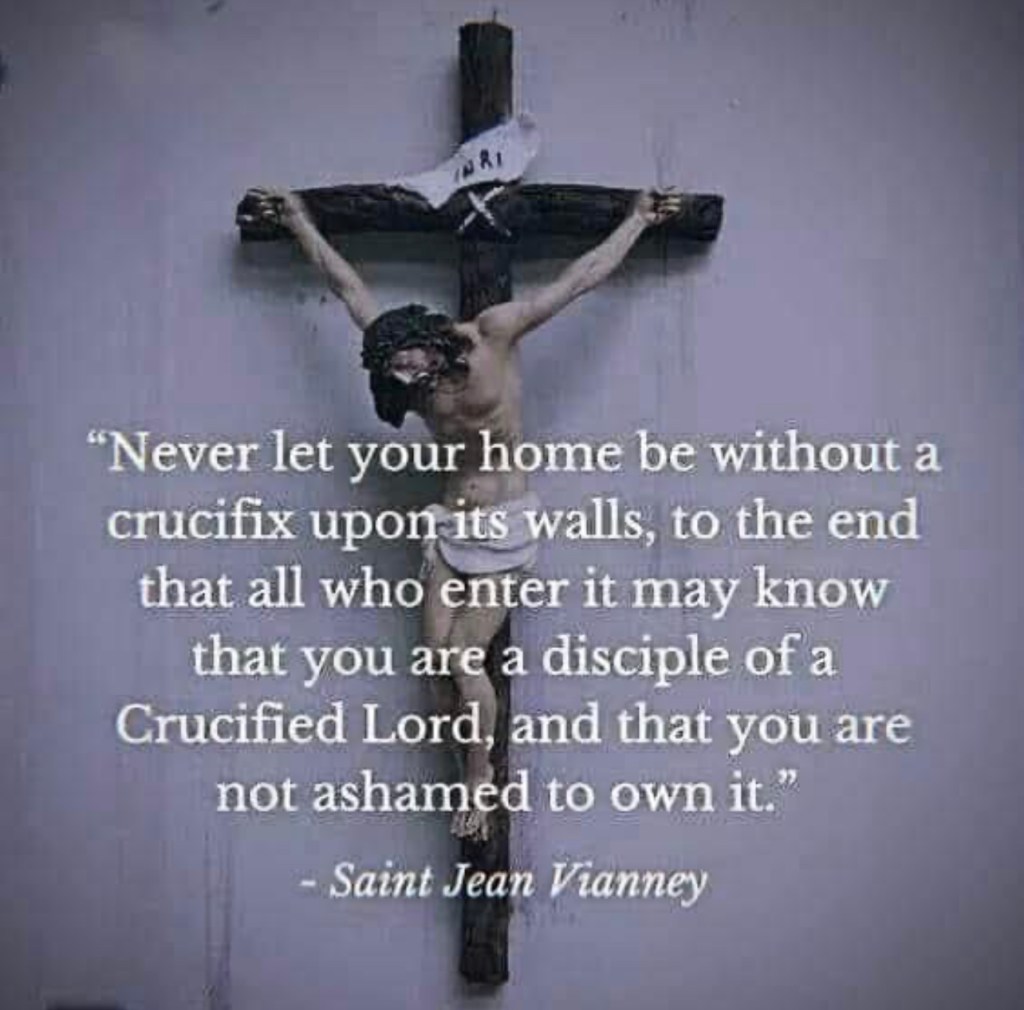
The sacramental more fundamental than a medal around the neck is a crucifix affixed on the wall. Catholic families should have a crucifix on every bedroom wall as well as displayed in a prominent general room where the entire family gathers, such as the living room or kitchen. There is nothing better to help a complaining or worrying child to put things into perspective than to see Jesus suffering on the cross with a limp body, pierced hands and feet, and a bleeding, stabbed side. Contemplating while viewing a crucifix will help your child to consider his or her problem of not making the sports team or the pain of having a toothache as something he or she can suffer through. If Jesus was willing to agonize through all those injuries and then ultimately die for me, I can offer up my smaller-sized pain. It also reminds them how much God the Father loved us – that He sacrificed His Son – and how much God the Son loved us – that He was willing to die for us.
Another common sacramental is holy water. Holy water does not just belong in a church. Many Catholic families have holy water fonts attached on their walls near either the front door or the door leading to the garage. The routine for the family is then to bless themselves with holy water when they enter and/or leave the house each day. If they don’t know it already, your children should be taught that holy water was used at their baptism as a symbol of our sins being washed away, so each time we use holy water we can be reminded that we were baptized and became part of God’s family as His adopted son or daughter.
We also use water that has been blessed by a priest – thereby calling it holy water – as a way to help protect from evil. St. Teresa said, “I have learned that there is nothing like holy water to put devils to flight.” When we make the Sign of the Cross , we remind ourselves that we believe in the Trinity and follow the Father, the Son, and the Holy Spirit. We also are remembering Christ’s death on the cross – thus, making the Sign of the Cross .
One suggestion is to let your kids help you pick out which wall-attached holy water font to buy, either at your Catholic bookstore or shopping online. You will usually find holy water in your church in a large receptacle that is purposely there for parishioners to bring their own bottles to fill and bring home. Take advantage of this, and again, engage your children by putting them in charge of filling up your bottle at church and pouring the water in the font at home.
You can choose to use holy water or not for this next suggestion – blessing your family members by regularly marking the Sign of the Cross on each child’s (and your spouse’s) forehead. This is a powerful and beautiful act that is a type of sacramental. Typically, the Church frowns upon laypeople blessing others with gestures, reserving this for priests with consecrated hands. Whereas priests are consecrated so that they may bless all people, parents are granted special authority to bless their immediate family members. Marking the forehead of your spouse and children with the Sign of the Cross is very beautiful as you are asking Jesus to do them good, by letting Jesus act in your spouse and kids.
So to make this a habit you won’t forget and that your child expects, it would be good to choose one specific time of the day for this marking with the Sign of the Cross – perhaps immediately before your child gets out of the car if you drive him or her to school each morning or perhaps at nighttime when your kid is ready to go to bed. Mom or dad simply uses his or her thumb to trace the Sign of the Cross on the forehead, after dipping the thumb in holy water if available. Simultaneously, the parent should say aloud a short ritual for blessing, especially since this helps your child understand why he or she is undergoing this sacramental ritual.
Your prayer could be as simple as: “Bless you in the Name of the Father and of the Son and of the Holy Spirit.” Another version could be: “May God bless you. May Jesus protect you. May the Holy Spirit be in your heart.” And this version is Biblically based from the Book of Tobit: “May God in heaven protect you on the way and bring you back to me safe and sound. May His angel accompany you.”
A longer prayer when marking the Sign of the Cross on your child (or spouse) when he or she is leaving home for the school day or workday could be:
“Dear Lord,
Bless _____. Give him (her) peace of mind and heart. Help him (her) to use his (her) gifts and talents to be a blessing to others and to give You glory in everything he (she) does. Help _____ know how much You love him (her) and how much his (her) family loves him (her). Grant him (her) a wonderful and safe day. Amen.”
Whether you recite a few words or a few sentences when you daily bless your child with the Sign of the Cross , by praying over your children you are asking God to be with your youngster throughout the day when you can’t be. Of course, you already know God is with your child 24/7, but in this outward prayer with your kid listening and being a part, he or she is taking in the importance you are placing in the power of prayer and in inviting the Lord into your family’s life. Furthermore, by incorporating this sacramental, you are demonstrating for your youngster the importance of making God the center of one’s day, and perhaps he or she will more likely bring thoughts of the Lord to his or her mind later in the day when at school or play.
As far as other sacramentals go, nothing says ‘Catholic’ more than Rosary beads, and every child should not only be gifted with their own Rosary beads, but there should be a regularly scheduled time for parents to tell their kids to go get their beads because it’s time for the family to pray the Rosary together. This is certainly being counter-cultural in today’s society. “None of my friends’ parents make their kids pray the Rosary!” is probably the truest statement your child ever will scream at you when you tell them to put down the video game controller and pick up the beads.
Although it may not be realistic for today’s families to together pray five decades of the Rosary every day, a regular pattern of praying could be in the form of a family always praying the Rosary aloud together in the car when taking any road trip that is going to last an hour or longer. At a good pace, it only takes 17 minutes to pray five decades. You can promise the kids they can put their earbuds back in or return to fighting in the car with their siblings after the 17-minute timeout for family prayer. Children can take turns being the leader of reciting the first half of the Our Father and/or the Hail Mary, as this helps keep them engaged.
If the average parent today was asked to spend an hour driving their children to and from their piano or swimming lessons, these parents would willingly agree to do so. If the average teenager today was asked to devote an entire evening to scrolling on Instagram and playing a video game, there would be no hesitation. And yet, when was that last time that same average person took as little as 17 minutes to pray the Rosary? Sit down with your family if your kids (or spouse) is whining about having to pray the Rosary and see if you can get them to agree that Jesus Christ deserves at least some of our time each week. After all, His other titles include the Savior of the World, the Alpha and Omega, and the Head Over All Things.
We are given sacramentals to make our day holy and to help us stay devoted to our Lord. Throughout the day, whether we see a crucifix on the wall of our house, we feel a medal around our neck, or we bless ourselves with holy water, we are reminded that we belong to God and were made for heaven, and we desire to regularly and as soon as possible seek Him in the Sacraments of the Church.
 A PRINCIPAL'S PRINCIPLES FOR PARENTING
What a great addition to your family – make faith a priority in your daily lives
LikeLike