
Last year my wife and I had our 40th wedding anniversary. I called ahead to a fancy restaurant for dinner reservations and let them know it was a special anniversary. When we arrived and were seated, the waiter asked, “What’s the secret to staying married?” My snarky response was, “Don’t get divorced.”
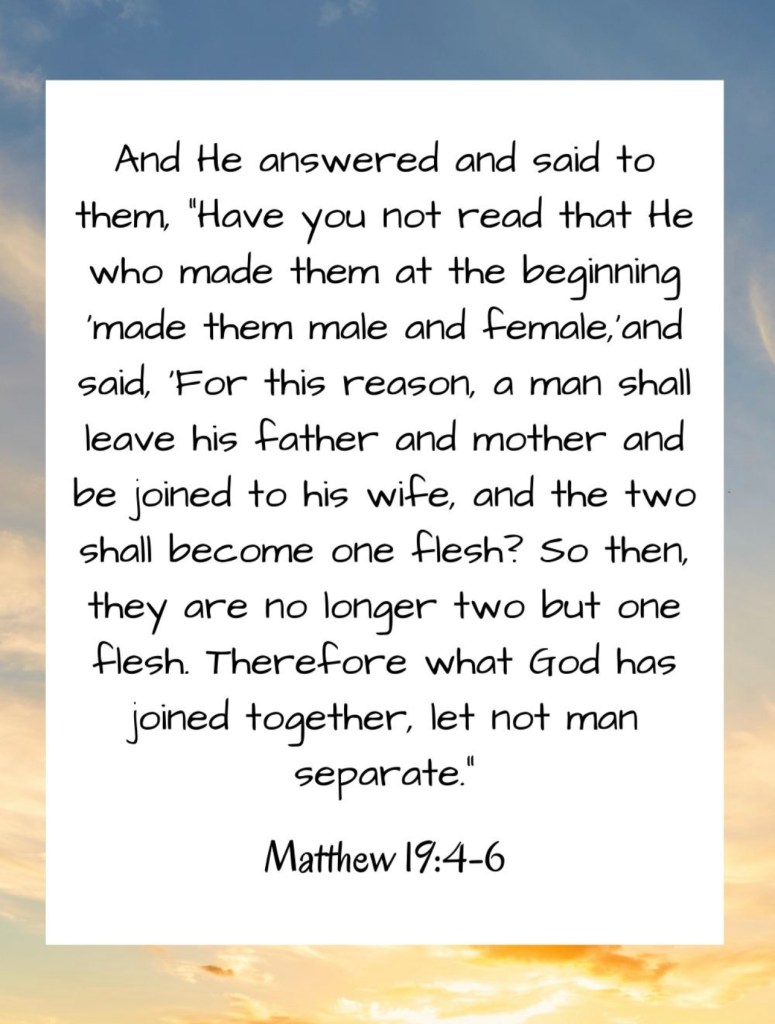
Seriously, we deserved a special anniversary celebration because long-term marriages have become as rare as no-hitters in baseball. While a life-long commitment has seemed to become archaic in the 21st century, Christ’s teaching on the permanency of marriage is unmistakable, held by the Church for 2,000 years:
“What therefore God has joined together, let not man put asunder…And I say to you: whoever divorces his wife, except for unchastity, and marries another, commits adultery.” (Mt 19:6,9)
Catholic marriage vows typically take on this form when the bride and groom declare their consent:
“I (name) take you (name) for my lawful wife/husband, to have and to hold, from this day forward, for better, for worse, for richer, for poorer, in sickness and in health, to love and to cherish until death do us part.”
The truth about marriage is that it is ordained by God to last until death, just as our Lord’s love is faithful to us to the end. Sadly, the recent estimate is that 50% of first marriages and up to 70% of second marriages will end in divorce.
Somewhat encouraging, for Catholic couples, this rate of divorce drops to about 28%. This lower figure is most likely related to required pre-marriage counseling for those who get married in the Church as well as the assumption that authentically Catholic husbands and wives understand marriage is a Sacrament in which they will receive all the grace necessary to live it well and keep it intact. Seriously faithful married couples are more likely to believe divorce will harm their souls and destroy not only their covenant with their spouse but with God.
Divorce not only harms one’s relationship with one’s spouse and Creator, but it ends up showing the family’s children that marriage vows mean nothing. Thus, in their future relationships, the kids have every right to justify the same action because of the example set by their divorced mom and dad.
In my 40 years teaching and administering in Catholic schools, there was one sad reality that I witnessed – children in divorced families were more likely to have both academic and behavioral problems. I could describe many anecdotal incidences to try and prove my theory, but you might be more convinced with the overwhelming mountain of empirical evidence.
Research here, here, and here has shown that children of divorce are at increased risk for academic failure, behavior problems, poor psychological adjustment, reduced self-concept, and reduced social competence. The behavior problems and other setbacks and hardships can be seen in the Journal of the World Psychiatry Association that notes that kids of divorced parents are more likely to engage in risky sexual behavior, live in poverty, and experience their own family instability when they start their own marriages or relationships.
Here are some specific facts from the above sources proving that divorce increases the likelihood the involved children will face difficult, sometimes formidable challenges:
- Kids from divorced parents have an 8% lower probability of completing high school, a 12% lower probability of college attendance, and an 11% lower probability of college completion.
- Children whose parents divorced display a higher frequency of depression and/or violence and a higher risk for suicidal attempts. Later in life, men from families that divorced during their childhood were more than three times as likely to consider suicide than men whose parents never divorced.
- Youngsters living in step, blended, or one-parent families are about twice as likely than kids from intact families to have a mental disorder or need psychological help.
- Children of divorced or separated parents are twice as likely to live in poverty and engage in risky sexual behavior as they get older.
- Adolescents whose parents have divorced are more likely to experience injury, accidents, and illness than children whose parents have remained married.
- Kids of divorced parents grow up to make less income and have lower-level jobs compared with children from two-parent families.
Besides not wanting to harm their children physically, psychologically, and academically, another reason for moms and dads to avoid divorce is the fact that men and women who stay married are overall happier in life, as this study showed. It revealed an amazing 30% more happiness rating between married and unmarried Americans.
But there is an even more fundamental reason for a married couple to stay together – God created marriage as a lifelong commitment and Jesus commanded this permanence!
God has a two-part plan for your marriage that began on your wedding day. One part of the plan is for each spouse to make it a goal to help the other spouse get to Heaven. The other component of God’s plan is for you and your spouse to die to self – i.e. dying to your own selfish desires and trusting that God has what’s best for you – and with this selflessness to be open to new life that your marriage might bring about through conception and/or adoption.
In the Sacrament of Marriage, God expects the husband and wife to help each other grow in holiness. Our Heavenly Father has created a plan that has each spouse sharing their strengths with their partner while asking this partner to in turn help them make up for their own weaknesses. A husband and wife must strive to encourage each other to grow in relationship with Jesus so that they can ultimately lead one another towards the prize of Heaven. This is accomplished if husband and wife work at making each other saints by living a lifelong partnership where each practices devotion and patience and in turn learns from their partner how to be more devoted and more patient.
A good marriage has been compared to what happens when you place two sharp, flawed rocks in a rock tumbler with abrasive grit and water. The tumbler rotates for a period of time, causing friction between the rocks and the grit and producing smoothed surfaces. The result is two polished, smooth rocks, displaying beautiful colors and patterns. In the same way, two imperfect and rough-edged people in a marriage end up smoothing each other out as they tumble together for a period of time, forced to develop in sacrifice, patience, and love.
St. John Chrysostom wrote on married partners being companions on the journey they vowed to take together:
“If a man and a woman marry in order to be companions on the journey from earth to heaven, then their union will bring great joy to themselves and to others.”
There are a few primary ways to help your spouse get to Heaven. Praying for them and with them is the first way. Besides attending Mass together each weekend, Catholic couples should consistently pray together, such as before bed or as part of their dinner grace, where they thank God for all His blessings – and one of these blessings is your spouse – and graciously ask God to help each other become the husband/father and wife/bother possible. A major study showed that couples who regularly go to church decrease their risk of divorce by 47%. Another study revealed a more remarkable statistic – couples who not only attend church weekly but also pray together daily have divorce rates of less than 1%.
A second way to help your spouse get to Heaven is to encourage him or her to grow in virtue. Couples acquire virtues through the repetition of particular practices and behaviors, such as truthfulness, understanding, reverence, kindness, gratitude, and selflessness. A marriage coerces each partner to choose to act every single day in certain ways and thus, desirously, grow in virtue through communicating a loving word, performing a generous deed, or executing an act of self-sacrifice. You can consider your marriage a “school for virtue,” but just realize this particular school has no graduation date; classes last a lifetime.
Besides God creating marriage for the purpose of spouses working at making each other saints, He implores a man and wife to be fruitful and multiply. God doesn’t want a married couple to have kids simply to pass on the family name, but to be co-creators of new human life and help form new souls for an eternal destiny with Him. The children who result from the marriage union are the supreme gift of marriage. Marriage is the foundation of the family, where sons and daughters learn values and virtues that make them good Christians as well as good contributors to society. So, we have discussed why God created marriage and what a married couple’s objectives should be, but what do we do when a marriage is struggling and husband and wife bicker and shout more than nourish and hug? How can couples resist the urge to divorce, so that they don’t harm their children and also don’t harm their relationship with their Lord?
In my next post, I will pick up here to discuss some successful practices of Catholic husbands and wives that has kept them happy and together, avoiding divorce.
 A PRINCIPAL'S PRINCIPLES FOR PARENTING