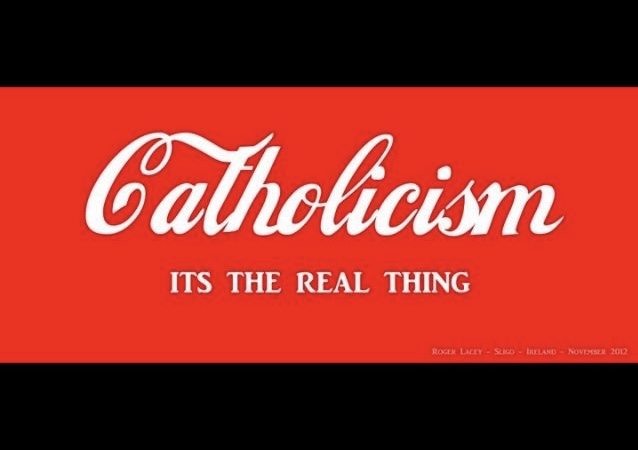
A few generations ago, in an effort to keep competing soda companies from stealing away their customers, Coca-Cola began their most famous marketing campaign with the enduring catchphrase, “It’s the real thing!” The “Coke – It’s the Real Thing” campaign asserted the genuine, original, and authentic qualities of Coke – the original cola invented in the 19th century – as compared to copy-cats created years later, such as Pepsi-Cola and RC Cola.
In a similar way, over the years copy-cat Christian denominations have tried to compete with the real thing, Catholicism. Regrettably, they have been quite successful in stealing away the original Church’s “clientele,” even though the Catholic religion is the only genuine, original, and authentic Christian Church.
There are more than two billion Christians in the world, separated into about 45,000 denominations – from Catholics, Lutherans, and Baptists to thousands of miniscule-sized Christian sects. Each of these denominations/sects have divergent views on matters of faith and morals and each professes to be the true church for Christians to attain eternal salvation. Christ in no way desired such a fractured and disjointed Church when he said to Peter: “You are Rock and on this rock I will build my Church, and the gates of hell will not prevail against it. I will give you the keys of the kingdom of heaven” (Matthew 16:18-19).
Jesus used the word “Church” – singular, not plural. He had one, and only one, Church in mind which he founded it in the year 33 A.D. and named the Apostle Peter as its first leader. Then in 325 A.D., when the Church held its first ecumenical council, the Nicene Creed was established so to preserve the faithful from a variety of heresies. This so-called “mission statement” of the Church includes the assertion that Christians “believe in one, holy, catholic and apostolic Church.” These purposeful word choices all point to the belief from the beginning of Christianity that there was never a plan for denominations and sects to form.
The most famous fracture of Jesus’s Church was in 1520 when a Catholic priest, Martin Luther, broke away to set up a new church according to his own ideas, not the Lord’s. Luther’s protest against the Catholic Church was implying that Christ failed with the original Church He established, and so Christians had to leave it and begin a new church. The actions of Luther and the other tens of thousands of Christian sects started before and after him contradict Jesus Christ. All of these Christians who break away from the Catholic Church to create or join other denominations are heretics, implying that God could not keep His promise to protect the Church against radical corruption.
While there were definitely abuses from clergy in the Catholic Church during Luther’s time that deserved being called out, and while some corruption continues today making it tempting for Catholics to want to walk away from the Church, Christ Himself predicted there would be such abuses and corruption. Where Luther went wrong and where the scores of other denominations have gone amiss is instead of focusing on staying the course in following Jesus’s intents and desires, they left His Church in search of a sect that was most suited to each individual’s wants and attractions. These Christians refused to stay with the original, true Church that Jesus started but instead shopped for a church that made them feel most comfortable and had more undemanding tenets to which to adhere. By doing so, they have made a mockery of Christ. He intended to institute just one Church, but fallen-away Christians – whether they are simply ignorant or purposely heretical – have deemed their desires more important than following the will of the Son of God.
The Catholic Church is the only church that can claim a divine person as its founder. All other Christian denominations were formed by worldly, sinful humans. Similarly to Lutheranism in the 16th century, non-Catholic churches trace their origins back to various human founders at a much later date than when in the 1stcentury Jesus Christ founded the original Church. For example:
- The Presbyterian Church was founded by John Calvin in 1536.
- The Methodist Church was founded by John Wesley in 1738.
- The Seventh-Day Adventist Church was founded by Ellen White in 1863.
- The Foursquare Church was founded by Aimee McPherson in 1923.

Only the Catholic Church can trace its lineage back to Jesus personally appointing the person to be its head after He ascended. Starting with Peter’s appointment, the line of popes has continued unbroken for 2,000 years. This apostolic succession was what Jesus envisioned as he began His Church and sent Peter and the other apostles out into the world with authority to teach, heal, and to forgive sins:
“Whatever you bind on earth will be bound in heaven” (Matthew 16:19; 18:18).
“Whose sins you forgive, they are forgiven, whose sins you retain, they are retained” (John 20:23).
“Go into the whole world and proclaim the Gospel to every creature” (Mark 16:15).
Jesus knew his apostles were mortals who would need to continue bringing forth new leaders (aka bishops) in each succeeding generation. And that is just what the Catholic Church has done. This God-given authority is exercised by the bishops within the Catholic Church to this day. Although this hierarchical manner of the Catholic Church is despised by many Christians, and a major reason for other denominations to have been formed, it is exactly what the Church started out as and was created to follow.
We see in Acts 15 the apostles coming together under the leadership of Peter to decide the question of what was required of Gentiles. Later in Galatians 1, we see how Peter was regarded as the head of the Church when Paul went to Jerusalem to confer with him. We read in Acts 1 and Acts 2 the details of the beginning of the Church and its miraculous spread through the power of the Holy Spirit.
There is no Scriptural evidence of the need for or the Lord’s call for independent local churches to break off from the original Church and start up a new “franchise.” Protesters and rebels who renounced Jesus’s original, solitary Church by beginning their own Christian denominations undermined His authority. These dissenters are textbook examples of the worst sin of all – the sin of pride – as they believed their own invented catechism was more perfect than the teachings of Christ’s Catholic Church. They appointed themselves as “Pope” or “Rock” because of their self-focused, self-elevated egotisms.
Nowadays, many Catholics express a sense that it is too difficult to follow some hard teachings of the Catholic Church, such as doctrine and traditions regarding contraception, homosexuality, and patriarchal leadership. Instead of remaining resolute in not only following Christ but following His Church which He founded to carry on His teachings, these deserting Catholics considered themselves smarter than Jesus so they left the Church He started so they could jump to another church which seemed more modern, less restrictive, and more comfortable.
Regrettably, these Catholic quitters think the solution to the problem of not being spiritually fed will best be discovered in a Christian denomination that Christ did NOT launch. This falling-away from the Church resembles how so many followers in Jesus’s time quit on Him when he stated that His flesh is real food and His blood real drink:
“I am the living bread that came down from heaven. Whoever eats this bread will live forever. This bread is my flesh, which I will give for the life of the world. …On hearing it, many of his disciples said, ‘This is a hard teaching. Who can accept it?’ …From this time many of his disciples turned back and no longer followed him. ‘You do not want to leave too, do you?’ Jesus asked the Twelve. Simon Peter answered him, ‘Lord, to whom shall we go? You have the words of eternal life. We have come to believe and to know that you are the Holy One of God.’” (John 6:51,60,66-69).
Perhaps the most fundamental belief of a true Catholic is to believe what the Church has always taught since Jesus’s time about the reality of the Eucharist being the Real Presence of God – Jesus Christ, body and blood – under the appearance of bread and wine. If one calls oneself a “Christian,” one must believe in Jesus’s own words – “This is my body” – just as one must believe Him when He said, “Peter, you are Rock and on this rock I will build my Church.”
Jesus’s clear teaching that the Eucharist is truly his Body and Blood – not a symbol or a reminder of Jesus – was rejected by Luther, Anglicans, and other new “start-up” religions who created non-Biblical explanations to redefine the Eucharist. The Catholic Church is the special, unique place where we can be truly fed with Jesus Christ, in the Holy Eucharist with the Bread of Heaven.
Both the earliest Church Fathers and Scripture substantiate that the Catholic Church’s teachings have remained untarnished and unchanged since the very beginning. No other Christian denomination/sect can say this about themselves. You can pick any teaching and see that it has been the way since the early Church. For example, in the first 300 years of the Church, ancient documents reveal Christ’s Church believed not only in the real presence of Christ in the Eucharist and apostolic succession, but also in the necessity to maintain the unity of the Church, the necessity of bishops, the formal designation of “Catholic” for the one church, the Sign of the Cross, and prayers to the Saints. Whatever this early Church was, it sure wasn’t Protestant.
One of the reasons the world is in such turmoil these days is because the tens of thousands of Christian churches hold a variety of positions on the spectrum of faith and moral issues. For example, some denominations endorse so-called gay marriage, some support divorce, and most do not believe in the Real Presence of Christ in the Eucharist. By not speaking with one voice, a weakened, broken Christianity has allowed much bad fruit to have been produced.
This cannot be what Christ envisioned when he instituted His Church. Do you really think our Lord wanted there to be 45,000 divisions among those who profess to believe in Him? Whereas, all the Christian churches have elements of the truth, the fullness of the truth resides in the original church – the Catholic Church.
Catholic Church history is not a rose-tinted tale. It may be filled with the highest of Saints, but it is also filled with the lowest of sinners. A strong faith is needed to keep one from walking away from the Church that Jesus found. Therefore, pray for the faith to remain strong, and pray for our Catholic clergy and leaders in the Church as well. We need them to resist the urge to water down traditional teachings in an erroneous attempt to keep their flocks from departing, just as Jesus did not water down the Truth that His body truly was the Bread of Life, even though it caused many to leave Him.
If you are a Catholic struggling to stay with the Church or having already left, whether it be from the clerical corruption, doctrine you disagree with, or the tempting comforts that neighboring denominations promise you, turn your gaze away from those doubts and disconcertments. Turn back to the Lord and the one Church He instituted 1,991 years ago.

 A PRINCIPAL'S PRINCIPLES FOR PARENTING
Dan,
What a dynamic posting. The whole world would benefit from your indefatigable truths. Preach it, Brother!
Every other major religion is based on human understanding and interpretation of a holy book, but Catholicism is a system of perfect interpretation of God’s word through a divine institution instituted by Christ. That is unique.
Your words lit a fire of confidence in my heart, that my membership in the one true church founded by Our Lord is my path to eternal life with Him. In the chaos that exists throughout today’s world, that brings incredibly comforting peace.
Danny Mueller
LikeLiked by 1 person
“indefatigable”??
I had to look that up 😆
Seriously, thanks for the compliment. I’m hoping through my writings to reach all types: to cheer on the current believers; to offer a life-line to the lost & fallen believers; and to encourage the wanna-be & curious believers.
LikeLike