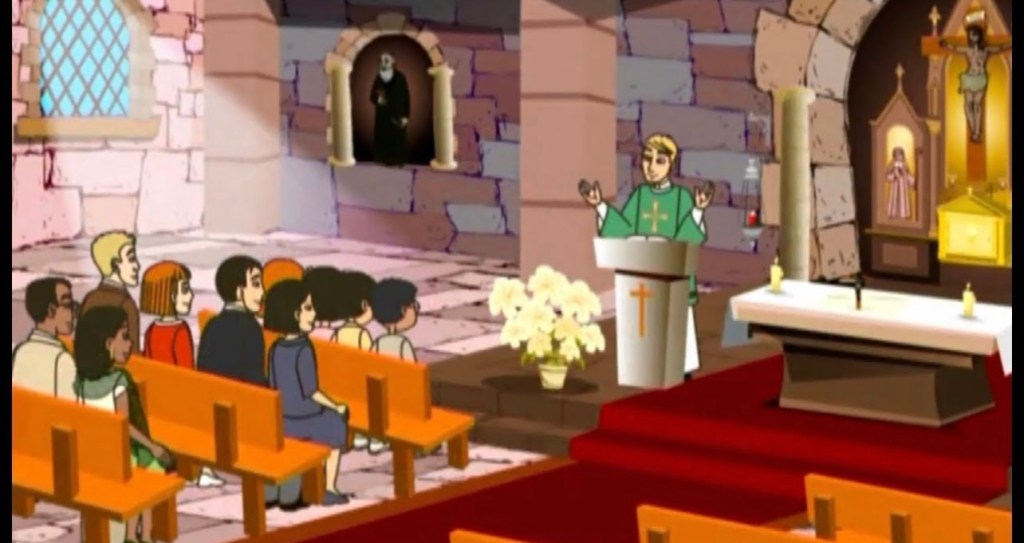
(This is the second in a series of five articles assisting parents in teaching the parts of the Mass to their children to enlighten them on what is taking place and help them develop a deeper understanding of why attending Mass is critical to our spiritual health. Note that the following explanations of the parts of the Mass and our expected responses/actions are written for the most common Mass that Catholics attend in the U.S. – the Novus Ordo Mass – as opposed to a Traditional Latin Mass.)
Last week began this 5-part series to assist parents in teaching the Mass to their youngsters. This week we continue by explaining the Liturgy of the Word and revealing the first actions in the Liturgy of the Eucharist. The following suggestions and information is to help parents teach their children what to expect during the Mass, why the priest is doing certain things, and what we are to do or say in response.
During the Liturgy of the Word, we sit down to hear and participate in readings from the Bible. God is going to speak to us through Scripture, and so we sit down to listen intently, just as children do at the feet of their wise and distinguished grandparent who is going to tell them a story. Parents should have their child follow the readings in the Missal if he or she is a visual learner.
The First Reading is from our Hebrew story (Old Testament), then we participate in singing or responding to a Psalm, and finally the Second Reading is from our Christian story (New Testament). It should be pointed out to little ones that whereas Our Lord is speaking to us in the first and second readings (as well as the Gospel), the Psalms have us as the ones speaking, or singing as the case may be. You can see this in the constant use of first-person narration in the Psalms, such as, “The Lord is my light and my salvation; whom shall I fear?”
All of these readings, along with the Gospel reading that will follow, are part of a thematic relationship that has been purposely constructed by the Church. We are not simply listening to readings chosen haphazardly from the Bible. It would help if prior to Mass – such as Saturday night before attending Sunday morning – parents would read the readings as a family or at least summarize Sunday’s thematic relationships to their kids. For example, perhaps the first reading tells how the blind will see when the Messiah comes, the Psalm is “The Lord opens the eyes of the blind”, and the Gospel is about Jesus giving sight to the blind. If parents take time explaining the readings in “kids’ terms,” the youngsters have a better chance of getting something out of them.
Next in the order of Mass, we all stand as a sign of reverence when the Gospel is read. Later in the Mass, we will kneel as an even bigger sign of reverence during the Consecration. For now, standing at attention, singing the “Alleluia,” and at the end having the priest or deacon literally kiss the Book of the Gospel all are signifying how something special is taking place. It is such a special reading that only the priest or deacon is allowed to read the Gospel at Mass.
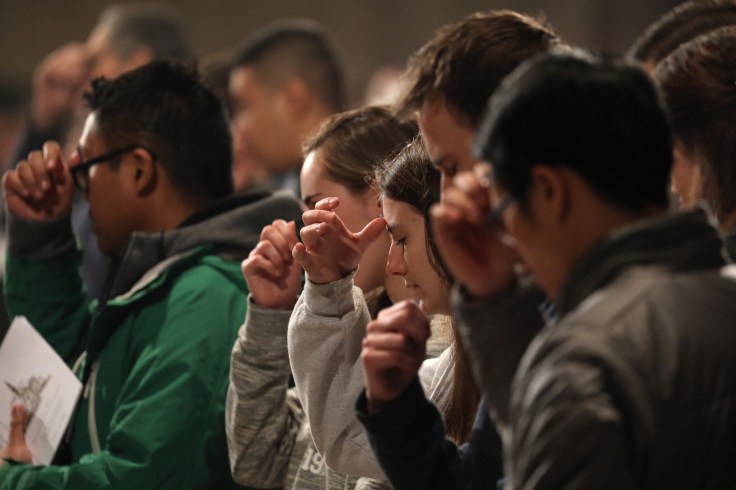
In addition, right before the Gospel is read, kindergarten-age and older children should be expected to do what all the adults are doing – that is, to make a fist with their right hand and with their right thumb make a small Sign of the Cross on their forehead, then on their lips, and then over their heart. Explain to them how we all do this because we are thinking, “God, may Your Words be on my mind, on my lips, and in my heart.”
The Homily that follows the Gospel reading is what other denominations call the sermon, and although most Homilies are not exactly kid-friendly in content and vocabulary, there can often be an explanation from the priest (or deacon) about what we just heard in the readings from which children can learn. Parents can improve the chances that their kids will try to pay attention during the Homily by having a weekly “contest” in the car ride home after Mass. Ask the kids what is one thing they remember from the Homily. Even if the only thing they remember is the priest’s corny joke that opened his Homily, a correct response could be rewarded with a stop at the donut shop or ten extra minutes of video game playing that afternoon.
When the homily is concluded, we then stand to recite the Nicene Creed – our statement of our faith that unites us with the Church worldwide. This began to be recited by Catholics in the 4th century, as there were many heresies popping up in the early Church that the Creed refuted, such as the false belief growing at the time that Jesus was not divine, but was created by God. It should be pointed out to children that this summary of our faith expresses our belief in one God in three Persons, as the Creed begins by us saying we believe in God the Father, then we state we believe in God the Son, and finally in God the Holy Spirit. Kids of reading-age should follow along in the Missal so they will be able to recite the Nicene Creed aloud during Mass.
The final act in the Liturgy of the Word is for the entire congregation to pray the Prayer of the Faithful, prayers of petition for the needs of the Church and its people. It reminds us that we are at Mass not only for ourselves but for the sake of those who are not present, such as the poor, the sick, and even those who have turned their hearts away from God. Children should be expected to recite aloud the “Lord, hear our prayer”response after each request to God is declared.
At this point in the Mass, we have ended what is considered the first half – mainly consisting of the Liturgy of the Word – and now we start the second half – mainly consisting of the Liturgy of the Eucharist. “Eucharist” is a Greek word that means to “give thanks,” and it is during this portion of the Mass where the main actions take place. The Liturgy of the Eucharist contains three main sections – the Presentation and Preparation of the Gifts, the Eucharistic Prayer which includes the Consecration, and Communion.
We sit as the priest receives the gifts of bread and wine – handed to him by members of the congregation or the altar servers. To help youngsters better understand what is taking place when the priest mixes a little water with the wine in the chalice, inform them what he is whispering at this time: “By the mystery of this water and wine, may we come to share in the divinity of Christ, who humbled Himself to share in our humanity.” The wine symbolizes Jesus’s Godly nature and the water His and our human nature. Mixing the two both symbolizes the union of Christ’s human and divine natures and symbolizes how our humanity is joined with Christ’s divinity.
Children remember hearing Bible stories during Old Testament times of human and animal sacrifices performed to honor God. An altar was prepared and the gift to God to be sacrificed was laid on the altar. Now kids need to understand that Jesus brought about a new way to sacrifice – offering Himself – and each Mass is a re-presenting of this sacrifice, although this time in a non-bloody manner. Our gifts to God are the bread and wine which the priest – acting in the person of Jesus at Mass – will offer to the Father, but not before the Son will make Himself present by converting them in the Eucharist to His Body and Blood.
This idea of gifts and sacrifice are heard when the priest and people have a back-and-forth dialogue. The priest says, “Pray, brethren (brothers and sisters), that my sacrifice and yours may be acceptable to God, the almighty Father.” The people respond: “May the Lord accept the sacrifice at your hands for the praise and glory of His name, for our good and the good of all His holy Church.” Although the sacrifice of the Mass is Christ’s action, it is also the sacrifice of the priest and of the people.
We end the first part of the Eucharistic Prayer, just prior to the central part which involves consecrating the bread and wine, by singing/praying the Sanctus (Latin for “holy” and commonly known as the “Holy, Holy, Holy”). The words of this prayer come straight from both the Old Testament and the New Testament. If parents read both Isaiah 6:1-3 and Matthew 21:1-11 to their children, they’ll be able to help explain where these words of the Sanctus originated.
The Sanctus is like an enthusiastic song or shout. Jesus Christ is going to come to this altar within a few minutes! There are many ways in which He could have chosen to come, but He wished to come by marvelously turning the bread and the wine into His own Body and Blood!
In the upcoming third article of this five-part series, we will detail the specialness of the foremost part of the Liturgy of the Eucharist – the Consecration.
 A PRINCIPAL'S PRINCIPLES FOR PARENTING
Dan,
I love the way you reverantly and articulately walk us through the Holy Mass. I wish I had your words when I was a child, but they are highly meaningful and insightful to me these many, many years after my catechism. Thank you for shining such a beautiful light on Jesus’s gift of the Liturgy. Your words are incredibly helpful to a Catholic who never wants to stop learning and growing in his faith.
Sincerely,
Danny
LikeLike