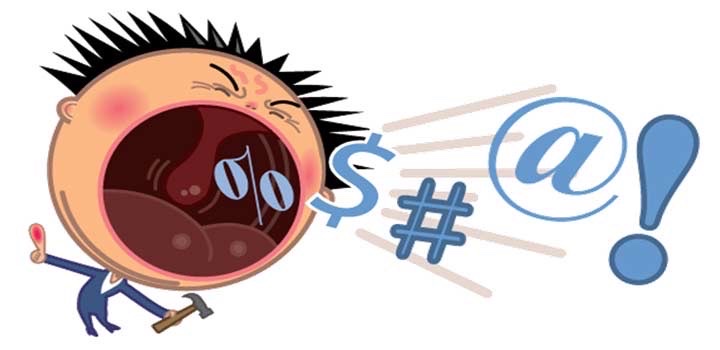
So many people habitually emit curse words in everyday conversations. Plus, the media, literature, and music they consume is full of profanity. Treating crude language as no big deal is a sign that society has degraded.
When I was a child, my mom would wash out my brother’s or my mouth with soap if we dared to say the “b-word.” No, that word wasn’t “b*tch” or “b*stard.” It was “b*tt.” Fast forward a few decades, and in my career as a teacher, I immediately corrected students if they used pseudo-swear words such as “sucks” or “crap.”
All of that was back in the 20th century. In current times, no one bats an eye if a little kid says “sucks.” The “b-word” is ordinarily used throughout society, as are “h*ll” and “sh*t.” Once off-limit words are now considered too trivial to care about.
In prior generations, the “f-word” and “s-word” were verboten on TV. Today they are heard on a variety of TV shows, along with the popularity of using the words “Jesus” and “God” as exclamations.
Nowadays, many popular podcasts, most comedians’ comedy acts, and much of the music industry routinely use profanity. Some of the most popular podcasters and the majority of comedians use vulgarities as their fundamental way to either express their displeasure or to get a laugh. One in every 47 words in hip-hop lyrics is a swear word, with “n*gga/n*gger” and “b*tch” the most popular.
So many curse words that once were censored are now accepted. Both youngsters and adults have become accustomed to hearing vulgarity everywhere. They are not only conditioned to accept it but have been shaped to use it. What once was considered bad has been normalized to be considered fine. But it is in reality still bad.
Profanity Is Unbiblical
An authentic Christian knows that profanity is not just bad manners and vulgar, but using it goes against what the Bible says. Several verses in Scripture warn of the immorality of crude language:
- “Put them all away: anger, wrath, malice, slander, and foul talk from your mouth” (Colossians 3:8);
- “Let no evil talk come out of your mouths, but only such as is good for edifying, as fits the occasion, that it may impart grace to those who hear” (Ephesians 4:29);
- “From the same mouth come blessing and cursing. My brethren, this ought not to be so” (James 3:10);
- “And He [Jesus] called the people to Him and said to them, “Hear and understand:not what goes into the mouth defiles a man, but what comes out of the mouth, this defiles a man” (Matthew 15:10-11);
- “The fear of the Lord is hatred of evil; pride and arrogance and the way of evil and perverted speech I hate” (Proverbs 8:13);
- “Therefore be imitators of God, as beloved children…But immorality and all impurity or covetousness must not even be named among you, as is fitting among saints. Let there be no filthiness, nor silly talk, nor levity, which are not fitting…” (Ephesians 5:1-4);
- “If anyone thinks he is religious, and does not bridle his tongue but deceives his heart, this man’s religion is vain” (James 1:26).
Modern culture treats profanity as no big deal. Christianity, however, treats profanity as nastiness not to be uttered. As creatures made in the image of God and having the Holy Spirit in us, we should not defame with our mouths.
How to Stop the Swearing Habit
So if cussing is a vice of yours, or if you catch your children using profanity, what can be done to curtail the cursing? One helpful advice is to substitute silly or nonsensical words and phrases when you have the urge to emit a strong emotion. For example, my mom was famous for saying someone should “go to the devil!” instead of using the word “hell.”
When I was a school principal, one of my teachers would say in front of her misbehaving middle school students, “What the heckaroni-beefaroni are you doing?!” And to students who uncaringly turned in poor work, she would call it “crud on a cracker.” She got the point across how exasperated she was. Additionally, she possibly gave her preteens and teens some ideas of things they could say that would not be considered vulgar language.
It might help your kids to understand the negatives of cussing by discussing how intelligent people with large vocabularies do not need to resort to profanity. There are clever exclamations that scholarly, gifted people can use in place of swear words, such as:
- Call someone a “filthy hikikomori” instead of an “a**hole”;
- Tell someone “your absence is required” instead of “f*ck off”;
- Exclaim “botheration!” instead of “sh*t!”
Let your children know that when they resort to crass language, they debase their self-worth. There are so many better, more eloquent ways to express their thoughts and get across a message than using worthless, profane nouns, verbs, and adjectives.
Another suggestion for parents is to work at keeping their kids from being inundated with profanity in the media in which they engage. Websites such as PluggedIn.com rate movies and video games and note what inappropriate language they contain. Websites such as ClearPlay.com and VidAngel.com filter out the bad language (and nudity) on streaming movies played on the home TV.
Of course, when children hear their friends swearing all the time, it is easy to slip into the same bad habit. So a basic adjustment parents can do is to make sure their sons and daughters hang around good influences.
Some families put a “swear jar” in the kitchen. Anyone caught cursing has to put cash (such as $1.00) into the jar. At the end of the month, the family member with the least amount of times caught using bad language gets all the money in the jar.
One might also try to replace the bad habit with a good habit by immediately saying to oneself a Hail Mary or Act of Contrition prayer after accidentally letting out a curse word. Catholics should also confess the abundant use of profanity and/or taking the Lord’s Name in vain when confessing their sins to a priest.
What Would Jesus Say?
Society is pushing the limits of profanity use and saying it is no big deal. Some even justify swearing as stress relief that is good for you. But those who love Jesus should take heed to His words and pray that the Lord strengthens them to get rid of this particular vice:
“Either make the tree good, and its fruit good; or make the tree bad, and its fruit bad; for the tree is known by its fruit. You brood of vipers! how can you speak good, when you are evil? For out of the abundance of the heart the mouth speaks. The good man out of his good treasure brings forth good, and the evil man out of his evil treasure brings forth evil. I tell you, on the day of judgment men will render account for every careless word they utter; for by your words you will be justified, and by your words you will be condemned.” (Matthew 12:33-37)
Jesus tells us that when we utter careless words, we will be judged. How much more might we suffer eternal consequences when we don’t merely use thoughtless words but speak profane words?
Swearing = Sinning
Call it what you want – cursing, swearing, cussing, being vulgar, using profanity, using obscenities. When bad language comes out of one’s mouth it is undignified at best and a sin at worse. It is a sin to be disrespectful or to debase others, and that is often the reason for using profanity.
It is understandable when someone lets out a loud, “f*ck!” when they stub their toe. It is entirely going against the commandment to love your neighbor when one calls him a “f*cker!”
Christians are called to build up the Body of Christ. Swearing tears down more than builds up, plus it does not promote intelligent conversation.
The Book of Proverbs informs us that:
“…A fool’s lips bring strife, and his mouth invites a flogging. A fool’s mouth is his ruin, and his lips are a snare to himself… From the fruit of his mouth a man is satisfied; he is satisfied by the yield of his lips. Death and life are in the power of the tongue…”
Many of us need to control our tongues. This includes not only refraining from speaking badly to or about another person, but curtailing a bad language habit from becoming so engrained in our daily lives.
A Hard Habit to Break
We know breaking a bad habit is not easy. But it is worth the effort to get ourselves – and our children if applicable – from cursing. It is one thing if we are trying to break the bad language habit of saying “you know” or “like” too many times in our conversations. But when the bad language habit is the overuse of disgusting words and vile phrases, we must definitely put an end to it.
By working towards speaking more intelligently, tactfully, and civily, we will feel like a more respectful and respected person. We also will feel both our intelligence and spiritually increasing.



Leave a Reply