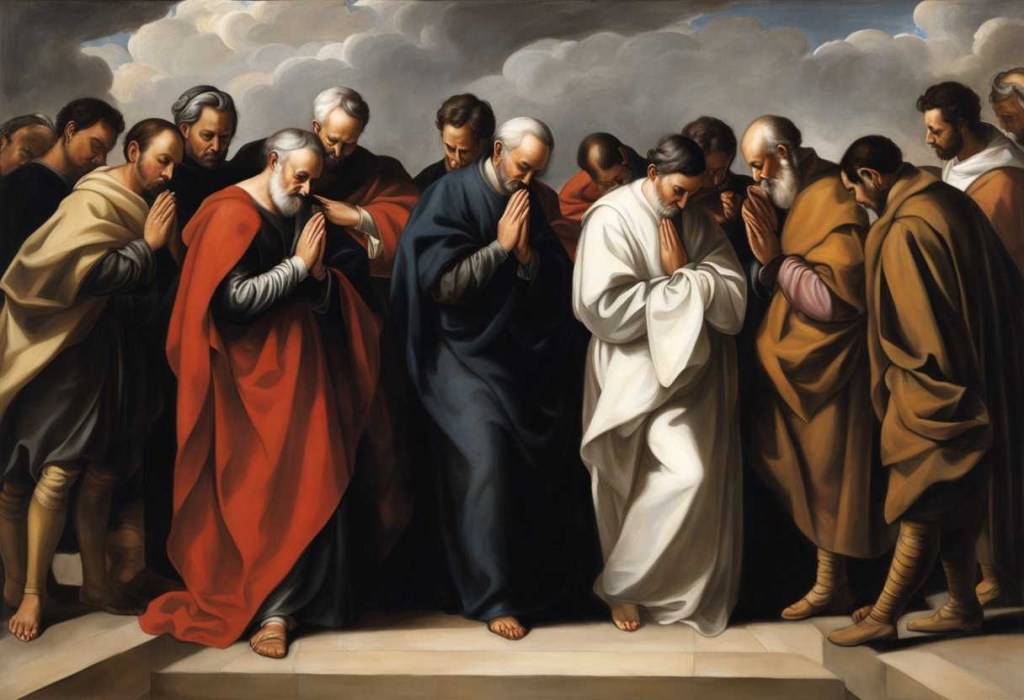
Most Catholics today routinely perform common bodily gestures when attending Mass, such as blessing themselves with holy water upon entering the church, genuflecting when entering their pews, and kneeling during the Eucharistic Consecration. But modern Catholics have appeared to have forgotten one, unique bodily gesture.
For hundreds of years, a Catholic would bow one’s head at the mention of the name of “Jesus.” Although widely practiced by most Catholics for hundreds of years, nowadays it is rarer to see than a nun in a habit.
Pope Gregory X Executes Paul’s Proclamation
Actually, at first instead of bowing, some people knelt when they heard Jesus’s name spoken aloud. In his letter to the Philippians, Saint Paul inspired the practice:
“Therefore God has highly exalted him and bestowed on him the name which is above every name, that at the name of Jesus every knee should bow, in heaven and on earth and under the earth, and every tongue confess that Jesus Christ is Lord, to the glory of God the Father.” (Philippians 2:9-11)
Since kneeling or genuflecting upon hearing Jesus’s name was somewhat impractical to do dozens of times during a Mass and when listening to a priest’s homily, a similar but simpler gesture rose in popularity – bowing.
Pope Gregory X conveyed his appeal that the physical gesture of bowing one’s head be an act to honor Jesus’s name at Mass. He wrote the following to the Dominican Order in 1274:
“Recently, during the Council held at Lyons, we deemed it a useful commendation to exhort the faithful to enter the house of God with humility and devotion, and to conduct themselves while there in a becoming manner, so as to merit the divine favor and at the same time give edification. We have also judged it proper to persuade the faithful to demonstrate more reverence for that Name above all names, the only Name in which we claim salvation — the Name of Jesus Christ, who has redeemed us from the bondage of sin. Consequently, in obedience to that apostolic precept, ‘In the Name of Jesus let every knee, be bent,’ we wish that at the pronouncing of that Name, chiefly at the Holy Sacrifice, everyone would bow his head in token that interiorly he bends the knee of his heart.” (With God: A Book of Prayers and Reflections by Francis Xavier Lasance)
Dominicans Spread the Devotional Practice
The Dominicans accepted the Pope’s request to honor Jesus’s name. They promoted this gesture at all their Masses and had their priests preach homilies about the Holy Name of Jesus. They even placed extra altars in their churches, specifically dedicated to Jesus’s Holy Name.
The Dominican Order also began the formation of Holy Name Societies throughout Europe. These became widespread in the 1500s, and America’s first Holy Names Society started in 1871 in a New York City parish.
In past centuries, Catholics placed an emphasis on honoring the name of Jesus and of bowing one’s head. This was one respectful and visible way to reflect an interior desire of honoring the only name which saves us.
It’s Time to Regenerate This Gesture
Sadly, this practice has fallen by the wayside for all of the 21st Century. The bowing gesture seems to only be honored these days by some of the lay faithful and priests at only the most traditional of parishes.
This failure to perform a bowing of the head goes against what the Catholic Church still details in the General Instruction of the Roman Missal:
“A bow of the head is made when the three Divine Persons are named together and at the names of Jesus, of the Blessed Virgin Mary, and of the saint in whose honor Mass is being celebrated.” (GIRM 275a)
Authentic Catholics who never knew about this practice or attend Masses where no one participates in this gesture do not need to wait for their pastor or bishop to announce its reinstitution. Instead, I suggest you simply start incorporating a reverent bow of the head when you hear “Jesus” voiced by the priest, deacon, or lector during Mass. (Note: The bowing gesture is specific to the Holy Name of “Jesus.” When one hears the words “Christ” or “Lord” at Mass, bowing one’s head is not expected, as these are titles, not personal names for Jesus.)
If you make this a habit, you will most likely find that you will listen and participate more attentively at Mass. Most importantly, your personal devotion to Christ will increase. The gesture helps you keep in mind that the Holy Mass you are attending is the Sacrifice of the Body and Blood of Jesus Christ. When you hear Jesus’s name pronounced, and you bow your head, you are also recalling that God took on a human nature at the Incarnation.
The bowing of one’s head at the Name of Jesus signals that His Name is amazingly powerful. Not only did Paul exalt our Savior’s name in the Philippians passage above, but Jesus Himself said, “In my name they will cast out demons; they will speak in new tongues.” (Mark 16:17)
Worshipping God by bowing is not just Biblical and historically traditional; it just makes sense. Jesus’s Name is above all others. So we should not treat it the same as any other name.


Leave a Reply