
Continuing from part one, part two adds more advantages of homeschooling, provides resources for parents, and refutes some common objections to homeschooling.
An enormous advantage of being homeschooled is each child can be taught when he or she is emotionally ready and intellectually mature enough to start learning certain concepts.
Learning is not, and should not be a cookie cutter process. There really isn’t a one-time-fits-all regarding when children need to be taught particular academics and learn specific skills.
In a classroom of 20-30 students, the teacher has to start all of the students simultaneously on a new lesson and move them along at the same pace. A homeschooling parent, however, can allow for individual timelines.
Similar to how some kiddos learn to walk at nine months while others take twice as long and won’t walk until 18 months, so too is there a diversity in when and how children should be taught how to accomplish academic tasks.
For example, the modern, institutional school system follows a type of time-clock which insists all students should learn to read around ages five or six. Homeschooling parents don’t necessarily follow a clock. It really is fine to wait for “God’s time” for when their son or daughter starts reading. In fact, studies show that children who learn to read a few years later than the norm eventually catch up in reading skills to those who were reading by age five. The later starters even end up having slightly better reading comprehension scores.
Refuting the Excuses for Not Homeschooling
So with all the advantages of being homeschooled, why aren’t a majority of kids in a homeschool?
One of the most common excuses families give on why homeschooling is not for them is they cannot afford to have one parent stay at home and forego their current double-income. Whereas this financial-aspect challenge could indeed be tough for some households, successful homeschool families have overcome it by tightening their belts and forgoing excessive things they previously spent money on, like extravagant vacations or fancier cars. In addition, homeschooling parents no longer have the expense of childcare or private school tuition.
Another common excuse are parents assuming the idea of “running a school” will be too intimidating. “I wouldn’t know where to start!” is a typical exclamation. Fortunately, homeschool resources and courses are now easily accessible and often cheap or free. A good starting point is the rapidly growing community of homeschooling parents that provides families new to homeschooling with ideas and support. Hybrid classical/homeschool models now exist where children meet a couple days a week to learn together. A fellow parent in the community, local tutors, or online services can assist a homeschool parent who is weak in math or science himself or herself.
Numerous homeschooling courses are also available in print or online, and curricula for all grade levels are plentiful. Parents are painlessly able to gather materials specifically designed for homeschoolers, such as lesson plans, textbooks, and virtual classes.
Some accredited Catholic programs worth checking out include:
- Angelicum
- Kolbe Academy
- Mother of Divine Grace
- Our Lady of Victory
- Seton Home Study
- Catholic Virtual
- Aquinas Learning
- Tan Academy
Other Excuses
Still another excuse that causes parents to hesitate in initiating homeschooling is they are not sure they can be successful educators. What these doubting moms and dads need to realize is homeschooling is really only “parenting.”
They homeschooled their child all through his or her toddler and preschool years when they taught their youngster how to walk, talk, potty, color, count, read, run, ride, jump, negotiate, share, and wait-a-turn. They certainly have the “credentials” to continue being their kid’s chief educator through the elementary school grades and beyond.
Also, research from the National Home Education Research Institute reveals that homeschooled students’ achievement test scores average impressive high rankings. These high marks come regardless of their parents’ own educational background and expertise. In fact, homeschooled children whose parents do not have college degrees still score significantly higher than public school students.
Homeschooled youngsters will often win renown competitions like national geography bees, spelling bees, science fairs, mock trials, and other honors. It is not their parents’ academic pedigree that makes the difference; it is because they received customized curricula taught by involved, dedicated parents.
Homeschooled Students Do Indeed Develop Social Skills
Parents who are considering homeschooling their children will sometimes have their friends or extended family tell them that their kids will not learn social skills. They will end up being isolated due to lack of daily socializing in a classroom of two dozen peers and on a playground full of two hundred kids. These are purely subjective – and false – assumptions.
The research actually indicates that homeschooled children show more than eight times less antisocial behaviors than conventionally schooled kids. A student who is homeschooled is more likely able to initiate conversations, cooperate with others and take turns, and invite uninvolved peers to join in play. Furthermore, homeschooled students display stronger leadership abilities than their public school counterparts.
There are a number of opportunities throughout the week for homeschoolers to socialize even though they don’t spend seven-plus hours a day in institutional buildings:
- They can work on school projects with other homeschooling peers;
- They can attend morning Mass and then play together afterward with other homeschool families on one or more scheduled days each week;
- They can take parent-organized “fieldtrips” to museums, stores, libraries, and parks, where they can practice social skills with adults as well as other homeschool kids;
- They can participate with peers in the afternoons and on weekends in community athletic programs, music and fine art classes, and parish-based events.
The reality is that the socialization all public (and many private) schools provide is not always a constructive thing. Socializing often translates to connecting with peers who may be into drugs, sexual deviancy, and/or anti-God ideologies. Families in one’s local homeschooling community might not all practice the same religion, but they do share similar peaceful, moral worldviews.
Being Counter-Cultural Is Safe and Sane
Finally, there are the naysayers who argue that parents are overprotecting their homeschooled kids by “putting them in a bubble.” The sarcastic comeback to their argument can be that putting kids in a bubble in today’s debauched and unsafe society is actually what smart and loving parents do. Scripture offers similar retorts:
“The wise person is cautious and turns from evil; the fool is reckless and gets embroiled.” (Proverbs 14:16)
“The astute see an evil and hide; the naive continue on and pay the penalty.” (Proverbs 27:12)
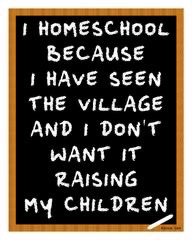
Parents who choose to homeschool see a society that is rapidly heading down the path of depravity. They consider it a wise move to be counter-cultural and, with their children, go against the current. They see all of their public school neighborhood kids and even many of their private school neighbors go with the world, often in a lazy fashion and taking limited initiative.
Meanwhile, they see their homeschooled children develop into independent, determined, hardworking adolescents. These parents have confidence that their offspring will eventually mature into young adulthood not needing adult support or society’s approval.
Except in rare occasions, no rational Christian parent should keep their children in the government-run school system. Enrolling in a parochial or classical Catholic school can potentially be a quality choice for today’s young families, as long as they find one that is not just a secular-light school that happens to hang crucifixes on their walls.
However, turning their house into a homeschool is a choice that is second-to-none for today’s Catholic family. Homeschooling parents assuredly know that depraved ideologies, watered-down faith formation, non-individualized instruction, and pointless curricula will never take place in “their school.”
 A PRINCIPAL'S PRINCIPLES FOR PARENTING
Leave a comment