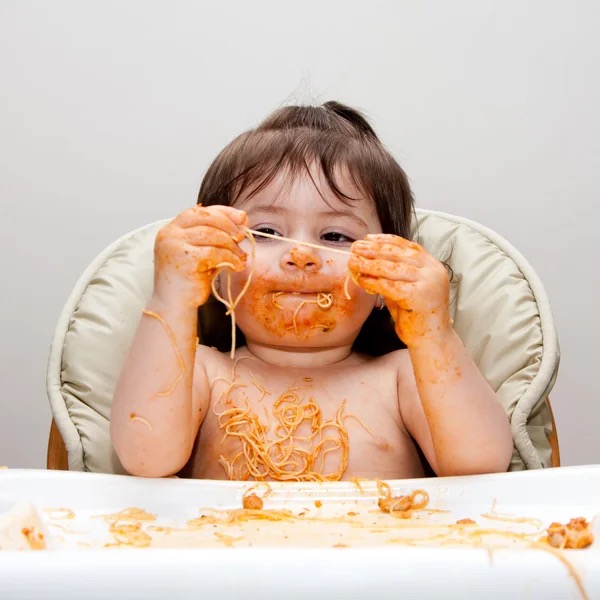
How are an Italian dinner and a medieval knighting ceremony related to the reception of Holy Communion?
One can eat spaghetti and meatballs with his or her fingers, but it is less messy to eat with a fork and place the food directly in the mouth. A king can grant knighthood by placing a sword on the shoulder of a standing knight, but it is more dignified and practical if the knight kneels.
Similarly to the above examples, a Catholic can receive the Sacred Host on his or her hand while standing. However, it is less messy, more dignified, more practical, and shows more importance to receive on one’s tongue while kneeling.
The Magi, when approaching the baby Jesus, did not stand around but got on their knees (Matthew 2:11). That is because kneeling is the most obvious and natural sign of adoration and reverence a Catholic can make when approaching Christ – whether He is in a manger or in the Eucharist.
Receiving In the Hand Is Not Reverent
Over these past 50-some years, both clerics and laity have watered down in seriousness and sacredness the distribution and reception of Holy Communion. They question, misunderstand, or even downright disregard the Real Presence of Christ’s body and blood in the Eucharistic sacrament.
The host is called the “Bread of Heaven” and the “Food of Angels.” It is never referenced as a snack, treat, hors d’oeuvre, or finger-food. Thus, it is disrespectful to consume it in the same way as a person consumes appetizers, jelly beans, or potato chips. Yet soon after 1970, the majority of Catholics started doing it this irreverent way.
The doctrine of the Real Presence of Christ in the Eucharist states that Jesus is literally and wholly present – body and blood, soul and divinity – under the appearances of bread and wine. This belief in the Real Presence began when Jesus first told His Apostles about His body being in the Bread, and Peter exclaimed, “You have the words of eternal life; and we have believed!” (John 6:66-69).
Evidence of this belief continued with the early Church Fathers, such as St. Cyril in the 4th century who said:
“Do not, therefore, regard the bread and the wine as simply that; for they are, according to the Master’s declaration, the Body and Blood of Christ. Even though the senses suggest to you the other, let faith make you firm” (Catechetical Discourses: Mystagogic 4:22:9).
The Real Presence doctrine promotes “transubstantiation.” After the priest at Mass speaks the words of consecration, the characteristics of the bread and wine may seem to remain. But through the act of transubstantiation, the gloried body and blood of Jesus Christ replace the inner substance or essential reality of the bread and wine.
Transubstantiation not only means the Real Presence of Christ, it also means the real absence of bread and wine. One could say that the “breadness” and “wineness” at Communion are changed into the living Jesus.
Almost all other Christian religions believe the bread and wine are merely symbols. Catholicism believes in transubstantiation and therefore proclaims that the bread and wine becomes Jesus’s body and blood which nourish us. Throughout most of Catholic history, the Church plainly stated and the congregants fully believed that when Catholics take Holy Communion they are receiving the actual Body of Christ.
Too Many Modern Catholics Are Non-Believers
However, since the latter part of the 20th century, this belief has become much weaker among a majority of Catholics. A 2019 Pew study stated that only 31% of U.S. Catholics believe that “during Catholic Mass, the bread and wine actually become the body and blood of Jesus.”
Another study in 2023 by a different organization (the Center for Applied Research in the Apostolate) used different methodology and stated a slightly higher percentage. But that study’s 38% figure was still embarrassing. Both studies translate to saying that six or seven out of every 10 Catholics do not believe in and understand what the Church teaches about the Real Presence of Christ.
What is the reason that the majority of modern Catholics who receive the Body of Christ at Mass do not believe it is really His body? The biggest reason is due to major changes that took place in the latter part of the last century.
There were faulty interpretations and unfounded applications of the Second Vatican Council (Vatican II). This resulted in the Church moving from Communion being given solely on a recipient’s tongue to the option of being given on the palm of one’s hand. Around the same time, most parishes started removing the communion-rail and changed to making all recipients process forward one at a time in a straight receiving line.
History Shows the Truth About Holy Communion
Prior to the late 1960s and early 1970s when the repercussions of Vatican II spread worldwide, lay Catholics received Holy Communion under the species of bread alone, kneeling, and on the tongue. Historical proof reveals that the Church from its earliest beginnings mandated reception of Communion on the tongue.
- In the 4th century, St. Basil the Great explained, “The right to receive Holy Communion in the hand is permitted only in times of persecution.”
- Around that same timeframe, the Council of Saragossa insisted that excommunication was the consequence for anyone who dared receive Holy Communion by hand.
- In the 7th century, the Church’s Synod of Rouen likewise condemned Communion in the hand as a safeguard against sacrilege.
- In the same century, the Ecumenical Council at Constantinople reasserted that those who take the Sacred Host in their hand would be excommunicated.
- And it was St. Thomas Aquinas in the 13th century who explained that only the consecrated fingers of a priest should touch the host (Summa Theologiae IIIa, Q82, a3).
A Weak Pope and a Strong Resistance
Although Communion in the mouth was universal for about the first 1,960 years of Catholicism, a minority of bishops in some areas of the world were more radically “modern” and went rogue, so to speak. Pope Paul VI tried to show his strong opposition to Communion in the hand in his 1969 instruction Memoriale Domini. But by the end of this document, one can read into the Pope’s submission to the minority as he offers the bishops of the world permission to distribute in the hand.
Regrettably, this newfangled way to receive the Eucharist caught on, connected with the new “liberation” ushered in by the spirit of Vatican II. So by the 1980s, most Catholic parishes were only distributing on the hands. This was totally wrong, as Communion in the hand was – and still is to this day – supposed to be the exception to the rule, not the norm.
Not only was receiving in the hand considered an inferior allowance, but the instructions for doing so were much more stringent. Although Pope Paul VI conceded to the pressure and allowed receiving in the hand, he stressed the need for it to be done as carefully and reverently as possible. This meant literally moving your mouth down to the palm of your hand on which the priest placed the host, eating directly from this hand.
Small Particles of the Host Are Also Jesus
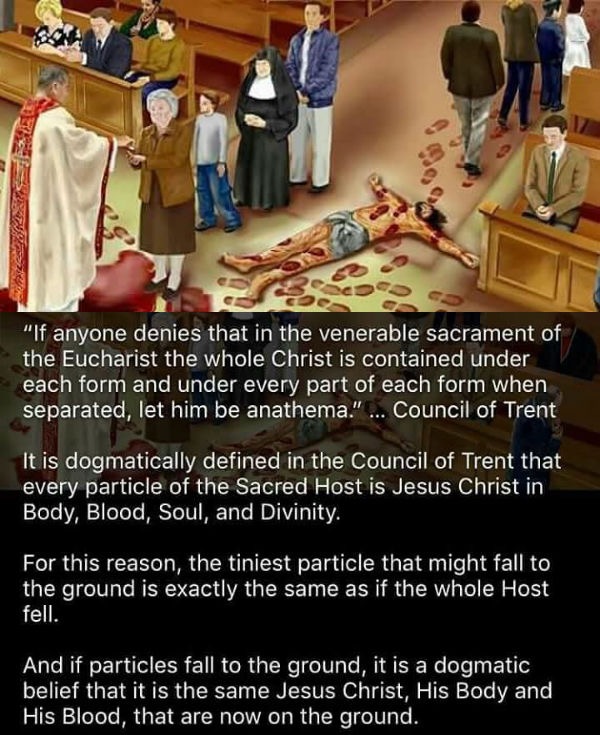
Communicants were never meant to pick up the host with fingers from the other hand, as this would more likely disturb the host and cause small particles to fall to the ground. These particles are Jesus’s body!
It may be true that today’s method of receiving Communion in the hand seems more natural to modern man than receiving on the tongue. But unfortunately it is more likely to cause disruption to Jesus’s body. A “black glove” experiment can demonstrate how particles of the host get lost. This is a big reason why consuming the Bread of Angels in the same way as ordinary food is wrong.
Throughout Church history it was always stressed that one should receive Holy Communion while kneeling (if physical condition allows it) and upon the tongue because it shows that “the Eucharist is no common food, but our very Lord and God.” The most recent Catholic catechism, Credo: Compendium of the Catholic Faith, states:
“We believe, adore, and submit to the ineffable divine Majesty hidden in the little host, allowing ourselves to be fed by the good God like little children, since this supernatural food is His alone to give, and we cannot earn it or be ‘equal’ to it.”
Saying Amen Is Supposed to Mean That You Believe
When a Catholic receives Holy Communion and the priest presents the sacred Host and says, “The Body of Christ,” the recipient responds, “Amen.” That word translates to mean I give you my solemn agreement. Responding “Amen” at Communion is affirming before God one’s belief that what is being received is, in fact, the Body of Christ. Hidden under the appearances of bread, the host is not a symbol but is Jesus’s body that is meant to nourish one’s soul.
Therefore, any Catholic who participates in Holy Communion and responds, “Amen,” to the priest’s “The Body of Christ,” would appear to be a hypocrite if he then proceeds to hold out his hand in the same way he does when at Costco and the sample lady presents him with a tasty treat.
One who believes he is receiving his Lord should want to receive it in the more holy manner possible. Nothing could be holier than kneeling and having the representative of Christ, with consecrated hands, be the one to directly place the Eucharist on your tongue.
Getting the host placed in one’s hand, more often than not by a so-called “extraordinary minister” who is on the same level as the receiver, merely allows the Catholic to feed himself…while standing…while lined up in a queue…as quickly as possible so the Mass can end is under an hour. It undermines all of holy and aesthetic aspects of the act of Eucharistic Communion.
In contrast, when someone with consecrated hands who is acting in persona Christi feeds us directly into the mouth and we are kneeling in a subservient gesture, we are passively being fed like a small child by his parent. This arrangement best represents the divine feeding of us with Bread from Heaven.
Get On Your Knees and Stick Out Your Tongue
The Apostle Thomas doubted Jesus’ resurrection one week, and then the next week, after seeing Jesus in the flesh, proclaimed, “My Lord and my God!” That exclamation – My Lord and my God – is also what Catholics should be saying to themselves at every Mass during the moment the priest consecrates the bread and wine and elevates for all to see the Sacred Body and Precious Blood of Christ.
Soon thereafter in the order of the Mass, all authentic Catholics should want to receive the Lord Jesus in Holy Communion by the manner practiced throughout most of history – kneeling and on the tongue. The current practice of Communion in the hand is foreign to Catholic tradition and does not create the same type of intimacy with the Lord.
It would be wonderful if all clerics taught modern Catholics the two traditional, fundamental receptions of Holy Communion: receive on the tongue and receive while kneeling. The Church’s promotion would stop decades-old irregularities in how Catholics mistreat the Body of Christ. It would also create a dramatic reversal in the lay faithful from disbelief to belief not seen since the Apostle Thomas.


Leave a Reply