There once was a time when all Catholic families worked their weekend schedule around Mass, as they made sure going to church each Sunday was never missed. Sadly, the majority of (self-identifying) Catholic families these days rarely attend Mass beyond Christmas and Easter. Even if they do go once or twice a month, it’s often their second-choice that was only taken because the family’s prioritized calendar of weekend sports tournaments, Saturday night kid sleepovers, and Sunday morning NFL game-watching had an unexpected opening to squeeze in 60-minutes at church on a particular weekend.
Many modern Catholics are ignorant of the precept of the Church which states that a genuine Catholic attends Mass weekly and on other Holy Days. A precept is a minimum requirement for a baptized Catholic to fulfill to be able to truly consider oneself a Catholic. Other precepts include the minimum requirements to go to Confession and receiving Eucharist at least once a year and observing certain days of fasting and abstinence.
Besides Sundays, there are six other Holy Days when American Catholics are obligated to attend Mass:
- January 1: The Feast of Mary, the Mother of God
- Forty days after Easter Sunday: Ascension Thursday (which some dioceses in the United States transfer to the following Sunday of that week instead)
- August 15: Assumption of Mary into Heaven
- November 1: All Saints’ Day
- December 8: The Feast of the Immaculate Conception
- December 25: Christmas, the Nativity of Our Lord
Add the Holy Days to the 52 Sundays, and a faithful Catholic should be attending Mass at least 58 times a year. I can already hear many of you parents responding to this number in exasperation: “You want me to get my kids to Mass on six Holy Days in addition to every single Sunday?! I’m lucky to get them to a grand total of six ordinary Masses all year!”
As a busy parent, it comes down to setting priorities for you and your family and to keep commitments to the things you value most. Going to church on the weekend as a family is just that – a priority and a commitment. When you baptized your children, you committed to raise them in the faith. You can’t say you’re raising your kids Catholic if you fail the most fundamental requirement of being Catholic – attending weekly Mass.

British Archbishop Leo Cushley stressed the importance of the Sunday Mass obligation for Catholics in a letter he wrote to his archdiocese, where he said in part:
“It is true that many people think of Sunday as just part of the weekend, a welcome break from the usual routine, and perhaps a day for family, or sporting activities. Naturally, it’s good to relax and make time for these things, but our culture has largely forgotten that Sunday is a weekly holiday because of its meaning as the Christian holy day. Attending Mass on Sunday is a solemn and binding obligation. If we deliberately fail in this matter, it is a grave sin, and we must go to Confession before receiving Communion again.
The sacrifice of the Mass is a foretaste of heaven that empowers us to do real and lasting good in the world. Without the power of the Mass, we are not only cut off from the mystery of grace, but also from Christ and community. Surely, we cannot treat Christ our Savior as one option among others for us to shuffle at our convenience. I therefore urge you, brothers and sisters, to make the choice to attend Sunday Mass, to make it a priority, and to bring others with you. There’s no better thing you can do for children than to bring them to meet the living Lord Jesus at Mass every week. If you teach them like this to seek the Kingdom of God first, you can be sure He will bless them in all the other ways that you hope for.”
We recall how Jesus was upset when His disciples could not spend just one hour staying awake with Him. He merely asked for them to pray on that Holy Thursday night when He was in agony in the garden, awaiting His arrest. But they failed.
If I am hopefully fortunate enough to approach Jesus at the gate to heaven after I die, I do not want to try to explain to Him why I could not spend just one hour each week in His Father’s house to pray. Especially if He then followed up asking why I instead was able to spend many, many hours each week binge-watching TV or able to devote an entire weekend to hanging out at my children’s lacrosse, soccer, or volleyball tournaments.
Consistent Sunday Mass attendance by Catholic parents and children started decreasing with the Generation X people born in the 1970s. Attendance declined at a more rapid pace in the Millennial and Generation Z generations after that.
Most Catholics today only experience a standing-room-only, packed church twice a year – on December 24 at the Christmas Eve Mass and at the Easter vigil or morning Mass. However, those born in the Greatest Generation and Silent Generation (i.e., the first half of the 20th Century) had to squeeze into packed pews every single week of the year – regardless if the date was December 24, January 24, or February 24.
Unless one attends a Latin Mass parish nowadays, where their church pews are typically packed to the brim reminiscent of a century ago, most Novus Ordo Mass parishes in the 21st Century have embarrassingly low attendance. At these Masses, even the late-arriving families don’t have to worry about finding seats, as they can choose from among dozens of empty pews.
Some say there are generally three types of Catholic families:
1) “Chreaster Catholics” = they only attend Mass twice a year – on Christmas and Easter;
2) “Lukewarm Catholics” = besides Christmas and Easter, they make a few additional appearances at Masses throughout the year, such as on Ash Wednesday, at a relative’s First Communion, and perhaps during one or more weeks in Advent or Lent;
3) “Authentic Catholics” = you will find them at Mass every week at one of the two days that begin with the letter “S.”
If you’re that last type of Catholic family – “Authentic” – you can stop reading this blog post right here. But if “Chreaster” or “Lukewarm” describes your family, please read on.
First, I suggest “Chreasters” and “Lukewarms” set up a family talk where mom and dad explain to their children that going to Mass is the most important thing that they can do together all week. In some cases, this talk has to be given to the resistant spouse as well.
A child can make a commitment to get to his or her sports practice nightly or to practice a musical instrument a few days each week. A parent can make a commitment to drive that child to the nightly sports practice school or to get himself or herself to the gym for a daily workout. Thus, it would seem to make sense in comparison that attending Mass once a week is not that difficult of a commitment to make.
Being committed to one hour a week to go to church as a family is not just good for every family member’s soul, it also models to children what a life of commitment is about. If one can’t keep a simple commitment as a Catholic to attend Mass one hour a week, can that person keep other more complex commitments?
What’s nice about the Catholic Church is parishes schedule a variety of weekend Mass times. Plus, there are usually a number of Catholic churches within a reasonable driving distance. So, no matter a family’s busy schedule, it would be quite a stretch to argue that there is no way a family can fit attending Mass on their weekend calendar.
Many of the non-denominational mega-churches and other Protestant churches have no more than two services each weekend, typically sometime between 9:00 and 11:00 on a Sunday morning. But most Catholic churches have at least a Saturday evening vigil Mass, and two or more Sunday morning or early afternoon Masses from which to choose. Some parishes even hold Masses on Sunday evenings.
Thus, even with a family’s busy calendar noting an all-day Sunday sports tournament or a classmate’s Saturday night slumber party, chances are mom, dad, and the kids can still find a Mass to attend that doesn’t conflict with all their weekend events.

It is one thing to get school-age kids to go to Mass with parents weekly, but it is quite another to assume college-age and older children will keep on attending Mass. As kids mature, parents you can no longer use the “as long as you’re living under my roof” ultimatum.
What is important to understand in this case is the main factor in assuring children will continue to go to church in later years as they grow older is if their own dad attended with them as youngsters. For those families with two parents, it’s critical that dad attend Mass with the kids. Yes, mom should attend too. But it’s the dad’s attendance that has the most positive repercussions.
One large study published in Switzerland showed that the religious practice of the father of the family, above all, determines the future attendance at or absence from church of the children. Among the results of the study (which wasn’t confined to researching only Catholics, but all denominations) were these amazing statistics which revealed how vital dads are:
- If both father and mother attend church services regularly, 33% of children raised in these households will end up as regular churchgoers as they age, while 25% of these children raised by two church-attending parents will not practice their religion at all when they become adults.
- If the father is irregular and mother regular in church attendance, only 3% of the children in these families will subsequently become regular attendees themselves as adults. Meanwhile, 38% percent will stop attending church altogether.
- If the father is non-practicing and only the mother regularly attends church services, only 2% of these children will become regular worshipers in the future, yet a whopping 60% of these kids will be lost forever to the church.
- HOWEVER… If the father is the regular churchgoer, and the mother is either irregular in attendance or totally non-practicing, a remarkable statistic emerges. In this case, as many as 44% of children raised in these types of households will regular attend church as they mature. That is a higher percentage than the 33% given above for when both parents attend church regularly!
The results of this study may seem counter-intuitive. One would think that if the kids grow up in a home where both parents regularly attend church (#1 scenario above), that would be the best chance those kids became churchgoers later in life. Perhaps there are many cases of the dad merely attending church because the mom expects it, and dad grumbles about going as much as the children. It is possible these stats are showing that the strongest inspiration to the kids (as shown in scenario #4) develops when they see dad take the lead and show passion about being a Christian, without mom’s influence or involvement.
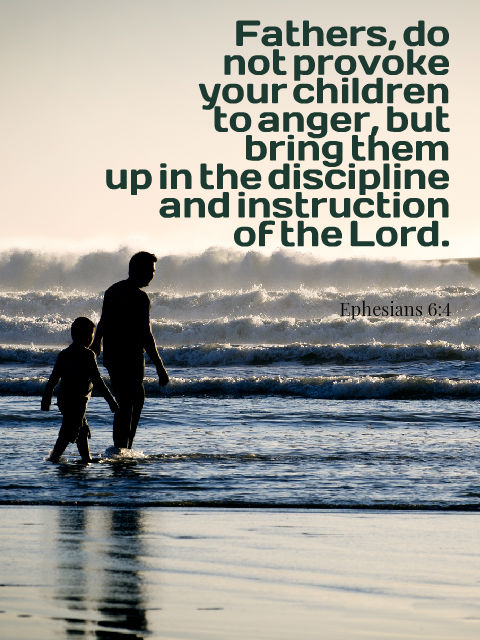
This above study seemed to reinforce the essential role of a family’s father as the spiritual leader. Fathers are to care for their children as our Father in Heaven cares for us.
We know children tend to take many cues about life from their moms. Yet it appears when it comes to faith-life, dad is the cornerstone. If dad takes faith in God seriously, then the message to their children is that God should indeed be taken seriously.
The lesson for dads is clear. Fathers should not make it a goal to be seen as the cool, casual parent of the household who lets the kids off the hook from attending Mass. The goal is to be seen as the faithful, committed dad who is the first out the door each Sunday morning (or Saturday evening). Dads are called to be the ones each weekend who start the car and give a honk to the family to hurry up and get in.
The father is to be the spiritual head of the family. The history of the world – from God the Father, to Abraham, to Joseph of Nazareth – has always referred to the male of the family as the spiritual head. I implore all you fathers to do your part in keeping up this tradition. If you like to play the percentages, and you want your kids to have the best chance of growing up and being faithful Catholics/Christians when they are trying to raise their own families, you would be smart to make sure in your family it is dad who is foremost modeling faithfulness by going to church regularly.
And remember, as the Catholic precepts state, regularly equates to every single weekend (with a dispensation due to illness or extreme circumstances).