
Nothing excites kids more than summer vacation, and speaking as a 40-year educator, I can tell you that nothing excites teachers and principals more either. Unfortunately, there is a problem when students take off almost three months for summer vacation.
All this vacation time creates “summer slump” – an actual occurrence where students return to school in the fall with lower ability in academic skills such as in reading and math than at the level they finished that prior spring. Summer slump is caused by children not “exercising” their brains over summer vacation and thus forgetting educational facts, knowledge, and skills by the time their return to school in the fall.
One study of elementary school students concluded that children who read more books over the summer scored higher on reading comprehension tests in the fall than those who did not read over the summer. Another study revealed that kids can lose over two months of math skills they learned in the just-completed school year if they don’t partake in any math education during summer vacation.
And anecdotally, I can attest that teachers have to spend most if not all of the first month of the new school year reviewing the previous year’s grade level curricula and knowledge before they feel confident enough that their students are ready to start learning at their new grade level.
To combat summer slump, between traditional summer fun and family trips, parents should work reading, math, writing, and other academic and study skills into each week of vacation. By doing so, their kids will not lose much learning. This does not have to look like “real” school where the youngsters will feel like they really don’t get a vacation but are more like being enrolled in a type of summer “bootcamp.”
But there does need to be structure built into summer days. One of the reasons kids have developed a slump when they return to school at the end of summer is because they have gone 10 weeks with no structure and then are expected to flip a switch the day they return to school.
Structure is created by having a Monday through Friday schedule of learning-related lessons and activities that parents and their kids follow. Structure during the summer should also incorporate basic schedules such as these:
- As a family eat at least two of the three main meals at the same time each day;
- Go to bed at a set time and wake up at a set time;
- Incorporate one daily chore or a number of weekly chores.
Following is one sample of what a structured summer schedule could look like for a family. Of course, flexibility is allowed to take into account family trips and special events. On those occasions, moms and dads should forget the schedule of lessons and activities below and instead build in educational-fun each day of the trip. This could include having children journal daily about their trip or study history when visiting historical places. Additionally, children can be made to “unintentionally” work on math skills by helping to calculate mileage to and from locales each new day of the trip.
READING:
Children who will be entering grades K-5 should read for at least 20 minutes every weekday in the summer, practicing the reading strategies they learned over the preceding nine months. Middle and high school aged kids should read independently for at least 30 minutes daily. These 20-30 minutes do not have to be continuous. If it works better for your family’s schedule to build in some minutes in the morning and some later in the evening, that’s fine. Of course, for younger children, these minutes will include a combination of times parents both read to and read with them.
It may motivate your children to read a certain number of pages or chapters each day, and keep track on their personal reading logs. It’s also motivating if reading is a family activity, with mom and/or dad reading at the same time as the kids, perhaps each comfortably set up with their specific reading “nooks” in the house, such as the couch, a beanbag chair, or even an outdoor lounge chair.
Children are more likely to read if they have a say in what they read, so you will want to let them choose their own books at the public library or to occasionally buy at a bookstore. However, if you have a child who gravitates toward comic books or “graphic novels,” these should only be read in moderation. You’ll hear librarians and teachers these days say, “I don’t care what the kids read, as long as they’re reading,” but this sells their students short. That is similar to a parent saying, “I don’t care what my child eats, as long as he/she eats.” No, you do care, and thus you make sure there are fruits and vegetables sprinkled in with the carbs and sugar snacks.
Comic books and graphic novels don’t develop children’s abilities to sustain the kinds of attention and concentration demanded by traditional books. Intellectual stamina isn’t likely to result if kids solely or mainly read comic books and graphic novels, since reading these styles of books looks like this: read 15 words and look at a picture; then read 10 more words and look at another picture; then read 1 interjection and look at another picture; etc. You want to challenge your youngsters to read hundreds and even thousands of words at a run.
MATH:
Play at least one math game with your kids at some time every weekday to reinforce the just-completed year’s addition, subtraction, multiplication, and/or division facts that your child learned. Some game ideas include using flashcards, using a deck of cards, and playing free games you can find online.
Every weekday give each child a two-minute timed-test on paper using the addition, subtraction, multiplication, and/or division facts appropriate for each child’s grade level. The goal is to solve at least one more problem in two-minute’s time as the day prior. Here are some resources for addition, subtraction, multiplication, and division timed-tests.
Alternate days throughout the week of either completing a tangible math workbook page or complete a free online math lesson on the Khan Academy website. Math workbook pages such as this one can be found online and printed out or purchased at a bookstore or on Amazon. Khan Academy offers practice exercises, instructional videos, and a personalized learning dashboard that empower learners to study math at their own pace.
KEYBOARDING:
Typing skills are essential in today’s technology dependent learning environment. Your kids need to learn to type using the QWERTY keyboard and emphasizing proper keyboard finger placement. As your children develop in age and finger dexterity, they should be increasing the level of speed and accuracy while typing. Have your children practice proper keyboarding fingering over the summer by using an online program two days each week such as this one.
Just as learning to play a sport or an instrument with correct form is vital, it’s also essential that youngsters use the correct finger positions on the keyboard to build accurate muscle memory. Knowing teenagers will be using the computer a lot in high school, such as to type essays and research papers, by the end of 7th grade, students should be able to type a minimum of 35 words per minute accurately.
PENMANSHIP/CURSIVE:
Keyboarding is important, but handwriting with a paper and pen/pencil is a skill that should never be pushed aside. Depending on your children’s ages, they should either be working on their manuscript printing or their cursive handwriting throughout the summer.
On two different days each week have your children take at least 10 minutes to sit upright in proper position and practice their penmanship. One option is to complete one workbook page from a booklet you purchase or print out online. You can even kill two birds with one stone by using penmanship books that have your kids practice by writing Bible verses and Catholic doctrine, such as this source.
Another option is to help your children pick out stationery from the store and go “old-school” by writing letters. No texting or emailing allowed! With your help in locating addresses and buying stamps, the kids can choose a different grandparent, aunt, uncle, or other relative each week to whom to write a friendly letter. By doing this, they better understand the bond of family, and they can get your help in retaining proper punctuation, grammar, vocabulary, and of course, penmanship.
FAITH FORMATION:
With the assumption that seven days a week you and your children say their daily prayers, Friday is a good day to set up a one-day-a-week faith formation lesson. This can be how you can prepare your children for understanding what readings will be heard at Mass that Sunday. There is a great, free resource – The Kids’ Bulletins – that your youngsters will have fun using to learn the upcoming readings. Depending on your children’s ages, you may have to sit down and work on this bulletin together, but older kids can accomplish it on their own.
OUTDOOR PHYSICAL ACTIVITY:
Just as “recess” is a youngster’s favorite part of the school day, so too should outdoor play be the best part of every summer day. Make sure there is a large amount of time daily for your children to go outside and get the heart pumping while improving their small and large motor skills. A day shouldn’t go by that your kids aren’t doing one or more of these; bike riding; jumping rope; shooting the basketball; playing catch with the football or baseball; swimming; kicking the soccer ball; playing an old-fashioned game such as tag or red light/green light.
SATURDAYS & SUNDAYS:
So the kids don’t resent having to do summer learning, parents can make sure most of their weekends are un-scheduled for impromptu fun and/or planned family outings.
Saturday is a great day to make sure children complete their weekly chores, such as cleaning their bedrooms. It is also a good day for the family to work together on outside chores. Depending on the kids’ ages, they could pitch in with helping with tasks such as sweeping the porch/patio, watering plants, or mowing the lawn.
Sunday is the day to appreciate both the sun and the Son. After attending Mass as a family, families should consider taking it easy the rest of the day by heading to the beach, playing at the community playground, or getting a neighborhood kickball game going. Sunday afternoon or early evening can also be a time to play a board game with a sibling or enjoy a family movie from the couch.
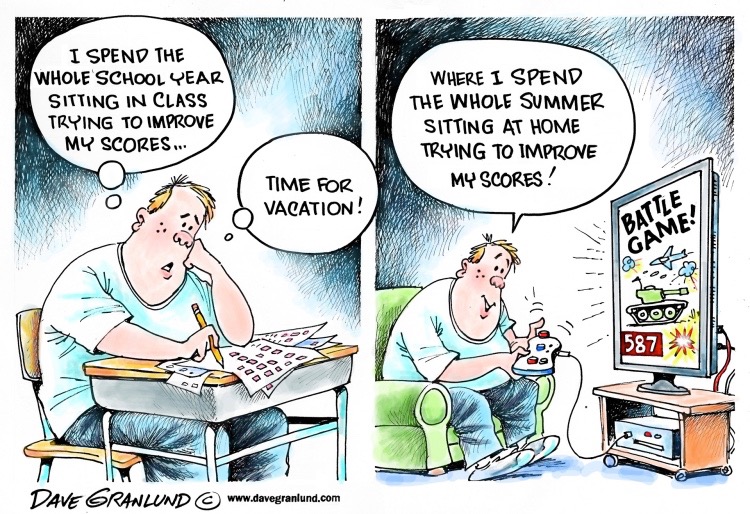
One final idea that aids in kids not getting into “summer slump” is for mom or day to pick a day or two during the week to incorporate activities that appear to be less “academic” and more of the “life skill” variety. Some of these activities could include:
- Cooking: This subtly involves math, science, and reading skills as well as reinforcing the importance of following step-by-step directions. It has the best incentive – you get to eat what you create! Parents and kids can work together to find a recipe, gather the ingredients, and complete it. And don’t forget that cleaning-up afterward is everyone’s required task.
- Arts and Crafts: Engaging in artsy projects during the summer nurtures a child’s creativity. Parents can set up a dedicated art space at home where their kids can explore various artistic mediums such as painting, drawing, sculpting, or crafting. It would be great if youngsters worked on at least one, hands-on art project at least one day each summer week.
- Gardening: As a way to teach science lessons along with celebrating the “magic” of growing something, children should learn to grow flowers or vegetables. This can be done out in the yard in a small garden of their own or in pots on the patio or deck. This will most likely involve daily watering by the kids as well as regular weed-pulling and harvesting.
- Shopping: When mom or dad does the family’s weekly grocery shopping, they should consider employing their youngsters in helping find items in the store. Parents can give out a grocery list and let the kids loose in the store, developing their independence and navigational skills. Another ploy is to make the grocery shopping experience a one-item-at-a-time scavenger hunt by mom or dad saying, “I need a 16 ounce bottle of olive oil, and it needs to cost less than $0.50 an ounce.” In this latter way, children are developing their math, critical thinking, and economic literacy skills.
If parents follow the above plan as a guide, creating their own interpretation of a daily and weekly schedule that works best for their unique family situation, chances are they will accomplish three things this summer.
First, they will better set up their children to have a successful start to the upcoming new school year because they will not have lost any learning over the summer.
Secondly, they will enjoy doing fun activities together as a family, such as the cooking, grocery-shopping, and card-game-playing activities sprinkled throughout each week.
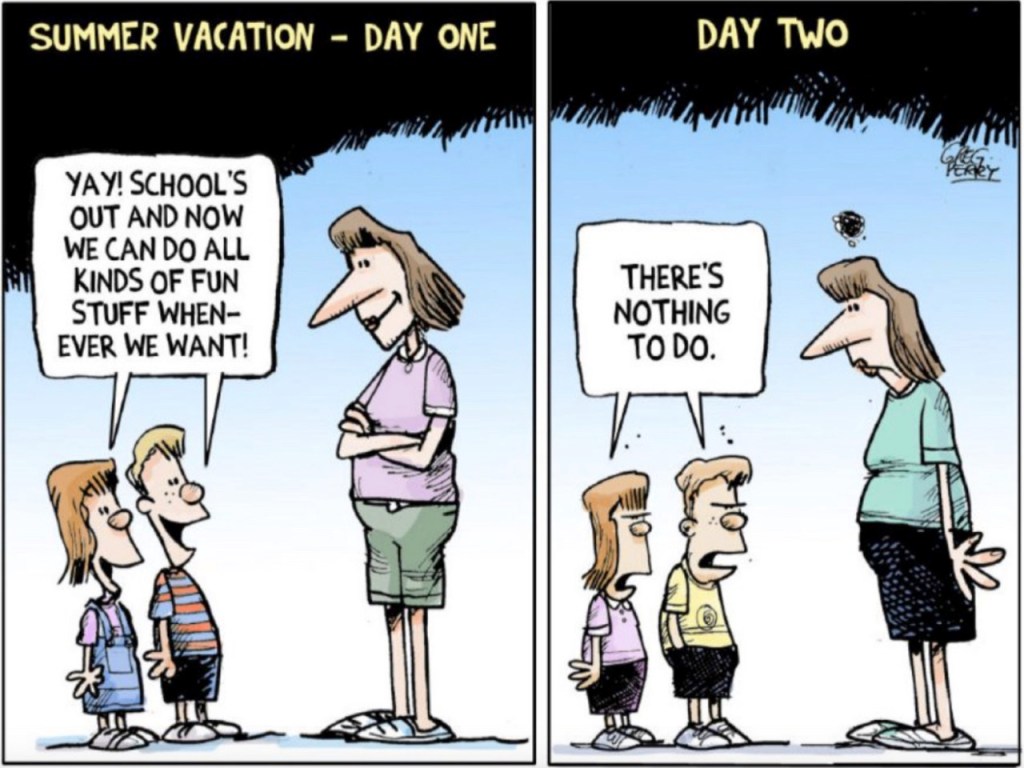
And most valuably, they will eliminate their children whining the once-popular declaration heard historically in households over the summer, “I’m bored!”


It’s reasons like yours why I tell today’s parents to choose either a “faithful” Catholic/Christian school or homeschool. Public schools are too corrupt these days.
LikeLike