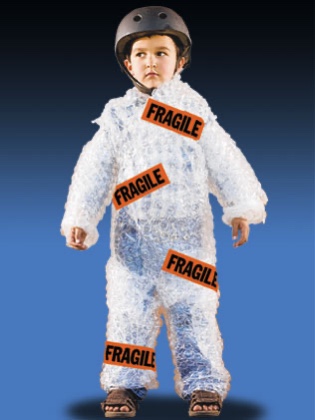
At first thought, no one would think that helicopters, bulldozers, and bubble-wrap are connected in any way. But in actuality, there is a common thread. These are all descriptors of three main types of modern parents’ parenting styles. And all three are troublesome.
A disturbingly high number of modern parents can be described as parenting in the style of helicopters, bulldozers, or bubble-wrap. Unfortunately, these popular ways to parent involve moms and dads thinking they are helping their children when they are really just overreacting, overprotecting, and stunting their kids’ proper development.
Helicopter Parents
Helicoptering is an approach to parenting in which mom and/or dad figuratively hover over their child constantly. The parents are closely monitoring for the purpose of needing to know if they must swoop down and act in order to prevent their youngster from getting hurt, feeling bad, missing out on something, or doing something incorrectly.
Helicopter parents will hover over their children so they can fight their kids’ battles for them, lest their children will get their feelings hurt or fail at something. The helicopter parent is being overprotective and over-involved, not allowing his or her kid to make a mistake or suffer some harm.
Bulldozer Parents
A second popular approach is the bulldozer parent. This is a more aggressive style than the helicopter parent in that the bulldozer is doing more than just hanging extra close to their child so to be ready to swoop in when necessary. The bulldozer parent is like the helicopter parent on steroids.
This type of mom and/or dad is on the ground from the start, clearing the way in front of their youngster. The bulldozer might choose to badger teachers who give their child a bad grade or push up against the coach who doesn’t give their child enough playing time. Like a bulldozer on a construction site, this type of parenting aims to flatten and push out of the way anything that they perceive as upsetting to their child.
Bubble-Wrap Parents
Bubble-wrap parents act similarly to how one would package an expensive, fragile vase in bubble-wrap before shipping it in a box. These moms and dads figuratively wrap air-bubble packing around their children so to keep them from any harm.
It is true there can be some common sense reasons for so-called bubble-wrapping one’s child. If there is an obvious concern for physical safety, moms and dads must be protective. Demanding a youngster wear a helmet when bike riding is smart parenting.
But overreacting to potential physical harm is detrimental to a child’s need to grow independence and lessen fears. For example, bubble-wrap parents overreact when they don’t allow their kid to climb a tree or ride a bike to a friend’s house.
Bubble-wrap parenting can also include keeping kids from any type of psychological harm or emotional trauma. This over-protection is seen when parents don’t want to discuss with their children any difficult, scary subjects like death.
Instead of overprotecting so as to not allow their kids to suffer any emotional harm, parents need to teach their youngsters how to “offer it up.” No matter what our cross in life is, if we can consider it a gift from God as He desires to strengthen us for some greater purpose, we will discover that our greatest struggles in life actually turn out to be our greatest blessings. (For more on the subject of “offering it up,” see my past article here.)
Parenting With the Best of Intentions
Overprotective parenting is usually done with the purest intentions. Unfortunately, negative effects are created in children who have excessively overprotective and overreactive parents. Helicopter, bulldozer, or bubble-wrap parenting does more harm than good.
Understandably, a mom’s or dad’s first impulse is to step forward to protect their children. And there are certain ages of kids or situations when stepping in to help is absolutely necessary. For example, when a toddler runs into the street, the parent must swoop in. But as the child gets older, parents need to do less acting and more listening, encouraging, and observing from afar.
Helicoptering, bulldozing, and bubble-wrapping parenting styles will generally create children with anxiety, weak character, and a lack of resilience. The best type of parenting of a 7-to-17 year-old is to give him or her room to grow and be independent. This may involve allowing him or her to fail, to make mistakes, to get feelings hurt, and sometimes even to get physically hurt.
Today’s Parents Need to Learn From Yesterday’s Parents
More than a half-century ago, when I was just a third grader, my mom gave me a job that today is considered politically incorrect. But back in the Baby Boomer generation, it was not even blinked at.
We lived almost within spitting-distance of the neighborhood mom & pop store. It was such a close-knit type of atmosphere that the store owner kept customers’ credit accounts on receipt books so people could grab things and pay later. My mom would weekly send me to the store with a handwritten note to the store owner which read, “Please give my son two packs of Winston cigarettes.” I would walk to the store myself, hand the note over, and in return the store owner would hand my 8-year-old-self packs of cigarettes.
Now, most parents today would not send an 8-year-old to the store by himself, even if it was less than 50 yards away from home. And of course there are now laws that prevent stores from handing cigarettes to children. But these realities are kind of disappointing. From this big-responsibility chore my mom gave me, I learned about bravery, independence, and trust. I had to walk to the store by myself. I had to talk to the store owner. I experienced the trust my mom had in me in doing this without me sneaking in a puff of a cigarette when walking home with the packs.
As I got a little older, I performed other acts which helped me experience life with all its dangers and disappointments so that I would properly mature. My mom allowed my brother and me to get a paper route. Technically, my older brother was the one assigned the route. But being his little brother, I was both coerced into and excited to help him. Every afternoon, we rode our bicycles a mile to the newspaper shack where the bundles of papers were dropped off, wrapped our route’s supply with rubber bands, and took off with the stuffed newspaper bags draped over the backs of our bikes. We had a route of 75 houses to deliver to, so this entire process took about two hours each afternoon.
There was no such thing as a cell phone to call our mom should we get a flat tire, skin our knee by crashing our bike, or run into so-called stranger-danger. None of those bad things happened to us during any of our paper route days, but I do vividly remember when a dog once bit me on my leg as I walked up to a front door to drop off a paper. With no cell phone, I just had to wait until that day’s route was complete to ride my bike home and tell my mom about the dog bite.
Now, had our mom been a helicopter-type of parent, she would have followed right beyond our bikes in her car, being ready in case we had bike trouble or crashed our bike as we tried to carry the extra weight of newspapers, especially those huge, heavy Sunday papers.
Had our mom been a bulldozer-type of parent, she would have driven her car in front of us to lead the way and make sure the traffic was safe and no dogs were ready to pounce.
Had our mom been a bubble-wrap-type of parent, she never would have let us take on a paper route in the first place, for fear of potential stranger-danger or worry of us feeling like failures if we ended up not being able to handle this tough job.
Fortunately, my brother and I were not raised by an over-protective, over-involved parent. Because of this, we learned independence, perseverance, and problem-solving. We also learned how to spot a mean dog.
Parents serve their children best when they give them the opportunity to experience just enough responsibility – and the stress that comes with it – to bring about attention and accountability without overwhelming them. Giving your child a manageable experience like a paper route or permission to buy something independently at the store allows him or her to learn to take risks and assume responsibility.
Age-Appropriateness
Parenting in a more laid-back, less protective style must be done taking the child’s age into consideration. You don’t give a 5-year-old his first pocketknife and tell him to go run off and play with it so to experience risky play with a sharp object. But to learn proper knife safety, you can ask that 5-year-old to help you make a snack by slicing a banana on a plate.
These days, you might not want to allow your 8-year-old to ride her bike herself to the big city’s downtown to buy herself a fast-food lunch. But you do teach and expect your 8-year-old to be able to tell her own order to the waitress when your family is sitting in a restaurant.
Unless mom and dad shut down the helicopter, park the bulldozer, and discard the bubble wrap, they will never be sure their youngster will grow up competent enough to keep himself or herself safe and to be responsible enough to make good decisions. When we baby our children, we deny them opportunities to mature, to learn how to overcome fear and cope with uncertainty, and to develop a feeling of responsibility. What we do instead by over-parenting and overprotecting is we create uneasy kids who can end up phobic and anxious over many things, such as talking to adults, tackling tasks requiring responsibility, and taking risks.
However, there are certain times in today’s culture when parents must definitely be overprotective with their children. Keeping them away from the dangers of technology in the form of smart phones and internet use when they are too young is one big example of when parents must be hovering and guarding. Another example when it makes sense for a parent to be overprotective or overreactive nowadays would be to not allow their child to attend a boy-girl party where parent chaperones would not be constantly present.
Let Kids Fail, Be Disappointed, and Suffer Natural Consequences
Kids who are allowed to fall and made to pick themselves up will more likely learn how to tolerate disappointment in their young adult years. Children who have to manage their relationships, stand up for themselves, and fight their own battles will more likely develop the skills in regulating their emotions and persevering through tough times in life.
Hovering incessantly, removing all problems, and smoothing out any discomforts might bring immediate relief and pleasure to children. But in the long run it will usually do more harm than good.
Parents who truly love their kids will bite their tongues, put their hands in their pockets, and stand at a distance more often than bailing out their youngsters. By doing so, their sons and daughters will learn through experiencing natural consequences of their action. They will develop more positively, and very likely grow up to be better parents than their own moms and dads.

 A PRINCIPAL'S PRINCIPLES FOR PARENTING